





 Portuguese
  English
  Spanish
  8 min of reading
  0 comments


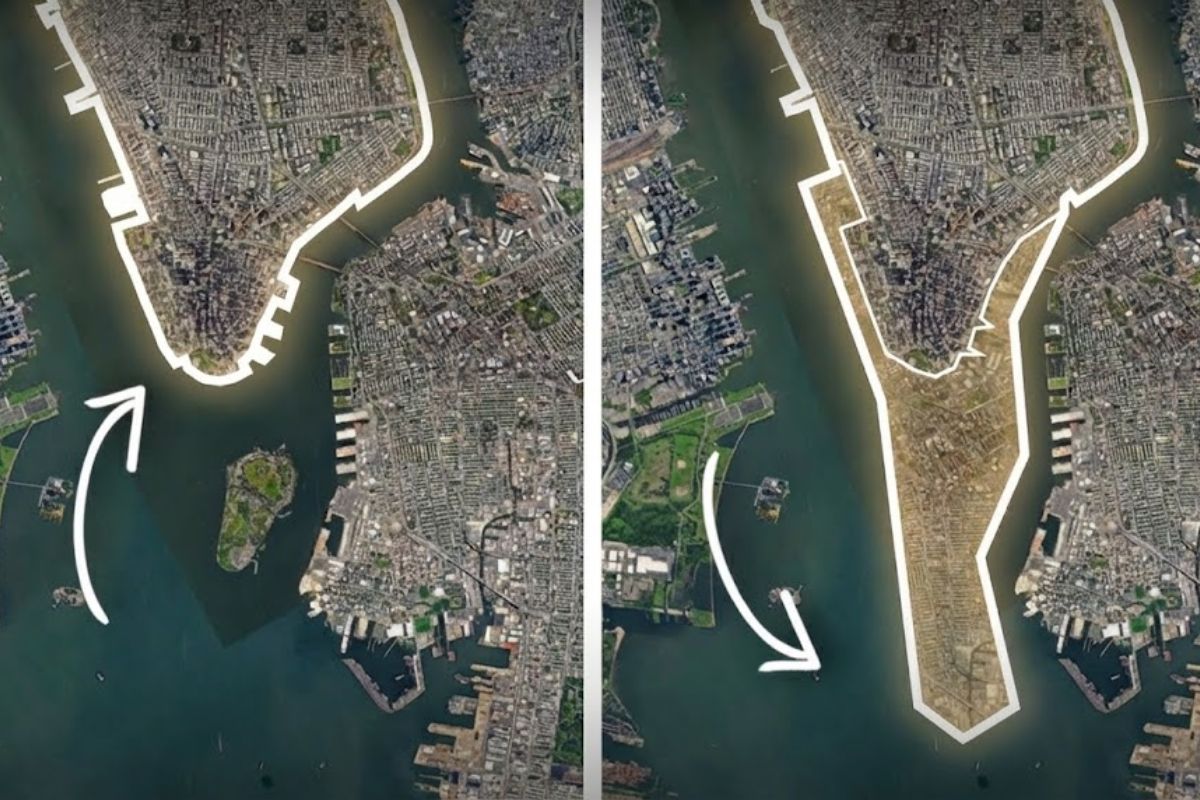
In New York, the proposal to recover more than 1,700 hectares at the tip of Manhattan, or 1,760 acres between Hudson and East, would cost US$ 40 billion or more and, in theory, deliver 187,000 houses for almost a quarter of a million, with works that could take decades and face resistances.
New York is once again described as a metropolis at physical limits, a concrete jungle that concentrates global economic activity, but that cannot create space at the speed demanded by the housing demand. With a population of about 8.5 million people, the accumulated housing pressure from decades pushes the city towards increasingly radical solutions.
The loudest idea of the moment proposes to expand Manhattan over the sea and create a new strip of land, nicknamed New Mannahatta. The plan mixes urban ambition, promises of coastal protection, and a potentially over US$ 40 billion bill, while facing harsh criticism regarding practicality, final cost, timeline, and the political reality of approving something of this scale in New York.
Why New York Has Returned to Discuss “Gaining Land” from the Sea

The starting point is simple and uncomfortable: New York is presented as a “space-less” city, pressured by a long-standing housing problem.
-
Spain surprises the world by erecting 62 artificial dunes, mixing sand with natural remains of posidonia, and causing the structure to lose only 1.4% of its volume in 1 year.

-
With 16 Bulava missiles, improvements in acoustic stealth, and a design focused on silent patrols, Russia’s nuclear submarine was born to ensure Moscow’s invisible retaliation and has become one of the pillars of its maritime strength.

-
‘Populous’ city in Rio among the worst in Brazil in national ranking and exposes silent development crisis.
-
Couple buys house in the South Zone of São Paulo, opens a hidden door in the garage, and finds a secret wine cellar with dozens of old wines forgotten since the 1970s.

The growing need for more housing, felt by residents and the functioning of the city itself, paves the way for extreme proposals, since traditional solutions do not seem sufficient to change the situation significantly.
It is in this context that the discussion about expanding Manhattan over the sea re-emerges with strength. The proposal seeks to address two pains at the same time: the lack of housing and the climate risk associated with storms and flooding.
The promise is bold: to create new ground where there is currently water and, from there, to reorganize the urban future with new homes, infrastructure, and an additional kind of coastal shield.
The Design of New Mannahatta and the Size of the Expansion in New York
The plan describes the expansion of the territory at the tip of Manhattan, in New York, through land reclamation.
Two ways of dimensioning the ambition appear together: more than 1,700 hectares added around the tip of Manhattan and, in another measure, 1,760 acres of new land positioned between the Hudson and East rivers.
This “new Manhattan” would, in practice, serve to extend the coastline and increase the available usable area.
The concept is presented as a kind of terraforming of the coast, a way to reconfigure the edge of Manhattan to create a new urban perimeter, with space for housing and for the rest of the infrastructure that a city of this size demands.
The name New Mannahatta, in itself, acts as a piece of urban marketing: it is not just a landfill, but an attempt to sell the idea of a “new piece” of New York, with sufficient scale to be perceived as a real extension of Manhattan, and not just a spot intervention.
Housing: How Many Houses Could Fit and What Would Change in New York
The housing promise is the heart of the argument. In theory, the expansion could create 187,000 new homes and could accommodate almost a quarter of a million people.
The size of this promise is not casual: it tries to transform an engineering project into a social and economic project, capable of alleviating a significant part of the housing pressure in New York.
The logic is straightforward: if New York has no space, then space needs to be created. And by creating a new strip of land, it opens up a field to plan housing and infrastructure “from scratch,” with greater freedom than in already consolidated areas.
It is a solution that does not depend on “squeezing” the existing city, but on redesigning a piece of it.
At the same time, the numbers come loaded with caveats. The discourse insists on the phrase “in theory” for a reason: the construction cost, the execution time, and political approval may prevent the housing promise from becoming a reality, especially in New York, where public debate tends to be intense and the regulatory path is complex.
Timeline: 15 Years to Create the Land and Decades for Infrastructure
Besides the cost, time appears as a critical barrier. The plan suggests 15 years to create the land itself.
After that, it would enter the longest and least glamorous segment: developing the remaining infrastructure, which could take several more decades.
This timeline turns the project into a generational bet.
In New York, this means that the city would need to sustain political support, financing capability, and administrative coherence over a very long period, crossing electoral cycles, changing priorities, and budget disputes.
The longer the timeline, the greater the risk of the project being interrupted, resized, or captured by agendas that distort the original promise.
And, in a megaproject, changes in scope often mean changes in cost, timeline, and public acceptance.
The Price of Creating New Ground in New York and Why It May Increase A Lot
Experts estimate that the cost could exceed US$ 40 billion or more. And there is an embedded warning: estimates can easily double by the time the project is completed.
In megaprojects, this type of escalation is one of the main reasons for resistance, because the discussion shifts from just “how much does it cost today” to “how much will it cost when finished”.
The defender of the plan argues that, once completed, the bill could be offset by the new value of the land created.
The thesis relies on a central characteristic of New York: the city is described as having some of the highest costs per acre of land in the world. In other words, the generated asset would be so valuable that it would help justify the investment.
Still, the debate does not resolve itself with this equation. A critical point is the timing of disbursement: the cost is massive in the present, while capturing the value depends on completion, development, and stability of the project over decades.
The financial risk is not just in the number, but in the crossing to the end.
Climate and Sea: The Promise of Coastal Protection in New York
The project also seeks to sell itself as a response to the climate problem New York faces. The idea is that the new extension would help protect against storm surges and flooding, with a design that would include wetlands and marsh areas around, along with elevating the area to reduce vulnerability to future storms.
This argument is strategic because it connects urban planning and resilience. Instead of being “just” a big landfill to build houses, New Mannahatta is treated as a piece of coastal defense.
Housing becomes part of a larger package, which includes physical barriers and climate adaptation.
At the same time, this promise raises the level of scrutiny. In New York, discussing the coast means discussing risk, impact, and governance.
The more functions the project tries to fulfill, the more complex the public and regulatory negotiation tends to be.
Land Reclamation: What the World Has Already Done and the Warning Embedded in the Case of Dubai
The proposal from New York is based on the idea that reclaiming land from the sea is not new.
There are historical examples of coastal expansion, and in the contemporary world, emblematic cases reinforce that engineering can change maps.
One of the cited examples is the Netherlands, where land reclamation would represent 20% of the total land area of the country.
The message behind this is clear: the practice can be broad, structuring, and enduring when executed consistently.
On the other end, there is the example of the artificial palm-shaped islands in Dubai, cited as recent megaprojects, but with an important warning: they are described as sinking.
The argument behind this warning is that there is a reason why coastlines do not form naturally in this type of shape. For New York, the political lesson is immediate: any artificial coastline proposal easily becomes a target for criticism when there are symbolic examples of instability.
Technically Possible, But the Bottleneck is New York Politics
The assessment presented is that the construction itself would not be the main question. Technically, it would be possible.
The comparison even suggests that, for countries accustomed to land reclamation, such as the United Arab Emirates and the Netherlands, something like this would seem relatively simple.
The real problem, especially in the United States, would be the politics. Megaprojects often die in paperwork, approval rounds, committees, and administrative disputes.
And, in the case of New York, the very reputation of extensive regulation and slow approval processes weighs as a central argument against viability.
This means that the question “is it possible to build?” becomes less relevant than “is it possible to approve and sustain?”. In New York, engineering may be the beginning; governance is the filter.
A Century of Similar Ideas: 1910, 2011, and the Resumption in 2022
The history of the theme shows repetition. The idea of extending Manhattan appeared as early as the 1910s, when engineer Kennard Thompson published a proposal described as “Really Big New York”, envisioning an extension of Manhattan of 2,560 acres, or four square miles of urban surface.
Decades later, in November 2011, a more serious and modest attempt emerged: a research group linked to Columbia University’s Center for Urban Studies and Real Estate published the LoLo concept, short for Lower Lower Manhattan.
Instead of something close to 2,500 acres, the request was for 452 acres. Still, the concept did not take off and did not go beyond local chatter.
The proposal presented in 2022 raises the ambition again and puts New York back at the center of an old discussion, as if the city were trapped in a cycle: the housing problem increases, a grand idea reappears, resistance grows, and execution remains distant.
What Sustains the Debate in New York Even with So Much Uncertainty
In 2026, the project “New Mannahatta” continues to be an academic and theoretical proposal, having not progressed to a stage of official execution or approval by the New York government.
Although it has not been formally “canceled” (as it was never adopted as a government plan), it remains off the immediate agenda of the authorities for various reasons.
Even with resistance and criticism, the conversation returns because the pressure does not diminish. New York is described as a city that needs to act drastically to make any significant change in its development.
The logic is one of limits: when the housing problem drags on for decades, traditional proposals lose strength, and big projects return to the stage.
Therefore, New Mannahatta serves as a reality test.
In the end, the proposal remains a large “what if,” with clear numbers on paper and many variables off it. The plan is monumental, but the uncertainty is as well.
Do you believe that New York should invest in a New Mannahatta to increase housing and coastal protection, even knowing that the biggest obstacle may be approving and sustaining the project for decades?








Seja o primeiro a reagir!