





 Portuguese
  English
  Spanish
  3 min of reading
  0 comments


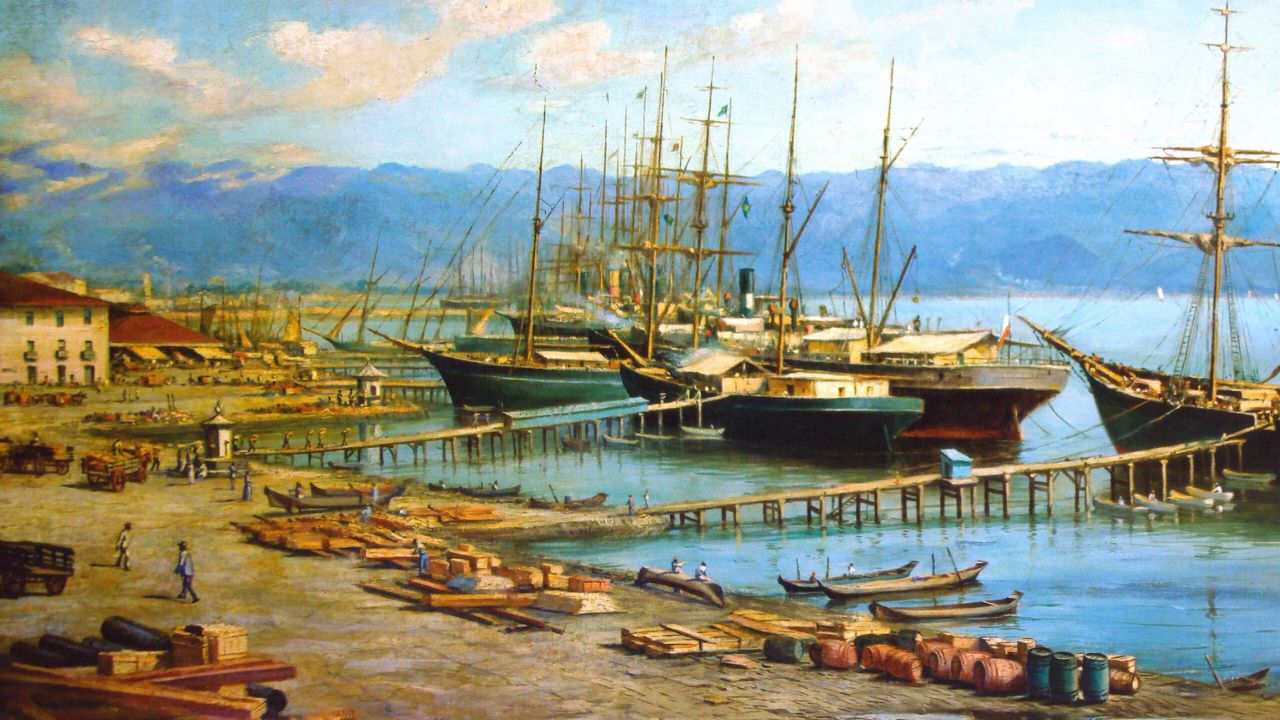
A Detailed Analysis Reveals How Brazil’s Main Port Complex Breaks Records, Faces Challenges, and Invests Billions to Secure Its Future as a Continental Leader.
The Port of Santos is the centerpiece of Brazilian foreign trade and the largest port complex in Latin America. In 2024, the port surpassed historical movement records for cargo and containers, consolidating its strategic importance. However, accelerated growth exposes critical challenges, such as bottlenecks in its land and sea access. To address these issues and ensure leadership in the coming decades, an ambitious billion-dollar investment plan and a deep digital transformation are underway.
From Colonial Post to Logistics Powerhouse
The history of the Port of Santos is directly linked to Brazil’s economic formation. Its origins date back to the 16th century, but its modern foundation occurred on February 2, 1892, with the inauguration of the first 260 meters of wharf by the Santos Dock Company (CDS). This milestone established Santos as the first Organized Port in the country.
Growth was driven by economic cycles, particularly that of coffee, which solidified the port as the main outlet for “green gold.” In the 20th century, the port’s management went through different phases. A decisive moment was the Ports Law of 1993, which transferred terminal operations to private initiative. Today, the Port Authority of Santos (APS) acts as the administrator in a public-private partnership model that handles nearly one-third of Brazil’s trade balance.
-
Friends have been building a small “town” for 30 years to grow old together, with compact houses, a common area, nature surrounding it, and a collective life project designed for friendship, coexistence, and simplicity.

-
This small town in Germany created its own currency 24 years ago, today it circulates millions per year, is accepted in over 300 stores, and the German government allowed all of this to happen under one condition.

-
Curitiba is shrinking and is expected to lose 97,000 residents by 2050, while inland cities in Paraná such as Sarandi, Araucária, and Toledo are experiencing accelerated growth that is changing the entire state’s map.

-
Tourists were poisoned on Everest in a million-dollar fraud scheme involving helicopters that diverted over $19 million and shocked international authorities.


The Numbers That Consolidate the Port’s Leadership
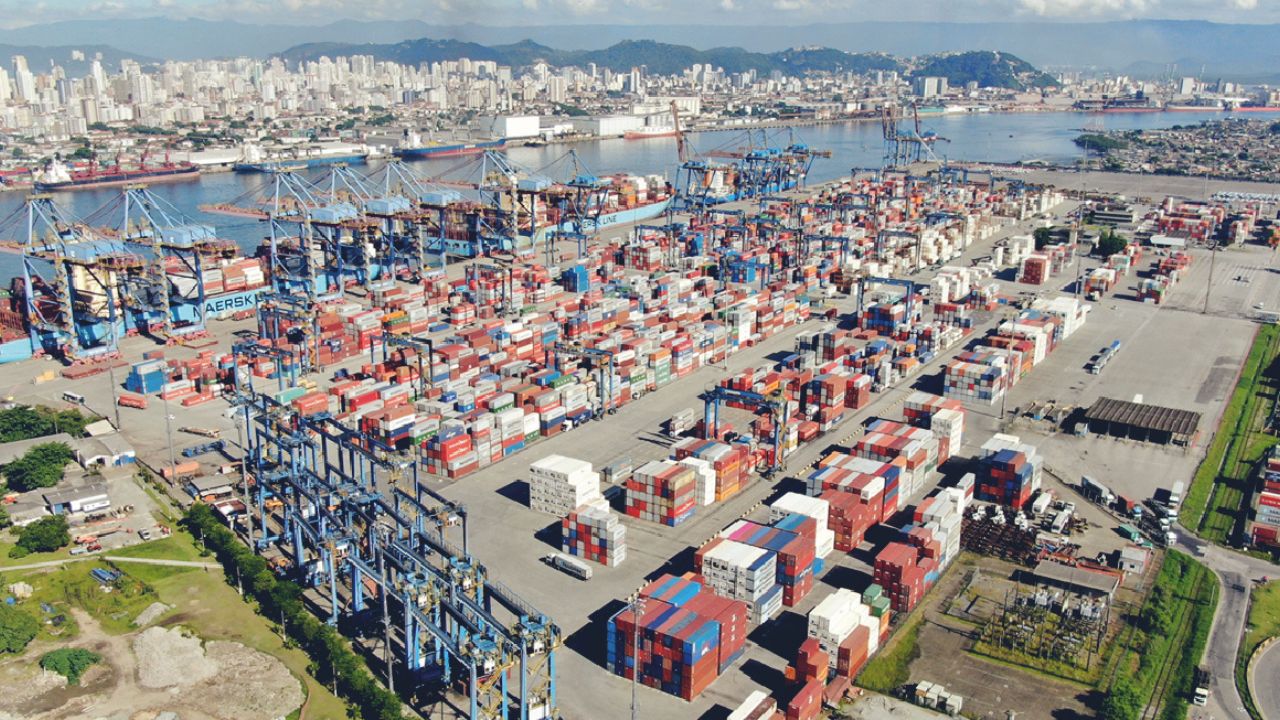
The Port of Santos demonstrates robust performance, breaking successive records. The year 2024 was a milestone, with total handling of 179.8 million tons, a 3.8% growth compared to 2023. The standout was the container segment, which for the first time surpassed the 5 million TEU mark (twenty-foot equivalent unit), closing the year with 5.4 million TEU, an impressive 14.7% increase.
The port’s strength lies in its ability to handle various types of cargo. The solid bulk cargo leads in volume, with 90.7 million tons in 2024, driven by agribusiness with products such as soy, sugar, and corn. Containerized cargo represents the segment with the highest added value and most dynamic growth. Finally, liquid bulk cargo also reached a record of 19.6 million tons, mainly due to the handling of fuels.
Terminals, Access, and Structural Challenges of the Port of Santos
The efficiency of the Port of Santos depends on an ecosystem of private terminals and a complex access network. Since 1993, handling has been carried out by leased terminals, such as Tecon Santos, Brasil Terminal Portuário (BTP), and DP World Santos, which continuously invest in technology.
However, the access infrastructure is the biggest challenge. The Anchieta-Imigrantes System (SAI) is the main highway, but congestion is chronic. The road modal accounts for the majority of transportation, generating delays and costs.
The strategic solution is the rail modal. Currently, the railways account for about 30% of the movement, and the goal is to raise this share to 40%. To do this, investments are needed in the modernization and expansion of the railway network.
Billion-Dollar Investments and Digital Transformation

To ensure its competitiveness, the Port of Santos is executing the most ambitious modernization plan in its history. The Federal Government announced an investment of R$ 12.6 billion between 2024 and 2028 to drive structural projects.
Among the main projects are the Santos-Guarujá Tunnel, an investment of R$ 6 billion to connect both banks of the estuary; the Dredging of the Channel, a critical work to allow the largest ships in the world to operate at full capacity; and Tecon Santos 10, a new megaterminal for containers that could increase the port’s capacity by up to 50%.
In addition to the physical works, a deep digital transformation is underway. The implementation of a private 5G network and a “digital twin” (a virtual replica of the port) will optimize operations, simulate scenarios, and enable quicker and more accurate decision-making, transforming Santos into a “smart port.”









-

-

2 pessoas reagiram a isso.