





 Portuguese
  English
  Spanish
 5 min of reading
  0 comments


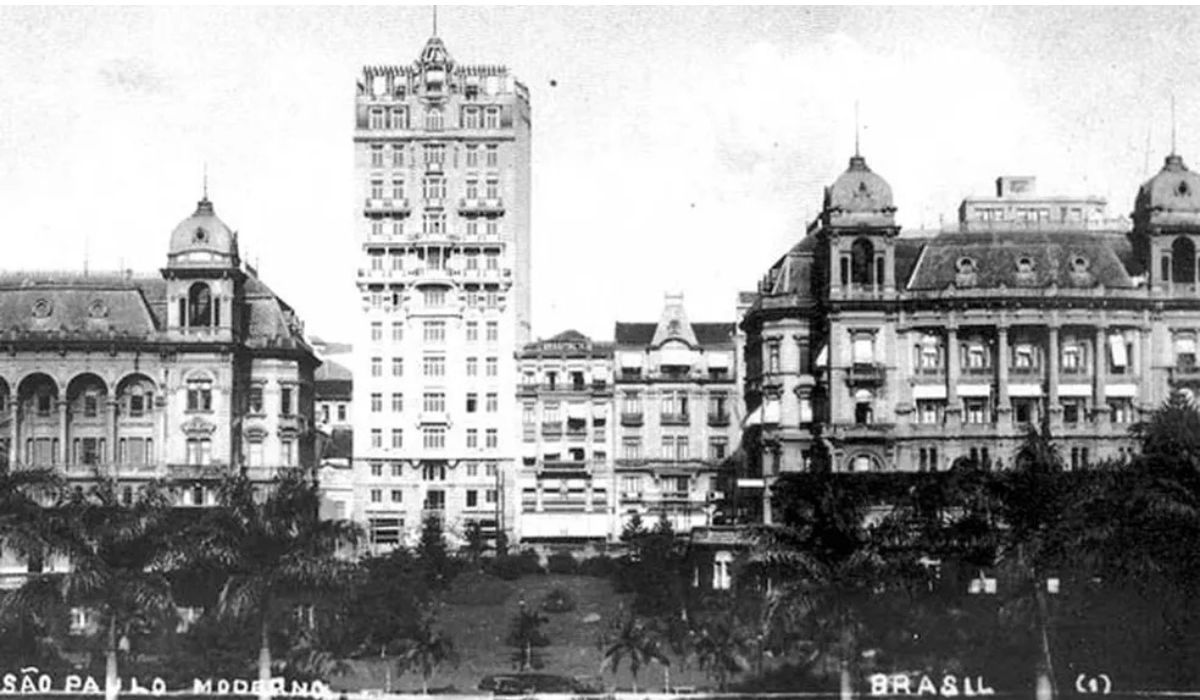
A Building That Changed the Horizon of Downtown São Paulo and Exposed the Tensions of a City in Verticalization, Between Popular Fear, Engineering Solutions, and the Visionary’s Decision to Live at the Top as a Public Demonstration of Confidence.
The Martinelli Building, in downtown São Paulo, has gone down in history for being one of the first major landmarks of verticalization in the city and for concentrating, since its construction, debates about safety and engineering.
Conceived by Italian immigrant Giuseppe Martinelli, the building began to be erected in 1924 and, even during construction, already provoked reactions of surprise and mistrust from part of the population.
Historical records gathered by the City Hall of São Paulo report that, at that time, there were those who avoided circulating in the vicinity of the construction site for fear of collapse.
-
Friends have been building a small “town” for 30 years to grow old together, with compact houses, a common area, nature surrounding it, and a collective life project designed for friendship, coexistence, and simplicity.

-
This small town in Germany created its own currency 24 years ago, today it circulates millions per year, is accepted in over 300 stores, and the German government allowed all of this to happen under one condition.

-
Curitiba is shrinking and is expected to lose 97,000 residents by 2050, while inland cities in Paraná such as Sarandi, Araucária, and Toledo are experiencing accelerated growth that is changing the entire state’s map.

-
Tourists were poisoned on Everest in a million-dollar fraud scheme involving helicopters that diverted over $19 million and shocked international authorities.


This fear intensified because the building was growing above the standard of a São Paulo that still had few tall buildings.
As the topic was new to the city, discussions about soil stability, materials, and construction techniques gained ground in conversations downtown, according to those same municipal sources.
Fear of Collapse and the Novelty of Skyscrapers
At the end of the 1920s, daily life in São Paulo did not yet include towers with dozens of floors.
As the work progressed, comments about the limits of available engineering and the ability of such a tall structure to remain stable in a bustling central area also increased.

The City Hall describes that the concern was not linked to a specific accident, but to the unprecedented nature of the project.
The Martinelli, which was initially supposed to be smaller, underwent expansion throughout the process and became a symbol of a city that was starting to change scale.
Opening in 1929 and Completion of the Martinelli Building in 1934
The building is often associated with 1929 because it was in that year that an inauguration took place, when part of the structure was already in operation, although the construction was not finished.
Municipal and historical reference sources indicate that the work continued afterward, until completion in 1934, when the building reached 30 floors and about 105 meters in height.
This interval between inauguration and completion helps to contextualize why the panic is often linked to 1929.
Even without having reached its final height, the construction site already indicated the scale of the undertaking, concentrating attention and fears at a time when São Paulo was still adapting to vertical architecture.
Villa Martinelli on the Roof and the Strategy of Giuseppe Martinelli
To face the mistrust, Giuseppe Martinelli had a palatial apartment, inspired by an Italian villa, built on top of the building, known as Villa Martinelli.
According to historical accounts gathered by the City Hall, the businessman and his family’s move to the penthouse was presented at the time as a way to demonstrate confidence in the structure of the building.
In practice, the decision served as a public gesture of safety, according to the narrative preserved by those sources.
By occupying the top, Martinelli sought to associate the image of the building with stability and permanence, at a time when height was still interpreted by the population as synonymous with risk.
Reinforced Concrete and Construction Solutions in the Martinelli
The Martinelli is also cited by cultural institutions as one of the constructions that helped to consolidate the use of reinforced concrete on a large scale in the country, a technology that was expanding during that period.
The adoption of this type of structure is pointed out as one of the factors that allowed for the advancement to more floors, with greater rigidity and load-bearing capacity.
There are records, in reference sources, that the building used imported materials in parts of the finishing and construction.
As not all public descriptions converge on specific details of the provenance of items like elevators and finishes, this text maintains only what appears consistently in institutional and public consultation sources: the relevance of reinforced concrete and the combination of construction solutions and finishes compatible with the ambition of the project.
Height of the Martinelli and Comparison with Palacio Salvo and Kavanagh
The height of the Martinelli is often contextualized by comparisons with other iconic buildings in the Southern Cone that emerged in nearby years.
In Montevideo, the Palacio Salvo was inaugurated in 1928 and appears in reference sources with 95 meters and 27 floors, at a time when tall constructions were treated as urban landmarks.

In Buenos Aires, the Kavanagh Building was inaugurated in 1936 and is described as being 120 meters, consolidating itself as a reference for verticalization and the use of reinforced concrete in the Argentine capital.
In this context, the trajectory of the Martinelli is treated by municipal sources as a turning point for São Paulo: it began construction in 1924, was partially inaugurated in 1929, and reached its final form in 1934, when it became one of the largest buildings in the region, with 30 floors and about 105 meters.
Listing by Conpresp and Reopening After Renovation
Over the decades, the building has gone through different phases and uses.
Records from the City Hall indicate that, at certain times, the Martinelli concentrated commercial and service activities and had relevance in the dynamics of the center, an area that historically brought together part of the economic and administrative life of the capital.
Over time, the building also underwent public intervention processes.
The municipal administration records that the Martinelli was expropriated in 1975 and reopened after renovations, with its reopening in 1979, in a move towards requalification linked to use by agencies and services.
Heritage protection is another documented point.
The building is included in the set of assets listed by Conpresp in a municipal normative act from 1992, which establishes preservation rules and conditions future interventions.
Currently, public information from the City Hall also mentions the existence of a terrace used as an observation deck, reinforcing the presence of the Martinelli in the center’s points of interest and in the urban landscape it helped to redefine.
IBGE: São Paulo Population and Municipal Indicators
The story of the Martinelli is related to the transformation of a city that became the most populous in the country.
IBGE data indicate 11,451,999 inhabitants in the 2022 Census and an estimated population of 11,904,961 in 2025 for the municipality.
In the same set of information, the institute presents an IDHM of 0.805 (2010) for São Paulo, an indicator widely used in national comparisons.
In the center, the building remains a material record of a period when height began to symbolize urban change and modernization.
At the same time, the described fear reaction from municipal sources is also used to illustrate how the city dealt with works outside the norm.









-

-

-

-

-

22 pessoas reagiram a isso.