





 Portuguese
  English
  Spanish
  3 min of reading
  0 comments


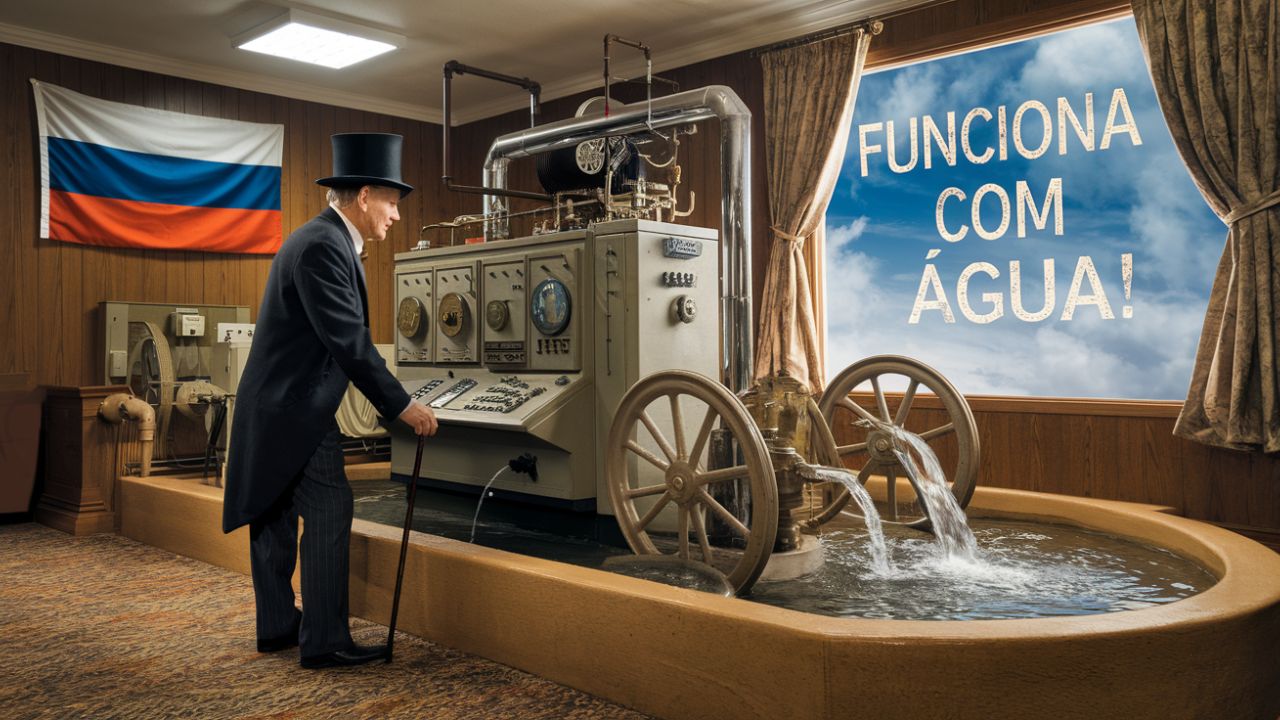
Created in 1936 by scientist Vladimir Lukyanov, the first analog computer used tanks, pumps, and pipes to solve complex calculations, revolutionizing areas such as civil engineering, geology, and rocket engineering in the Soviet Union.
A computer that works with water? That’s right, this happened nearly a century ago! In 1936, Russian scientist Vladimir Lukyanov created the Water Integrator, a revolutionary machine for solving complex mathematical problems, using nothing less than tanks, pumps, and pipes filled with water.
It may sound like science fiction, but this invention was a game changer — literally — in the history of computing. Let’s understand how such a peculiar analog computer emerged and how it shaped entire industries.
The Water Integrator: A Milestone in Computing History

Lukyanov was facing a significant challenge: how to solve complex differential equations related to concrete construction? He realized that the flow of water followed physical laws similar to those of heat distribution, and that’s when he had the brilliant idea. Why not use water itself to simulate these thermal processes?
-
Motorola launched the Signature with a gold seal from DxOMark, tying with the iPhone 17 Pro in camera performance, Snapdragon 8 Gen 5 that surpassed 3 million in benchmarks, and a zoom that impresses even at night.

-
Satellites reveal beneath the Sahara a giant river buried for thousands of kilometers: study shows that the largest hot desert on the planet was once traversed by a river system comparable to the largest on Earth.

-
Scientists have captured something never seen in space: newly born stars are creating gigantic rings of light a thousand times larger than the distance between the Earth and the Sun, and this changes everything we knew about stellar birth.

-
Geologists find traces of a continent that disappeared 155 million years ago after separating from Australia and reveal that it did not sink, but broke into fragments scattered across Southeast Asia.
The result was the Water Integrator, a machine capable of performing extremely advanced calculations, long before digital computers came onto the scene.
Instead of chips and transistors, the Water Integrator used interconnected tanks, pumps, and pipes to move the water. The position and flow of the water represented mathematical variables, while adjustments to the components allowed the equations to be solved. It was as if the water was “thinking,” flowing to find the answers.
Practical Applications: From Concrete to Rocket Engineering
Initially, the Water Integrator was used to study cracks in concrete under different weather conditions. This helped prevent failures in large structures and ensured safety in important works.
Over time, the machine proved its value in areas such as thermal physics, geology, and even rocket engineering. Ambitious projects of the Soviet Union, like the Baikal-Amur Mainline railway, directly benefited from the computational power of the Water Integrator.
The Role of the Water Integrator in the Baikal-Amur Mainline Railway
Even with the advancement of digital computing, the Water Integrator remained relevant for decades. In the 1970s, it played an essential role in planning the Baikal-Amur railway, a strategic project for the Soviet Union.
Today, the Water Integrator is more than a relic; it is a symbol of human ingenuity. It can be found in the Polytechnic Museum of Moscow, where it inspires visitors to rethink the limits of technological creativity.
The Future of Aquatic Computing?
Nowadays, the idea of using water in computing has not been left behind. A recent example is a gaming PC designed to be cooled underwater. Like the Water Integrator, this modern invention demonstrates how water continues to be a surprising element in technology.
Are we on the brink of a new era in computing, where natural elements once again play a central role?








-

-

-

10 pessoas reagiram a isso.