





 Portuguese
  English
  Spanish
 4 min of reading
  11 comments


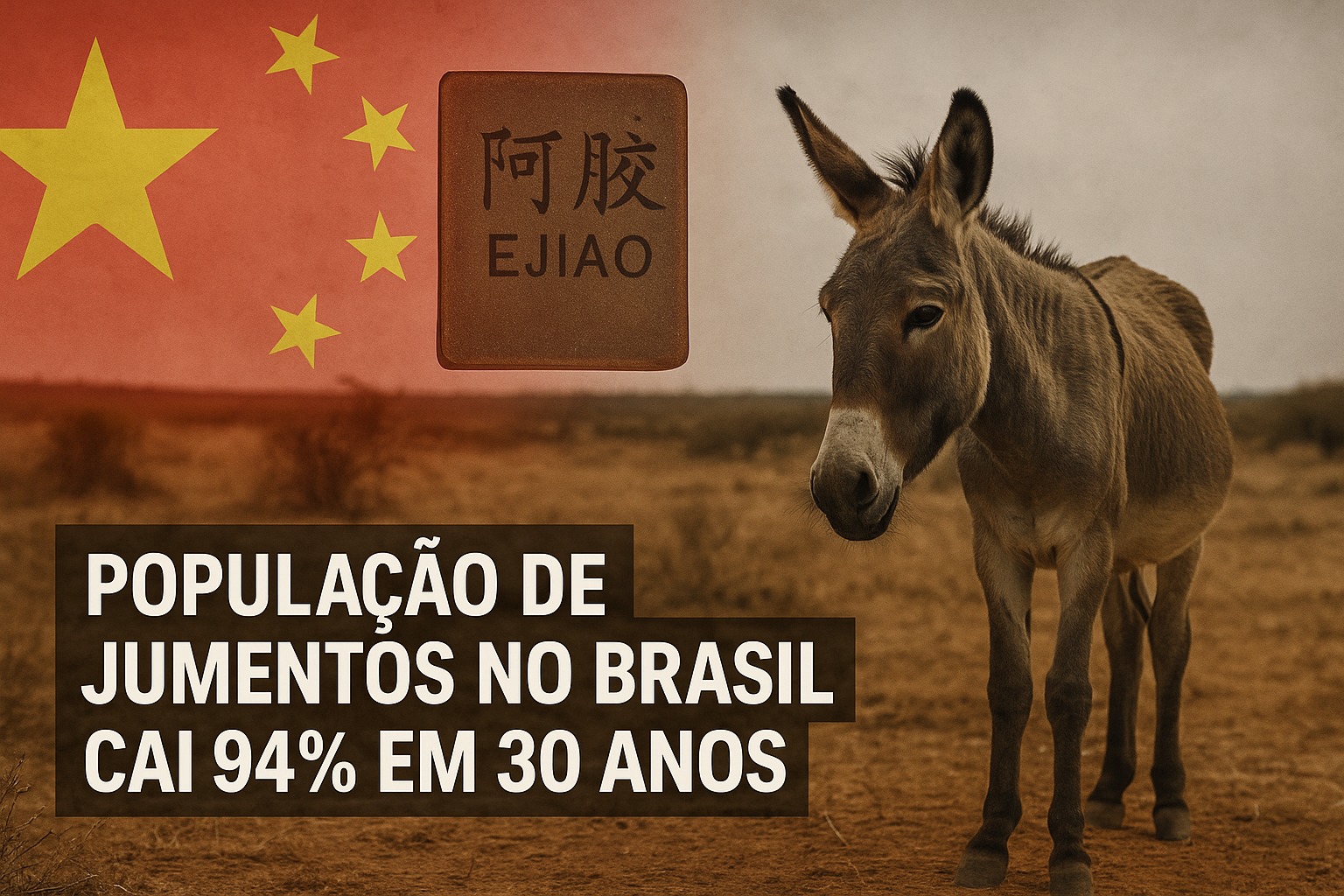


94% Decrease in Donkey Population Between 1996 and 2025 Intensifies Criticism of Slaughter, Expands Political Dispute, and Reinforces Scientific Warnings About the Real Risk of Species Disappearance in Brazil Due to the Advance of the Ejiao Market
The accelerated decrease of donkeys in the country worries researchers because the advancement of the collagen market extracted from these animals pressures already dwindling herds. The issue gained traction after new data indicated a 94% drop in the population between 1996 and 2025.
Rapid Decline of Herd and Extinction Warning
The demand for ejiao intensified slaughter. More than 1 million donkeys were killed in the cited period, resulting in a total number decrease from 1.37 million to 78 thousand. The pace, according to experts, threatens the species’ survival.
Professor Pierre Barnabé Escodro from the Federal University of Alagoas stated that the trend is irreversible without intervention.
-
While the world looks at oil, the war with Iran is already disrupting helium supply from Qatar, affecting car and iPhone chips, threatening AI expansion, and putting pressure on aluminum packaging at the highest value in four years.

-
Global warming will expose a treasure hidden under the ice of Antarctica and may spark an international dispute over gold and valuable minerals.

-
A street vendor from Praia Grande built a robot made of scrap from scooters and washing machines that pulls his popcorn cart on the beach, emits sounds, and interacts with customers, becoming an attraction on the coast of São Paulo.

-
The specifications of the Xiaomi 18 Pro Max have been leaked, and the highlight is a dual 200 MP camera with a new 22-nanometer technology that promises to consume less energy and capture details in shadows and bright areas using LOFIC HDR.


He said that the species may not reach 2030 in Brazilian territory, which reinforces the urgency for concrete measures.
The warning did not arise in isolation. Researchers and advocates recently gathered in Maceió at the third meeting of Donkeys of Brazil, which brought together about 150 participants.
The goal was to push for the approval of a project that bans slaughter nationwide.
Insufficient Oversight and Criticism of Current Model
Currently, three slaughterhouses in Bahia have federal authorization for slaughter. Although the activity is regulated, critics claim that there is no adequate traceability. Furthermore, they point out that there is a lack of controls over health and mistreatment.
Escodro classified the practice as extractive because donkey production for slaughter would not be economically viable.
According to him, there is a progressive depletion of a resource that does not recover at the same rate as extraction.
A study published in May in the journal Animals reinforced this scenario. In the study, 104 abandoned donkeys destined for slaughter showed systemic inflammation. The situation indicated negligence and suffering, highlighting failures in the production chain.
The Justice has already temporarily suspended the activity at different times. The actions came from organizations that report mistreatment and the risks of species disappearance. Some processes reopened the debate on responsibility and oversight.
Political Dispute and Contested Data
In 2022, a bill sought to prohibit slaughter in Bahia. However, in April of this year, deputy Paulo Câmara, the bill’s rapporteur, issued a contrary opinion.
He stated that the activity has regulation, economic relevance, and that the population would be “stable.”
The statement caused an immediate reaction. Entities issued a note of repudiation and contested the data presented.
They argued that the positioning ignored scientific evidence and the declining trend in herds. When sought, the deputy reaffirmed his opinion and said he would adhere to technical criteria.
The debate gained even more strength because the trade moves large amounts of money. The collagen extracted from donkey skin is the basis of ejiao, a traditional Chinese medicine product. It is used to treat anemia, insomnia, and impotence, without scientific proof.
Global Trade Advancement and Economic Pressure
The British organization The Donkey Sanctuary estimates that 5.9 million donkeys are slaughtered annually worldwide to supply this market.
The sector would move around 6.4 billion dollars, a factor that keeps international demand high.
In Brazil, the skin of a single animal can reach up to US$ 4,000, according to Escodro. Additionally, the price of live donkeys has risen from R$ 100 to up to R$ 500 in the interior of the Northeast. Factors that, together, recreate constant pressure on already diminished herds.
The international scenario confirms that the impact transcends borders. Research released on the 25th by Maasai Mara University in Kenya showed that animal thefts are increasing as they meet the ejiao industry. Rural communities, especially women, suffer direct losses.
Egypt, in turn, has practically lost its donkeys. The crisis led the African Union to approve a 15-year moratorium against commercial slaughter, an attempt to preserve herds that have disappeared rapidly.
Proposed Alternatives in Brazil
Among the solutions studied, researchers discuss creating sanctuaries in regions that still concentrate animals.
The idea is to form protected areas to allow for slower population recovery. It is considered an initial plan but viewed as possible.
Another course of action aims to reintegrate donkeys into family farming. Some groups are studying ways to reuse the animal in field activities, reducing abandonment situations.
There are also studies on donkey therapy, a therapeutic assistance practice.
Researchers argue that reintroducing these uses can generate social and economic value. Therefore, this could decrease slaughter and strengthen care policies.
It is an ongoing debate, still without consensus, but which gained traction after the meeting in Maceió.
The discussion remains open. The coming months will indicate whether Congress will put the bill banning slaughter on the agenda.
The decision could define the future of the species in Brazil, as the current trend has concerned specialists and entities for years.
Meanwhile, advocates assert that the data shows a critical situation. Some admit there is a certain urgency, even if they speak quickly or let a mistake slip, because the decline curve has remained consistent since the 1990s.
The issue is progressing in public debate. And, even with political divergences, there is a growing perception among scientists that containment measures need to occur soon, before the country follows the path of regions that have already lost their herds almost completely.
With information from O Globo.







Ainda bem que diminuiu senão o bozó tinha se reelegido
Judiação. Além de ser comparado com gente parva, ainda é perseguido pra ser morto.
Menos eleitores do PT