





 Portuguese
  English
  Spanish
  4 min of reading
  12 comments


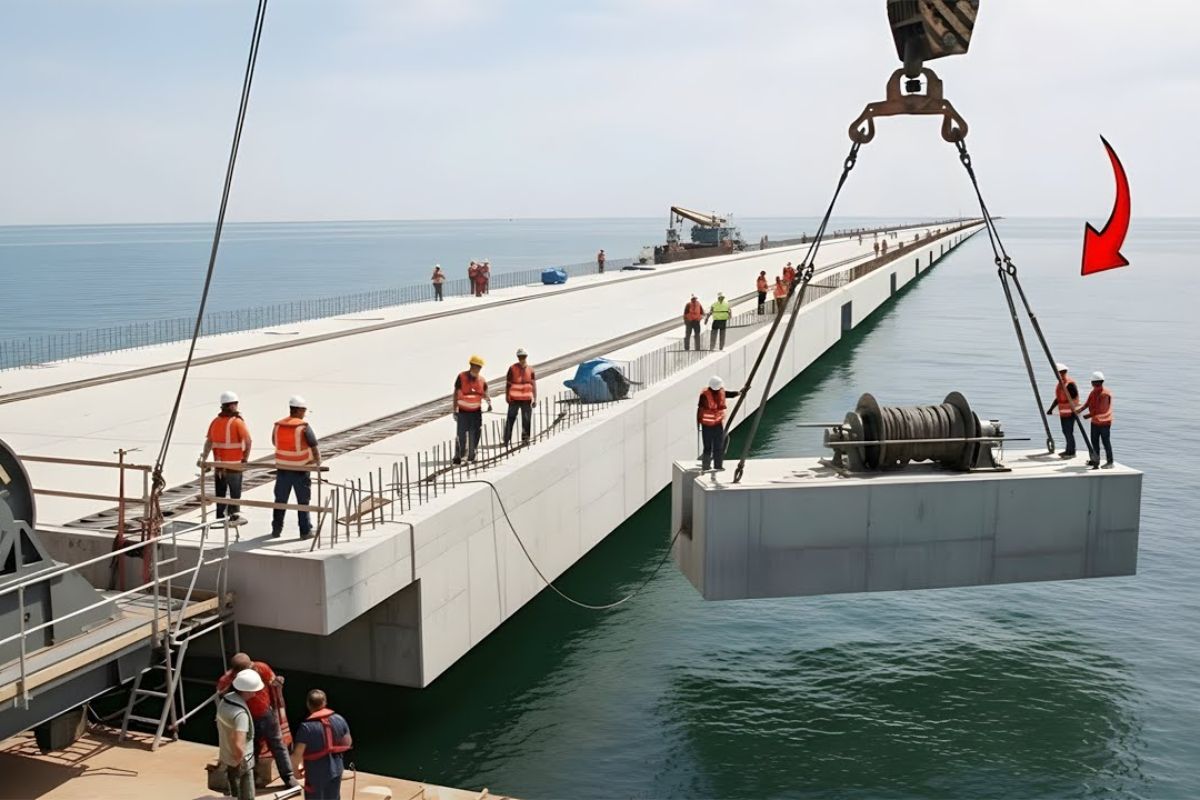


With 73,000 Tons and an Innovative Approach, the Floating Concrete Project in the Baltic Sea Is Revolutionizing Underwater Engineering. Find Out How It Connects Germany and Denmark, Promoting Advances in Global Infrastructure and Changing the Paradigms of Construction.
One of Europe’s most ambitious infrastructure projects is underway in the Baltic Sea. The construction of an underwater tunnel made with 73,000 tons of floating concrete blocks promises to transform underwater engineering and profoundly alter the future of construction and transportation.
The Problem of Connection Between Germany and Denmark
For decades, the region between Germany and Denmark has faced a significant logistical challenge due to the lack of a direct and effective link between the two countries across the Baltic Sea.
-
Abandoned house for 15 years disappears in the woods, shocks owner with unrecognizable scenery and is reborn in an intense transformation after almost 90 hours of work in just 10 days.

-
In just three hours, a natural stone floor transforms the entrance of the house with an organic effect, immediate drainage, and a sophisticated non-slip finish that doesn’t puddle water, dries quickly, and impresses with the final result.
-
‘Interlocking brick’ made of earth arrives in the construction industry with cost reductions of up to 40% on the project.

-
Espírito Santo will receive the largest engineering project in its history with the duplication of BR 262, which will have 50 viaducts, 28 bridges, and 2-kilometer tunnels cutting through the most challenging mountainous region of the entire state.


Despite various attempts at solutions, such as bridges or traditional tunnels, the absence of an efficient maritime crossing continued to increase costs and transport times, directly affecting trade and passenger flow.
The lack of a quick connection meant that vehicles and goods needed to take longer routes, resulting in significant delays and economic impact.
In response to this difficulty, increasingly bold proposals emerged to solve the problem, culminating in an innovative project that would be capable of transforming logistics and infrastructure in this region of the European continent.
The Floating Concrete Project: An Innovative Solution
Instead of following the traditional approaches of building bridges or underwater excavation, the solution found was the construction of an underwater tunnel with gigantic segments of floating concrete.
The idea is simple in concept but revolutionary in execution: to build the tunnel segments on land, prepare them, and then transport them to the seabed, where they will be precisely positioned.
This approach not only avoids the astronomical costs associated with underwater excavation but also provides a more efficient and safer method for constructing large underwater works.
Each floating concrete block weighs 73,000 tons and is designed to float due to its structure, which is based on Archimedes’ principle.
This means that, despite its massive weight, the concrete block can be transported across the sea, almost as if it were a huge vessel. This process has the potential to reduce costs and speed up the construction of large-scale underwater tunnels.
How the Underwater Tunnel Construction Works
The construction of the Fehmarnbelt Tunnel involves the production of 89 enormous concrete segments, which are prefabricated at a factory on land.
These segments are made of a combination of high-strength concrete and steel, creating a robust structure capable of withstanding the pressure of the sea and the weight of the road and rail traffic that will pass through them.
After manufacturing, each segment is carefully floated to the construction site on the seabed using specialized tugboats.
The process of submerging the segments on the seabed is meticulously coordinated. Each concrete segment is lowered into the excavated trench on the seabed and connected to the others, gradually forming the underwater tunnel.
Precision is essential throughout the process, as each segment needs to fit perfectly with the others to ensure stability and safety of the tunnel over its lifespan.
Precision Engineering and Technical Challenges
Building an underwater tunnel of such magnitude is not a simple task. Besides the obvious challenges related to the handling and installation of the floating concrete segments, engineers also had to deal with the complexities of seabed conditions, such as variations in pressure and sea currents.
The tunnel’s structure was designed to be flexible, allowing it to adjust to these changes without compromising its integrity.
The use of cutting-edge technology was essential to ensure that the project was carried out with millimeter precision.
During installation, automated positioning systems ensured that the segments were lowered accurately, while specialized tugboats moved the concrete blocks to their destinations on the seabed.
The Impact of the Project on Global Infrastructure
This project not only resolves a critical logistical problem for Europe but also opens doors to a new model for constructing underwater infrastructure.
If successful, the floating tunnel could serve as a model for other large-scale projects around the world, in locations where traditional bridge or underwater tunnel construction would be unfeasible or economically impractical.
Besides improving connectivity and transportation efficiency between Germany and Denmark, the project also represents a significant advance in the sustainability of underwater construction.
The possibility of constructing tunnel segments on land and transporting them to the sea can significantly reduce costs, construction time, and the environmental impacts associated with underwater excavation.
The Future of Underwater Construction
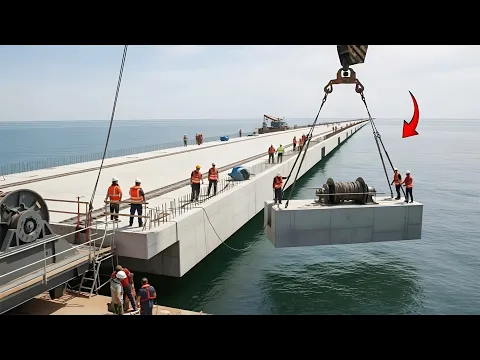

If the floating concrete project between Germany and Denmark is successful, it could establish a new standard for the construction of underwater tunnels worldwide.
The use of innovative technologies and creative solutions, such as floating blocks, has the potential to make the construction of large submerged infrastructures more accessible, safe, and sustainable.
In the future, we may see more infrastructure projects based on this model, from underwater tunnels to other forms of floating construction, adapted to the transportation and communication needs between isolated regions.
The official opening forecast for the Fehmarnbelt Tunnel is set for 2029.
Do you believe that the use of floating concrete could be the key to solving the challenges of constructing large underwater works in the future? Leave your opinion in the comments below!










En los años 60 se hizo con una tecnica similar el túnel subfluvial que une Santafe y Paraná en Argentina , con recursos más limitados , técnica y económicamente , que sigue en funcionamiento, llama la atención que no lo mencionen
Con una técnica similar se construyó el túnel subfluvial entre las ciudades de Santa Fe y Paraná en Argentina inaugurado en el año 1969. La obra consta de 36 tubos de hormigón de 65,45 mts. de longitud, que se fabricaron en un dique seco. Luego se llevaron flotando hasta la posición y se hundieron. Cordiales saludos
Under Mediterranean sea, European countries, North Africa and Asian.. would rather think to connect their people using this fantastic and wonderful concrete technology-underwater tunnel.