





 Portuguese
  English
  Spanish
  3 min of reading
  3 comments


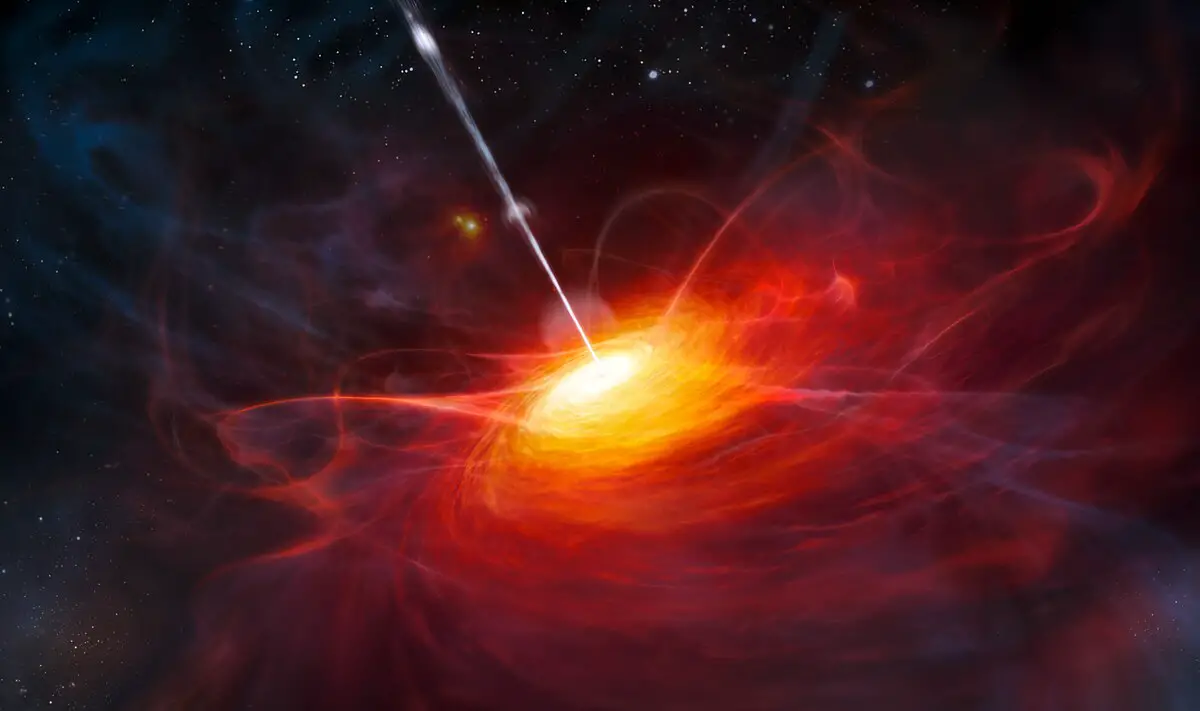


Incredible Cosmic Phenomenon: Quasar Outshines Any Known Brightness, Emitting 500 Trillion Times More Light Than The Sun!
Did you know that there is something in the cosmos so bright it defies imagination? Scientists have just discovered a quasar, named J059-4351, that shines an astonishing 500 trillion times brighter than the Sun!
What Is A Quasar? A quasar is an extremely luminous galactic nucleus, powered by a supermassive black hole rapidly accreting matter. It emits enormous amounts of energy, often outshining all the stars of the host galaxy, and is visible from great distances in the universe.
Located 12 billion light-years from Earth, this cosmic phenomenon is powered by a supermassive black hole that is growing at a record pace. It’s as if the universe is showing us its greatest masterpiece of energy.
-
Submarine cables installed to transmit the internet now also help scientists detect earthquakes.

-
After so many blackouts, a family transforms an electric truck into a power source for their home and shows how a 100 kWh battery can keep everything running for days.

-
Ukraine is already testing, and China has already shown the world, and now the Brazilian Army is developing its own swarm of autonomous drones with artificial intelligence that share data in real time and operate without centralized control, uniting military and universities.

-
Few people know, but the most nutritious part of wheat has been discarded for decades to produce white flour, and the “polyamine” spermidine activates cellular cleaning, reduces mortality, and may slow down memory loss.


What Makes This Quasar So Extraordinary?
Imagine a black hole devouring more than 413 solar masses per year, creating a spectacle of unimaginable light and heat.
The accretion disk around this black hole, extending over 15,000 times the distance between the Sun and Neptune, heats to temperatures exceeding 10,000 degrees Celsius, generating powerful winds that sweep everything around it. According to Christian Wolf, the research leader, this quasar is “the most violent place we know of in the universe.”
But wait, there’s more! This black hole is the largest “cosmic glutton” ever seen, consuming material at a rate of more than one solar mass per day. To put it in perspective, if we compared the growth of this black hole to a marathon, it would be running at the speed of light!
Why Did It Take So Long To Find It?
Surprisingly, this quasar was “hiding in plain sight.” Despite being incredibly bright, it was mistaken for a common star when it first appeared in images captured in 1980.
How did this happen? Machine learning algorithms, trained to identify quasars similar to those we already know, could not detect something so out of the ordinary. Only last year, using data from the Siding Spring Observatory in Australia, did researchers finally realize the mistake. And of course, it took the powerful Very Large Telescope in Chile to confirm its incredible brightness.
A Window Into The Cosmic Past
This quasar is more than an astronomical curiosity: it offers us a glimpse of the primitive universe, as its light took 12 billion years to reach us. Scientists are excited about the possibility of accurately measuring the mass of this colossal black hole, estimated to be 17 billion times that of the Sun.
According to Priyamvada Natarajan, an astrophysicist at Yale University, the giant accretion disk of this quasar could be the key to unlocking the secrets of black hole growth in the early universe.
Discoveries like this broaden our understanding of the limits of the universe. This quasar, likely long extinct billions of years ago, continues to illuminate our scientific curiosity. As Christopher Onken, a co-author of the study, said, “It’s amazing that something this bright remained invisible for so long.”
Astronomers believe this is a one-of-a-kind phenomenon. Wolf from the Australian National University emphasized: “Nothing should outshine this quasar in terms of brightness.” So, if you enjoy marveling at the secrets of the universe, this is the discovery to keep an eye on!
Amazing, isn’t it? As we explore the vast depths of the cosmos, each discovery reminds us how little we know and how much there is still to explore. And you, what do you think comes next?




Eu intuo que a luz que viaja universo afora, seja como a corrente contínua.
Ao interromper a fonte geradora, a energia cessa instantâneamente.
Assim deve ser a luz quando saem de sua fonte.
Se podemos ver a luz desse quasar, é porque ela é emitida no presente, então o que vemos não é o passado, mas sim o presente.
Ele está lá engulindo tudo e nós aqui contemplando.
Tudo no universo está no presente, por mais ilógico que possa parecer em função das distâncias inimagináveis.
Logo logo estaremos vendo há 20 bilhões de anos luz daqui, e aí restará duas alternativas: ou o Big Bang é uma estorinha infantil ou só podemos ver o presente.
A pergunta mais importante é: Após esse buraco negro devorar a galáxia onde ele está, o que deverá acontecer? Ele continuará em engolindo outras galáxias e também a nossa??
Impressionante como o universo a cada dia nos brinda com essas visões espetaculares…além da compreensão humana