





 English
  Francês
  Alemão
  Italiano
  Japonês
  Norueguês
  Portuguese
  Spanish
  6 min of reading
  0 comments


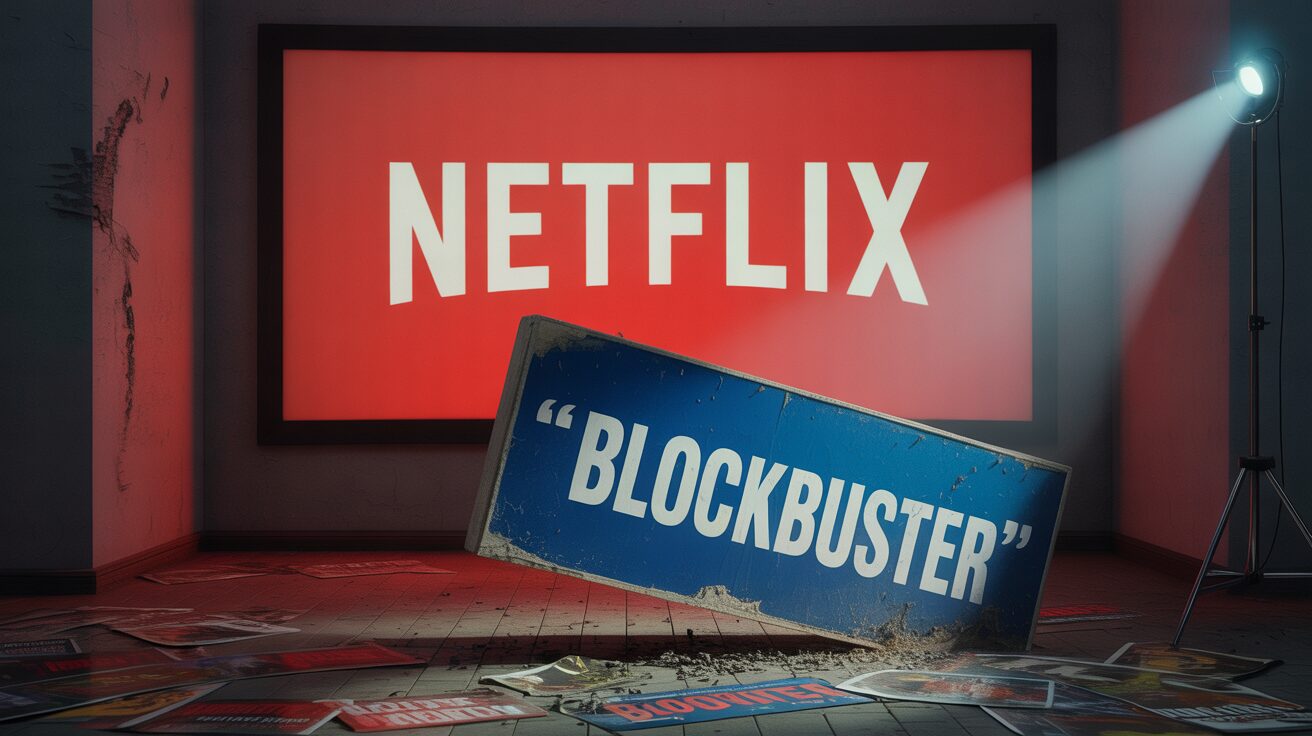
Icon of Video Rental in the 90s, Blockbuster Did Not Keep Up with the Streaming Revolution and Saw Its Empire Collapse in the Face of Netflix’s Rise and the Digital Era.
What Happened to Blockbuster: During the 1990s and early 2000s, going to a Blockbuster store was a weekend ritual. Choosing a movie from hundreds of colorful covers, chatting with the staff, buying popcorn on the way out — it was all part of the experience. The company had over 9,000 stores in operation worldwide, with a presence in more than 20 countries.
But within a few years, this empire crumbled. The digital transformation led by Netflix, ignored and underestimated by Blockbuster at first, turned out to be fatal. The company that dominated the movie rental market became a symbol of an era that failed to adapt.
After all, what happened to Blockbuster? How did such a strong brand, practically without competition, lose everything in such a short time? And what role did Netflix play in this story of rise and fall?
-
Spain surprises the world by erecting 62 artificial dunes, mixing sand with natural remains of posidonia, and causing the structure to lose only 1.4% of its volume in 1 year.

-
With 16 Bulava missiles, improvements in acoustic stealth, and a design focused on silent patrols, Russia’s nuclear submarine was born to ensure Moscow’s invisible retaliation and has become one of the pillars of its maritime strength.

-
‘Populous’ city in Rio among the worst in Brazil in national ranking and exposes silent development crisis.

-
Couple buys house in the South Zone of São Paulo, opens a hidden door in the garage, and finds a secret wine cellar with dozens of old wines forgotten since the 1970s.


In this article, we will revisit Blockbuster’s trajectory: from its meteoric founding to global peak, from rejecting a proposal from Netflix to its definitive collapse — and what remains of the legendary rental network.
The Beginning of a Global Phenomenon – What Happened to Blockbuster?

Blockbuster Inc. was founded in 1985 in the United States by David Cook, a software engineer who saw the potential of the movie rental market. At that time, the sector was dominated by small neighborhood rental stores, with limited catalogs and little professionalism. Cook decided to innovate.
The idea was simple but powerful: to create a network of rental stores with an extensive catalog, standardized visual appeal, fast service, and an automated stock control and return system. The first store opened in Dallas, Texas, and soon became a public success.
In the following years, the company expanded rapidly. With support from investors and a well-defined franchise model, Blockbuster opened one new store every 24 hours on average during the late 1980s. Before long, it became the largest rental chain on the planet.
In 1994, Blockbuster was bought by Viacom, one of the largest media conglomerates in the United States, for about US$ 8.4 billion. The idea was to integrate the rental business into the media giant’s entertainment portfolio, which included MTV, Paramount Pictures, and other brands.
The Peak: 9,000 Stores, Billions in Revenue, and Global Presence
During the 1990s, Blockbuster became synonymous with movie rentals. The stores were in every major city in the United States, Canada, Latin America, Europe, and Australia. In Brazil, the company reached out in partnership with the Lojas Americanas group, opening units in malls and high-traffic commercial centers.
With over 9,000 operational units and 84,000 employees worldwide, Blockbuster was earning billions annually. In 2004, it reached its peak, with net profit exceeding US$ 500 million and a presence in 25 countries.
The brand was so strong that it began to influence cultural behavior. Friday became “Blockbuster Day,” synonymous with home entertainment. The advertising campaigns were massive, the promotions attractive, and the loyalty system encouraged customer returns.
But even at its peak, warning signs began to appear. The world was changing — and Blockbuster did not seem interested in keeping up with this transformation.
The Netflix Proposal: The Chance Blockbuster Rejected
In 1997, a small company called Netflix was born, founded by Reed Hastings and Marc Randolph. The initial model was simple: renting DVDs by mail, with a significant advantage over the competition — no late fees.
The service was convenient, especially for those living far from Blockbuster’s physical stores. By 2000, Netflix was still small but had ambition. That was when Reed Hastings proposed a partnership.

The offer was as follows: sell Netflix to Blockbuster for US$ 50 million, on the condition that Netflix would manage Blockbuster’s digital presence while it handled the physical operations.
The response? Laughter. Blockbuster executives found the proposal absurd. To them, Netflix was insignificant compared to the power of the physical network. The idea of renting via the internet seemed exotic and unfeasible for most consumers.
This moment was marked as the turning point in Blockbuster’s decline. The company that dominated the market failed to see the innovation in front of it — and it would cost dearly.
The Beginning of the End: Debts, Poor Management, What Happened to Blockbuster and the Rise of Streaming
From 2004 onwards, the scenario began to change drastically. Netflix, which had been rejected, continued to grow with its monthly subscription model by mail. In 2007, it launched streaming movies over the internet, an innovation that would change everything.
Meanwhile, Blockbuster faced serious financial problems. Viacom divested from the company in 2004, making it independent again. But the market was no longer the same.
Blockbuster tried to react. In 2004, it launched the Blockbuster Online service to compete with Netflix in online rentals. It also created a monthly subscription system and even removed the hated late fees. But it was too late.
The company’s management came under fire for erratic decisions and a lack of strategic vision. The heavy infrastructure, with thousands of stores and employees, was incompatible with the new digital landscape. Blockbuster was a slow giant trying to run against an agile and visionary startup.
Moreover, with the arrival of new competitors such as Amazon Prime Video, Hulu, and iTunes, Blockbuster lost ground in what had once been its absolute territory.
The Bankruptcy: The End of Blockbuster as a Global Network
In 2010, the situation became unsustainable. With debts of nearly US$ 1 billion, Blockbuster filed for bankruptcy in the United States. More than 6,000 stores had already closed by then.
What remained of the brand was purchased by Dish Network, a pay-TV operator, for about US$ 320 million. The intention was to use the Blockbuster name to promote a video-on-demand service called Blockbuster On Demand. But the initiative lacked momentum.
Over the next few years, the Blockbuster name slowly faded away. In 2013, Dish announced the closure of the last corporate stores and the end of mail services. What was once an empire of physical entertainment became dust.
Today, only one Blockbuster store remains in the world, located in Bend, Oregon (USA). The unit is maintained by a local franchise, which has become a tourist spot, selling nostalgic products from the VHS era and DVDs. A true memorial of a brand that defined a generation.
The Legacy and the Lesson That Remains
The end of Blockbuster is considered one of the greatest cases of corporate myopia in modern history. A company that had all the resources to lead the digital revolution — a customer base, a strong brand, a global structure — chose to ignore the change.
The story has become a case study in universities, MBAs, and books on innovation. Particularly, the decision to refuse to buy Netflix for just US$ 50 million in 2000 is seen as one of the biggest missed opportunities in the technology and entertainment sector.
Netflix, which started as a modest DVD delivery company, became a global streaming empire, with over 260 million subscribers in 190 countries and original productions that won Oscars, Emmys, and Golden Globes.
Meanwhile, Blockbuster became synonymous with resistance to change. Its fall is remembered as a warning to companies in all sectors: no brand is safe from obsolescence, no matter how big it is.








Seja o primeiro a reagir!