





 Português
  Inglês
  Espanhol
  4 min de leitura
  0 comentários


WEG: Discover The History Of The Brazilian Giant Of Electric Motors. From Jaraguá Do Sul To The World, See The Trajectory Of Success And Innovation Of The Company.
Contrary to the idea that Brazil lives only on commodities, WEG has established itself as a Brazilian industrial powerhouse with a global reach. Founded in the 1960s in Jaraguá do Sul (SC) by three visionary entrepreneurs, the company today generates billions, employs tens of thousands, and exports technology to all five continents, being a global reference.
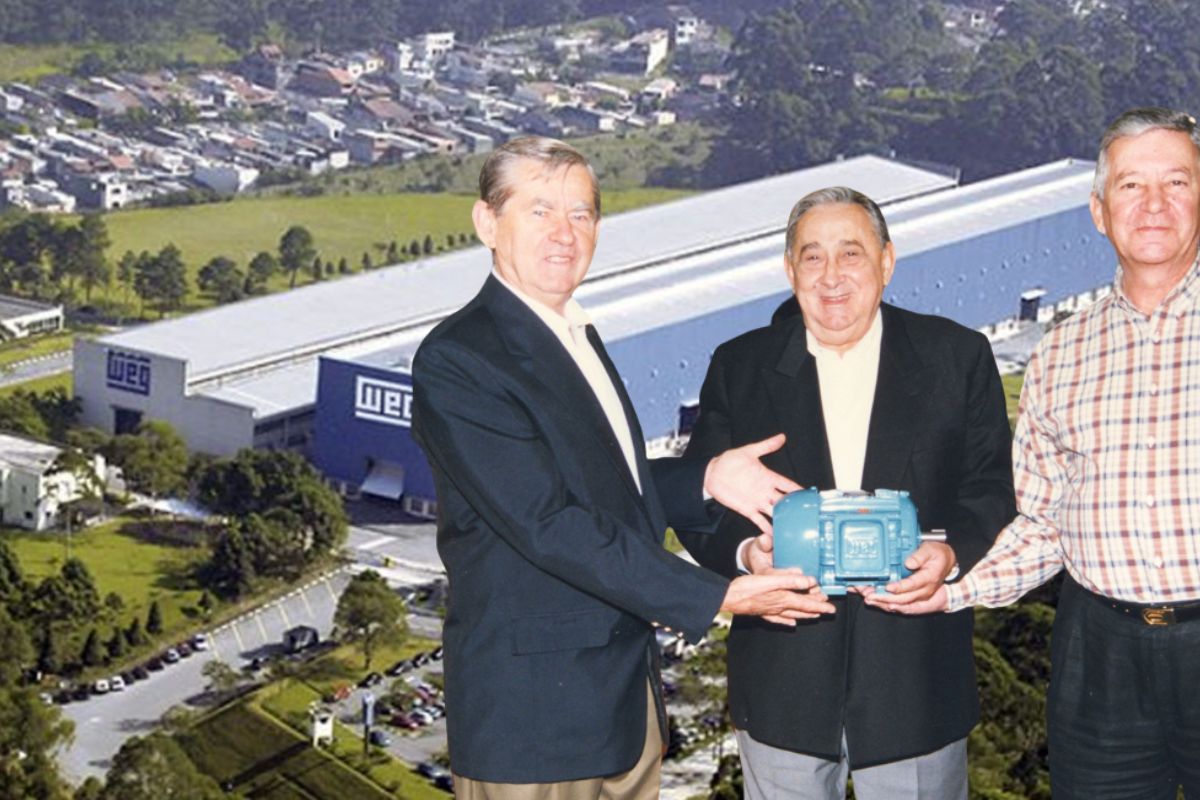
The Founders Of WEG: Werner Ricardo Voigt, Egon João Da Silva And Geraldo Werninghaus Join Forces In Jaraguá Do Sul
The history of WEG begins with the union of three men with complementary skills in Jaraguá do Sul, Santa Catarina. Werner Ricardo Voigt, an electrician passionate about the field since childhood; Egon João da Silva, an administrator with banking and business experience; and Geraldo Werninghaus, a talented mechanic coming from his father’s workshop. Noticing the high demand and delays in the delivery of electric motors in the region, they saw an opportunity.
On September 16, 1961, they founded Eletromotores Jaraguá. The initial capital was modest, equivalent to about three Beetles at the time. Egon became president due to his administrative knowledge. Soon, the company adopted the name WEG, formed by the initials of the founders’ surnames (Werner, Egon, Geraldo), a name that also means “path” in German and by which customers already referred to their products.
-
The world’s first octopus farm wants to open in the Canary Islands and is already provoking an international reaction: the plan aims to produce 3,000 tons per year.

-
Drought may be creating stronger superbugs in the soil and helping antibiotic resistance reach hospitals, warns a study highlighting a problem that could grow alongside extreme weather.

-
The biggest scam in history: Napoleon’s France deceived the United States by selling them a territory that was Spanish.
-
Why is the Danakil Desert so dangerous? It has unstable terrain and how extreme temperatures and toxic gases turn the region into one of the most hostile environments on Earth.


From The Interior Of Santa Catarina To Brazil: Overcoming Challenges And Building Quality

The beginning was challenging. WEG faced large competitors, mainly imported products, and dealt with the communication and logistics difficulties of a small town like Jaraguá do Sul, which had only 12,000 inhabitants. The Brazilian market was not yet accustomed to national industrialized products. Determined, the founders traveled by bus through neighboring cities, carrying motors under their arms to sell them.
The effort began to pay off. In 1964, WEG started building its own headquarters, Parque Fabril 1. Soon another challenge arose: the lack of skilled labor. The solution was to invest in internal training: in 1968, they inaugurated the WEG Training Center (Centroweg). Seeking improvement, the founders traveled to Germany to study processes and technologies, bringing back knowledge that became a competitive advantage. In 1970, inspired by this learning, the company created its quality policy and produced its first motor according to ABNT standards, which was a great success.
Diversification, Verticalization And International Conquest
Taking advantage of the Brazilian “economic miracle,” WEG products gained traction across the country. In 1970, in a bold decision for the time, the company began exporting to neighboring countries such as Guatemala and Uruguay. In 1971, it went public on the Bovespa. By the end of the 1970s, it had produced one million motors and was exporting to over 20 countries.
The Brazilian economic crisis of the 1980s brought difficulties, but WEG responded with strategy: it diversified its products, creating new business fronts (WEG Drives, Machines, Transformers, Chemicals, Automation), and began vertical integration, producing many of the necessary components in-house. These strategies drove growth. In 1989, after nearly 30 years, Egon passed the presidency to his son, Décio da Silva, and the founders joined the Board of Directors.
Under Décio’s leadership, WEG intensified its international expansion in the 1990s, targeting the large markets of the United States and Europe, opening branches in several countries. By the end of the decade, it dominated 79% of the Brazilian motor market and exported 29% of its production to 55 countries. The new millennium brought more milestones: in 2000, it acquired its first factories abroad (Mexico and Argentina); in 2001, it reached R$ 1 billion in annual revenue; and in 2006, it produced motor number 100 million.
Global Power And Billionaire Factory: WEG Today


After Décio assumed the presidency of the Board, Harry Schmelzer Jr., a career employee, became CEO and continued the rapid pace, focusing on acquisitions (over 25 companies) and new markets. Entering the wind power generation sector in 2011 was an important step. In 2012, external sales surpassed domestic sales, reaching 51% of revenue and consolidating WEG’s international success.
Today (May 2025), WEG is a global giant. It has subsidiaries in 37 countries and factories in 15. In 2022, its revenue reached R$ 29.9 billion (56% from abroad) and net profit was R$ 4.2 billion. With over 38,000 employees, it produces more than 19 million motors annually and offers over 1,500 product lines. It operates in four divisions: Industrial Electronic Equipment; Generation, Transmission And Distribution (GTD); Commercial Motors And Appliance; and Paints. Its astounding success on the stock market and a valuation increase of over 1000% in the past decade earned it the nickname “Billionaire Factory,” with 29 heirs of the founders appearing on the Forbes list.
The Legacy Of WEG
The historical focus on innovation remains a pillar of WEG. The company invests heavily in renewable energy, artificial intelligence (with the acquisition of startups), and electric mobility, securing contracts to supply chargers to automakers such as Volvo and Renault. The goal of providing complete electrical solutions, from start to finish, guides the company’s strategy. The journey of Werner, Egon, and Geraldo, who transformed an opportunity into an industrial empire, remains a great source of inspiration for entrepreneurship in Brazil.








Seja o primeiro a reagir!