





 Portuguese
  English
  Spanish
 4 min of reading
  0 comments


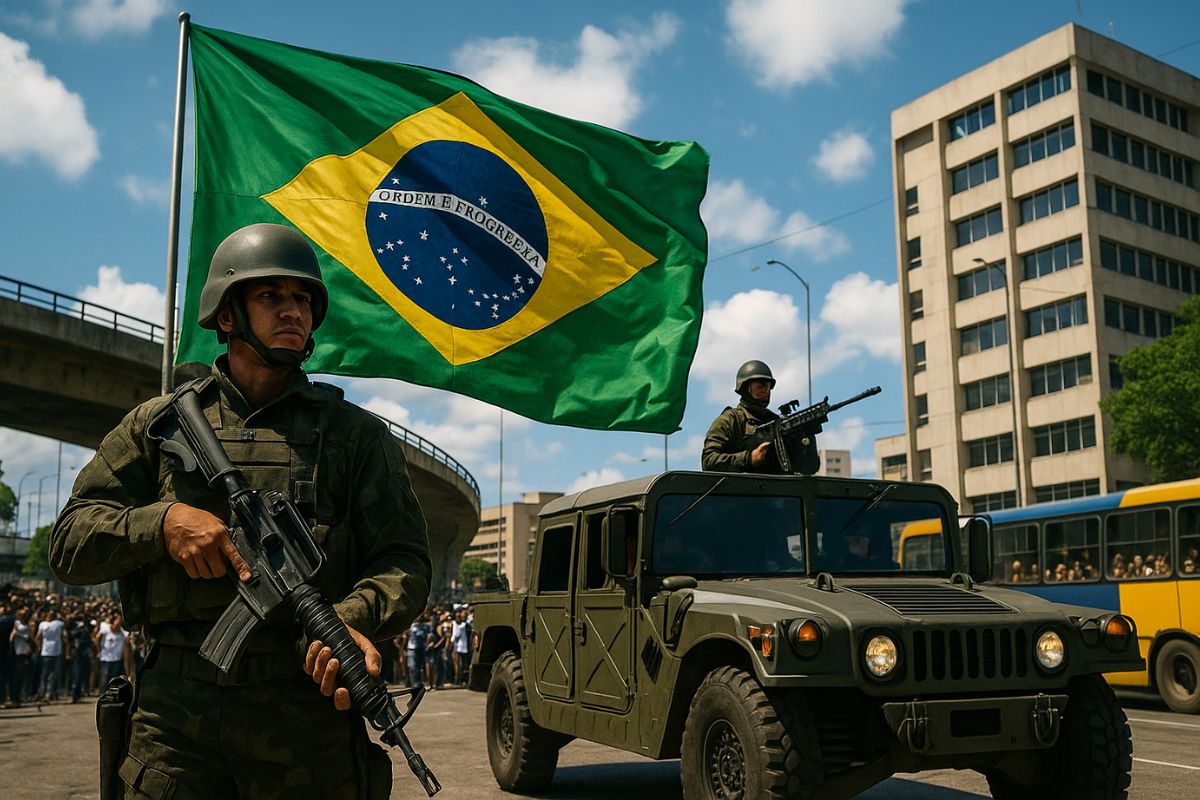
Understand What GLO Is, A Mechanism Provided By Law That Allows The Use Of The Armed Forces In Exceptional Situations, And Why It Has Sparked Tension Between The Government Of Rio And The Palace Of Planalto Again
The term GLO, short for Guarantee Of Law And Order, has once again dominated the political debate after the massive police operation in Rio de Janeiro, considered the deadliest in the state’s history, with at least 130 deaths. The action reignited the dispute between Governor Cláudio Castro (PL) and the federal government, following statements about the lack of military support.
The crisis exposed differences regarding the application of the law that authorizes the deployment of the Armed Forces in public security actions. While Castro claims he is facing crime “alone,” the Planalto argues that there was no formal request for GLO, a mandatory requirement for the military to operate in the streets.
What Is GLO
The Guarantee Of Law And Order is a constitutional instrument, regulated by Complementary Law No. 97, which authorizes the President of the Republic to employ the Army, Navy, and Air Force in situations of grave disturbance of public order.
-
The noise law will no longer be in effect at 10 PM starting in June with a new rule valid during the 2026 World Cup.

-
The Chamber opens a debate on driver’s licenses at 16 years old as part of a reform that includes around 270 proposals to change the Brazilian Traffic Code and may redesign rules for licensing, enforcement, and circulation in the country.

-
The new Civil Code could revolutionize marriages in Brazil with “express divorce” and changes that could exclude spouses from inheritance.
-
Banco do Brasil sues famous influencer for million-dollar debt and intensifies debate on delinquency, risks of seizure, and direct impact on Gkay’s credibility.


It can only be decreed when state police forces are unable to restore normalcy.
During the GLO, the Armed Forces acquire police powers, with temporary and restricted action to specific locations and periods defined in the presidential decree.
This decree also establishes the rules for troop engagement and the duration of the operation, ensuring direct control by the Union over military use.
When GLO Is Utilized
GLO is considered an exceptional measure, used only in critical moments or large-scale events.
In recent years, it has been applied in security operations in ports, airports, and international summits, such as the G20 and the Brics meeting held in Rio de Janeiro.
In all cases, the decree originated from the President of the Republic, usually at the request of governors, and with the technical support of the Ministry of Defense.
Outside of these situations, military use in public security depends on a formal request and official recognition of the incapacity of local forces.
Why The Issue Has Sparked Conflict Again
The current impasse began when Governor Cláudio Castro stated that the federal government denied requests for armored vehicles from the Armed Forces, claiming that this would only be possible with a GLO in effect.
Castro claimed that President Luiz Inácio Lula da Silva “is against GLO” and that, therefore, Rio would have to act with its own resources.
The Ministry of Defense confirmed receiving documents from the fluminense government but emphasized that the transfer of military equipment only occurs by GLO decree, which has not been formally requested.
The Minister of Justice, Ricardo Lewandowski, responded by stating that “the responsibility lies with the governor”, and that there is no record of an official request.
In light of the repercussions, Castro partially backtracked, stating that “there was a misinterpretation” of his statements and that he did not formally request military assistance.
Even so, the episode broadened the debate on the limits of GLO and the autonomy of states during security crises.
What The Law Says About Command Of The Forces
Complementary Law No. 97 states that, during the duration of a GLO, military authority assumes operational control of state police, meaning that local security forces become subject to the command of the Armed Forces.
This transfer of authority is one of the main reasons why the measure is treated with political caution.
Additionally, the law establishes that GLO cannot be used permanently, preserving the exceptional nature of the measure.
In practice, it is a temporary stabilization resource, employed only until public security control is restored by civil forces.
The resurgence of the debate about the nature of GLO occurs amid an escalation of violence in Rio de Janeiro and pressure on the federal government to adopt stricter responses.
While Castro’s allies advocate for the measure as “necessary to restore order,” federal government sectors warn about the risk of militarization of public security.
The issue also raises discussions about federative responsibility, transparency in operations, and constitutional limits.
Public law experts emphasize that GLO is an extreme tool and that its use must be based on technical criteria and rigorous legal standards.
Do you think the use of GLO should be expanded in situations of urban violence or maintained as an exceptional measure?










Seja o primeiro a reagir!