





 English
  Francês
  Alemão
  Italiano
  Japonês
  Norueguês
  Portuguese
  Spanish
  3 min of reading
  0 comments


Scientific Drilling Reveals Ancient Sediments and Evidence of Marine Life Beneath the Ice Sheet of Antarctica
A recent scientific discovery in West Antarctica has drawn the attention of the scientific community after a deep drilling operation penetrated hundreds of meters of ice to reach preserved sediments beneath the Antarctic ice sheet.
In total, an international team of 29 specialists drilled 523 meters of ice, working in continuous shifts to recover geological material buried for millions of years.

The work is part of the international scientific project SWAIS2C, an initiative dedicated to studying the sensitivity of the Antarctic ice sheet to global warming.
-
350-year mystery may have been solved: remains of a soldier who inspired the hero of The Three Musketeers found beneath a church in the Netherlands.

-
NASA photographed a nearly perfect square with 3 km sides on Mars, 13 times larger than the Great Pyramid of Giza, but the official explanation is natural erosion; still, no one has explained why the four sides have almost identical lengths.

-
Starlink breaks the barrier of 10,000 satellites in orbit and takes its expansion to an unprecedented level, with a direct impact on global internet, technological competition, and the race for space.

-
Japan finds an alternative to oil amid rising prices by transforming ocean balance into electricity with a new technology that maintains efficiency even when the sea changes.

According to the researchers involved in the mission, the main goal is to understand how this massive ice body reacted during warmer periods in Earth’s history.
The operation took place in the Crary Ice Rise, an extremely isolated region located hundreds of kilometers from the nearest scientific base in West Antarctica.
With this operation, scientists are expanding the understanding of the climate changes that have occurred over millions of years.
Scientific Investigation Reaches Preserved Sediments Beneath the Ice
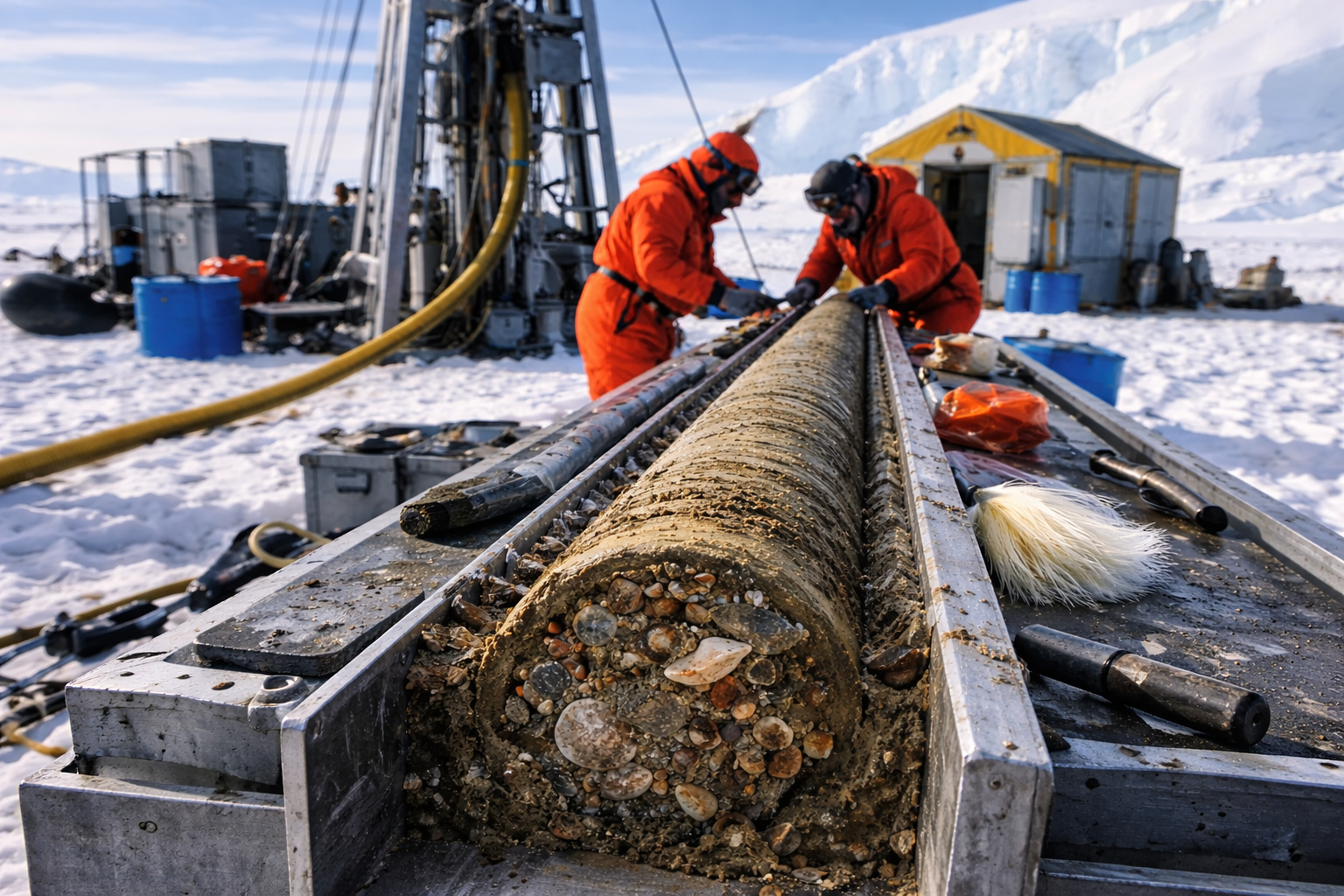
To reach the sediments located beneath the ice sheet, engineers used a sophisticated hot-water drilling system.
With this technology, the team made a deep hole through the thick ice sheet, until reaching the rocky base of the continent.
Then, scientists lowered over a kilometer of drilling pipes to collect the geological material preserved underground.
As a result, the team retrieved a sediment core measuring 228 meters long, considered the longest ever obtained beneath an ice sheet.
This material presents layers of mud, sand, and rock fragments, which record the environmental evolution of the region.
With this evidence, researchers can analyze how the Antarctic ice reacted to climate changes in the past.
Sediments Reveal 23 Million Years of Environmental History
The initial analyses indicate that the retrieved material contains approximately 23 million years of environmental history of Antarctica.
In the sediment layers, scientists identified marine microfossils, indicating periods when the currently frozen region was completely ice-free.
In addition, some layers contain shells and remains of organisms that depend on sunlight to survive.
These traces show that, at certain points in the distant past, the region currently covered by ice was occupied by open sea.
These records indicate that Antarctica had environmental conditions very different from the present throughout the history of the planet.
Among the main findings of the scientific discovery are:
• Recovery of sediments recording about 23 million years of environmental history
• Evidence of marine life in regions currently covered by ice
• Fundamental data to improve climate models for the planet’s future
This information helps scientists understand how the ice sheet may respond to current climate changes.
Laboratories Around the World Will Analyze the Samples
Now, specialized laboratories in different countries will analyze the retrieved sediments.
In these scientific centers, researchers will perform detailed analyses of the geological layers present in the sediment core.
These studies will allow refining the dating of the formation of the different layers.
Thus, scientists will be able to identify the environmental conditions that existed in each period of Antarctica’s history.
With this data, researchers expand scientific understanding of the planet’s climatic evolution over millions of years.
In addition, the results are expected to help improve climate models aimed at predicting the future behavior of Earth’s ice sheets.
In light of this evidence preserved beneath hundreds of meters of ice, an important question arises for the science of global climate: what can these ancient layers still reveal about the future of polar regions in light of global warming?






-

-

-

-

-

-

66 pessoas reagiram a isso.