





 Portuguese
  English
  Spanish
  3 min of reading
  0 comments


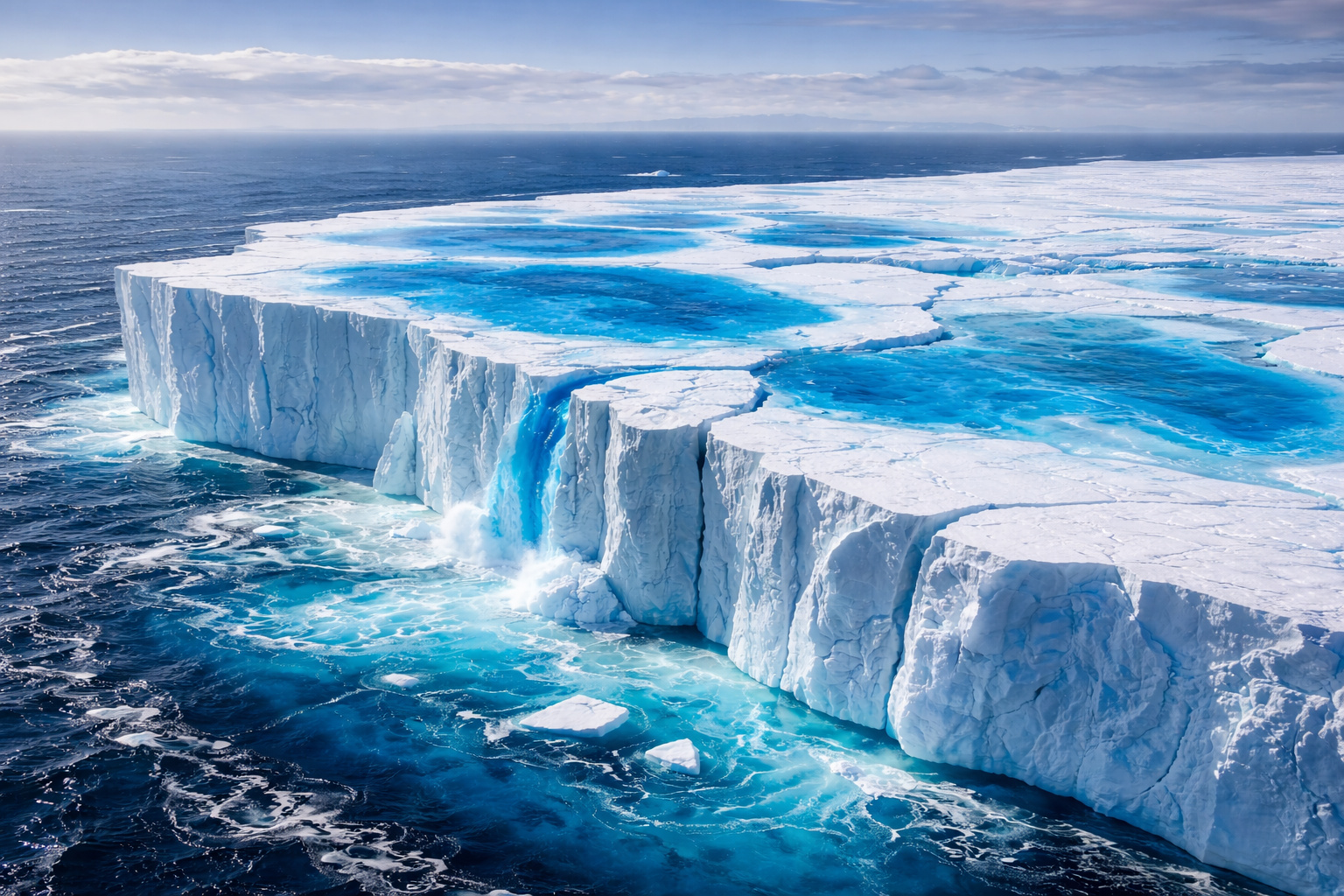
Images Recorded In December 2025 Show Unique Blue Tones In The Largest Tabular Iceberg In Antarctica, Revealing Physical Processes Leading To Its Fragmentation
A rare and visually striking phenomenon caught the attention of the scientific community at the end of 2025. A gigantic iceberg, drifting continuously since the 1980s, underwent an abrupt color change, beginning to display blue spots visible from space. The observation was made by instruments from the NASA Earth Observatory, which have been monitoring polar ice dynamics for decades.
It is the A-23A iceberg, currently located in the South Atlantic, after almost four decades of oceanic displacement. The images captured in December 2025 revealed, therefore, surface changes that, according to researchers, indicate an advanced stage of structural transformation. This visual change, although impressive, is directly linked to well-known physical processes in the study of large ice blocks.
Antarctic Origin And Exceptional Trajectory Of The Iceberg
The A-23A broke away in the 1980s from the Filchner Ice Shelf in Antarctica. Since then, it has followed a long maritime route, maintaining dimensions that place it among the largest tabular icebergs ever recorded. This unusual longevity, in turn, allowed for continuous monitoring over decades, providing a rare opportunity for studying the behavior of glacial masses on a prolonged scale.
-
While Brazil wants to end the 6×1 work shift, the president of Argentina wants 12 hours for his workers, increasing political tension in the country.

-
The village where two rivers run side by side without mixing in Santarém and Alter do Chão reveals some of the most beautiful freshwater beaches on the planet.
-
Mars is accelerating, and scientists have discovered that the planet’s day is getting shorter, revealing surprising signs of internal activity.

-
Artemis 2 is set to launch on April 1 at 7:24 PM to orbit the Moon with four astronauts, but a class X solar flare and coronal mass ejection could interfere with communications and threaten the launch.


Moreover, by remaining intact for so long, the iceberg has become a true natural laboratory. The information accumulated over the years has helped to understand how air temperature, solar radiation, and ocean dynamics interact in the evolution of these icy colossi.
Why The Iceberg Turned Blue
The blue coloration observed recently is not paint, algae, or external sediments. It results from the formation of pools of liquid water on the surface of the ice, a phenomenon that occurs when the air warms up and, simultaneously, solar light shines more intensely.
These pools tend to accumulate in natural depressions on the surface, increasing local weight. As a consequence, internal stress grows, promoting structural fractures and cracks. This mechanism, widely documented, is considered a classic signal that disintegration may be near. Environmental satellites from NASA, such as Terra, can identify these areas with high precision.
Oceanic Impacts Of Disintegration
When an iceberg of this size begins to fragment, large volumes of fresh and extremely cold water are released into the ocean. This influx alters, even if locally, ocean currents. Consequently, there may be an upwelling of nutrient-rich deep waters, a process that stimulates phytoplankton proliferation.
This group of microalgae forms the base of the marine food chain, demonstrating that the breakup of an iceberg affects not only the ice but also the entire surrounding ecosystem. Thus, even an apparently distant phenomenon exerts an indirect influence on ocean life.
Climate Monitoring Gains Importance
Although the formation and disappearance of icebergs are part of natural cycles, scientists warn that the general increase in temperatures tends to accelerate these processes. Therefore, continuous observation from space has become even more relevant in recent years.
The data series collected since the 1980s now allow for refining climate models and projecting with greater precision the future of polar regions. The visible transformation of A-23A, recorded in 2025, becomes part of this set of evidence used to understand how ice responds to global environmental changes.
In Light Of These Clear Signs Of Transformation, Do You Believe That Monitoring Large Icebergs Could Become One Of The Most Important Indicators For Anticipating Changes In The Ocean’s Climate Balance?










Seja o primeiro a reagir!