





 Portuguese
  English
  Spanish
  3 min of reading
  3 comments


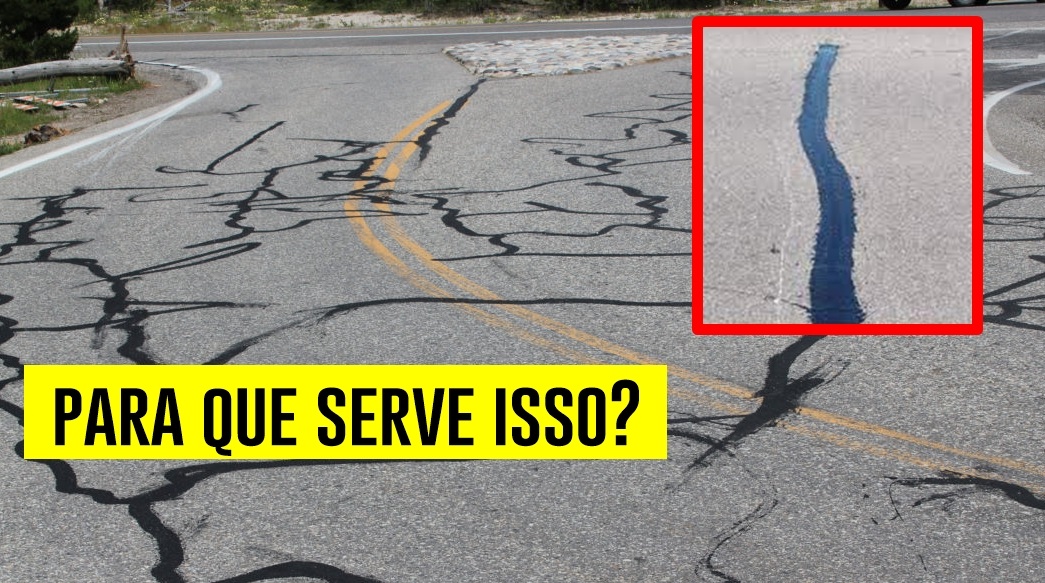


Many Roads in the US Have Strange Marks on the Asphalt. Learn What They Mean and Why They Are So Important.
If you have ever driven on roads in rural or urban areas of the United States, you have certainly noticed the black scribbles that cut across the asphalt in an apparently disordered manner.
Although they may seem like the result of careless work, these marks are, in fact, a fundamental element for road maintenance: crack sealing.
This efficient and affordable technique has been widely used to extend the lifespan of roadways without burdening public budgets.
-
Spain surprises the world by erecting 62 artificial dunes, mixing sand with natural remains of posidonia, and causing the structure to lose only 1.4% of its volume in 1 year.

-
With 16 Bulava missiles, improvements in acoustic stealth, and a design focused on silent patrols, Russia’s nuclear submarine was born to ensure Moscow’s invisible retaliation and has become one of the pillars of its maritime strength.

-
‘Populous’ city in Rio among the worst in Brazil in national ranking and exposes silent development crisis.
-
Couple buys house in the South Zone of São Paulo, opens a hidden door in the garage, and finds a secret wine cellar with dozens of old wines forgotten since the 1970s.

What Are Asphalt Cracks?
Asphalt cracks develop as a result of accumulated stress on the surface layer of the road. This stress can be caused by various factors, such as:
- Heavy Traffic: The continuous impact of heavy vehicles;
- Climate Variations: The expansion and contraction of asphalt due to seasonal temperature changes;
- Design and Construction Issues: Failures such as inadequate drainage and a weak base underneath the roadway.
In the field of roadway engineering, cracks are classified into different types. The most well-known include:
- Fatigue Crack: Makes the road resemble alligator skin, requiring complex repairs.
- Reflective Crack: Caused by movement between the layers of asphalt and concrete.
- Edge Crack: Characterized by wavy fissures near the roadside.
If every damaged road were to be repaved, the costs would be astronomical. That’s where crack sealing comes in.
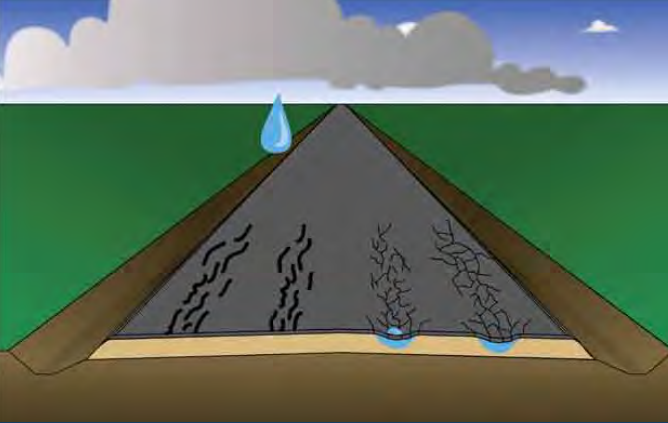
Crack Sealing
Crack sealing is a widely adopted method due to its efficiency and cost-effectiveness. Instead of completely reconstructing a road, the fissures are filled with materials that prevent water infiltration and the expansion of damage.
According to the “Introduction to Crack Sealing”, a 2008 study from Texas A&M University, sealing cracks costs about US$ 2,500 per mile (1.6 km) of road.
In comparison, applying a new layer of asphalt can cost up to US$ 60,000 per mile. A more recent example comes from the city of Littleton, Colorado, which in 2016 estimated sealing costs at US$ 5,500 per lane mile, while resurfacing reached an impressive US$ 320,000 per mile.
With such low costs and significant benefits, crack sealing has become a smart alternative to extend the lifespan of roads and reduce the financial impact on public budgets.
How Does Crack Sealing Work?
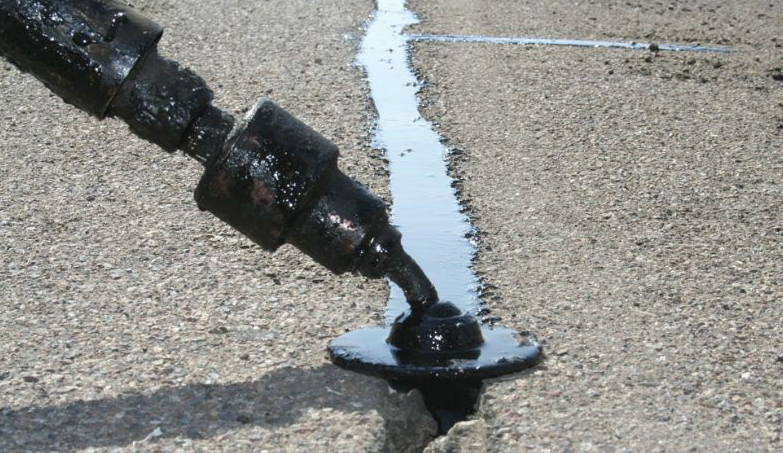
The crack sealing process uses advanced materials to ensure its effectiveness. Although it visually resembles tar, the material currently used is a blend of polymers and high-performance asphalt. This composition is designed to:
- Flexibility: Allows the seal to follow the natural movement of the road, preventing new fissures.
- Durability: Creates a resistant barrier against water infiltration, which can accelerate the degradation of asphalt.
Application is done with a device resembling a vacuum cleaner hose. The material is carefully melted and applied over the cracks, forming a firm and waterproof bond.
Benefits
In addition to reducing costs, crack sealing offers environmental and social benefits. By extending the lifespan of roads, it decreases the need for new materials and large-scale works, reducing environmental impact. Furthermore, it avoids prolonged road closures, minimizing inconveniences for drivers.
Cities like Littleton and states like California have shown that crack sealing is a sustainable solution to tackle the challenge of road maintenance.
With information from HowWorks.








No Brasil já é feito esses trabalhos em rodovias, Estacionamentos, Shoppings . Mais conhecido como selagem de trincas e fissuras em pavimentos rígidos ou flexíveis.
A Construobras de SP executa esses serviços
No Brasil este trabalho é feito pela CONSTRUOBRAS em Condomínios, Estacionamentos, Pátios de Indústrias, Rodovias.
Mas, no Brasil não daria certo…a obra cara, rende mais prop…