





 Portuguese
  English
  Spanish
  6 min of reading
  2 comments


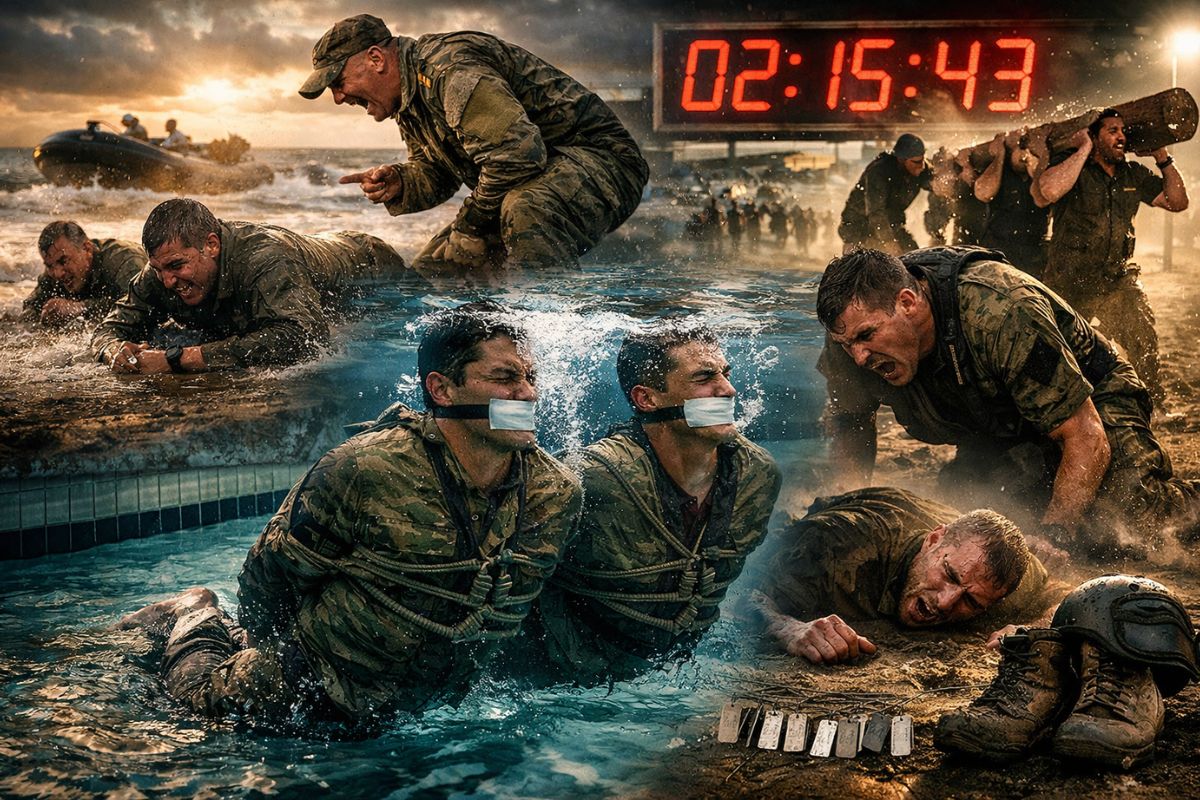


At The Coronado Base In San Diego And Little Creek In Virginia, The Navy SEAL Faces Screening That Begins Before The Course And Lasts For 30 Months, With Timed Swimming, Push-Ups, Boot Camp Running, Restricted Swimming Pools And The Hell Week That Brings Down Candidates Even When They Seem Physically Prepared
The Navy SEAL has become synonymous with the U.S. Navy’s special forces, but the most important word in this story is not elite, but selection. The path is designed to answer a tough question, in controlled environments, before someone has to respond in real chaos.
What stands out is not just the list of tests, but the sum of cold, sleep deprivation, social pressure, and time goals that transform a sports test into a self-control laboratory. Those who enter want to know how much they can endure, where they will break, and why so many give up.
Where The Navy SEAL Came From And Why Selection Happens In These Places

The Navy SEAL was formalized in 1962, with roots in maritime command units organized in a wartime context.
-
Friends have been building a small “town” for 30 years to grow old together, with compact houses, a common area, nature surrounding it, and a collective life project designed for friendship, coexistence, and simplicity.

-
This small town in Germany created its own currency 24 years ago, today it circulates millions per year, is accepted in over 300 stores, and the German government allowed all of this to happen under one condition.

-
Curitiba is shrinking and is expected to lose 97,000 residents by 2050, while inland cities in Paraná such as Sarandi, Araucária, and Toledo are experiencing accelerated growth that is changing the entire state’s map.

-
Tourists were poisoned on Everest in a million-dollar fraud scheme involving helicopters that diverted over $19 million and shocked international authorities.


From then on, the focus shifts to operating in rapidly changing environments, from urban to maritime, from desert to cold terrain, with missions that may involve capture, elimination of high-value targets, and gathering intelligence behind enemy lines.
The structure mentioned revolves around amphibious bases, notably Coronado, in the San Diego area of California, and Little Creek, in Virginia.
This is not just a geographic detail: the sea acts as a selection tool, and the operational culture is born around what water does to the body when fatigue has already taken over.
Entering this funnel is not presented as open to anyone. The described criteria include ages between 18 and 29, American citizenship, or ties to the armed forces under specific conditions.
This initial screening defines who can attempt, but the heart of the process is different: who can sustain repeated performance when the body wants to stop.
The Physical Screening That Looks Like A Gym Test Until It Becomes A Behavior Filter

Before any refined instruction, the logic is straightforward: the Navy SEAL does not “teach the basics” from scratch, he measures the foundation that the candidate already carries.
The described screening requires a 500-meter breaststroke swim with a maximum time of 12 minutes and 30 seconds, and mentions a much more aggressive competitive time, around 9 minutes, for those really looking to compete for a spot.
The rest follows the same logic of cuts and competition. There is a minimum number of push-ups and sit-ups in a 2-minute window to avoid elimination, with higher numbers associated with the competitive level. The pull-up appears as a requirement for repetition without support.
And running comes with boots and pants, over a short distance, but with a time that puts the candidate under stress, with a clear difference between “passing” and “standing out”.
This design is not just about strength. It’s about maintaining standards when the body trembles from lactic acid and the mind negotiates excuses.
In practice, the Navy SEAL looks for signs of discipline, pacing control, and reaction to failure, because selection rewards not a peak, but punishes fluctuations.
Ice Water, Hypothermia, And Panic As Part Of The Method

The most remembered part of the Navy SEAL often involves water, and the reason is simple: water does not forgive improvisation. The material describes exercises in which the candidate is exposed to cold after intense effort, generating thermal shock and performance drops.
The cold does not appear as a scenario, it appears as a tool, as it reduces coordination, alters breathing, and accelerates panic.
There is also a pool test associated with restrictions, with hands and legs restrained, at a depth mentioned as 3 meters, requiring the person to regain control and solve the problem under pressure.
The symbolic value of this stage is not in “swimming restrained,” but in demonstrating that even with physical limitations, the candidate does not mentally collapse.
The sensitive point is the boundary between extreme discomfort and real risk, with a direct mention of hypothermia.
This explains why so many dropouts do not seem like “weakness,” but rather a rational decision: the Navy SEAL exposes the candidate to a type of stress that is not resolved with motivation, but with the ability to maintain clarity when physiology becomes the enemy.
The Hell Week And The Math Of Dropout That Destroys Confidence
The so-called hell week, described as five days, is the showcase of the Navy SEAL process because it concentrates sleep deprivation and workload in a short period.
The presented script mentions a routine of 20 hours a day, with minimal rest windows, and a sequence of tasks that mixes running, push-ups, sit-ups, swimming, and rowing.
The most shocking number is the total distance attributed to running over those days, cited as 320 kilometers.
While the exact number varies from class to class, the message is consistent: the goal is to make the candidate operate broken and observe if he remains functional, obedient to procedures, and capable of cooperating when the ego is already gone.
It is here that time goals gain the tone of humiliation, not as gratuitous sadism, but as a tool of collective pressure.
The Navy SEAL works with a stopwatch because the stopwatch reduces debate. Either you deliver to the standard, or you don’t deliver. This creates a dropout rate that seems designed to erase dreams while also explaining why those who remain tend to carry the ritual as identity.
After Hell, The Sequence Of Modules That Keeps The Candidate Evaluated

Getting through the most famous phase does not end the selection. The material describes a journey of about 30 months to complete the path, with initial weeks of indoctrination, basic conditioning blocks, diving-related training, and later, land conflicts.
The idea is simple: there is no “graduate early,” there is sustained performance over time.
After the critical stage, there is a mentioned parachuting period lasting three weeks, and then the diving track remains relevant, which makes sense for a force with naval origins.
In parallel, the content mentions land competencies, such as reconnaissance, hand-to-hand combat, response to threats, and handling explosives, always with the candidate under evaluation.
The formal closure comes with qualification training, referred to as SQT, lasting 15 weeks, and the delivery of the badge with the trident symbol, marking that the candidate becomes, in fact, a Navy SEAL.
Even then, the narrative does not suggest relief: the entire process exists to ensure that behavior under stress is not episodic, but repeatable.
What This Ritual Produces And The Psychological Price That Almost Never Makes The Headlines
The public discourse often romanticizes the Navy SEAL as a human machine, but what appears between the lines is a selection model that privileges functional resilience.
It is not enough to be strong, it is necessary to remain predictable. The selection tries to avoid candidates who “shine” at first and crumble when routine turns into repetition, cold, and deprivation.
The price is evident: isolation, continuous pressure, weariness, and a different relationship with pain and sleep. The material also suggests that many drop out not due to lack of technique, but due to emotional collapse, injury, or understanding that the cost is not worth it.
And that is part of the design: dropout is not an accident, it is a metric.
When this ritual becomes an obsession on social media, the most honest question is not “who can endure,” but rather “why does anyone want to endure.”
Before 2026, the image of the Navy SEAL continues to serve as a magnet for those seeking proof of worth, but the reality described is less glamorous: it is a system built to reduce the human to the essential.
The Navy SEAL is not just a uniform, it is a long process that mixes physical tests, cold, sleep deprivation, and time pressure to measure behavior, not discourse.
The most brutal part is not a single event, but rather the repetition of stress until only what the person can do when the body asks to give up remains.
Now, a direct curiosity for those who read this far: at what point do you think most people really give up, in the cold water, in the pool with restrictions, or during the hell week without rest? And, thinking about your life, what was the situation in which you discovered a limit you didn’t even know existed?










Pois é, aqui no Brasil qdo as FA ou as PM montam em treinamento que não é nem um décimo desses, falam que é tortura!
Decididamente esses caras são fodas ,mas e sempre tem um mas soubeb eu atraves do Coronel Montenegro um **** das operações especiais que apesar de serem muito bons, não aguentam o estágio do Nosso CIGs,quem procurar esses fatos achará na net, ondia que os Badass dos EUA arregaram para os Samangos do nosso Guerra na Selva