





 Portuguese
  English
  Spanish
  4 min of reading
  0 comments


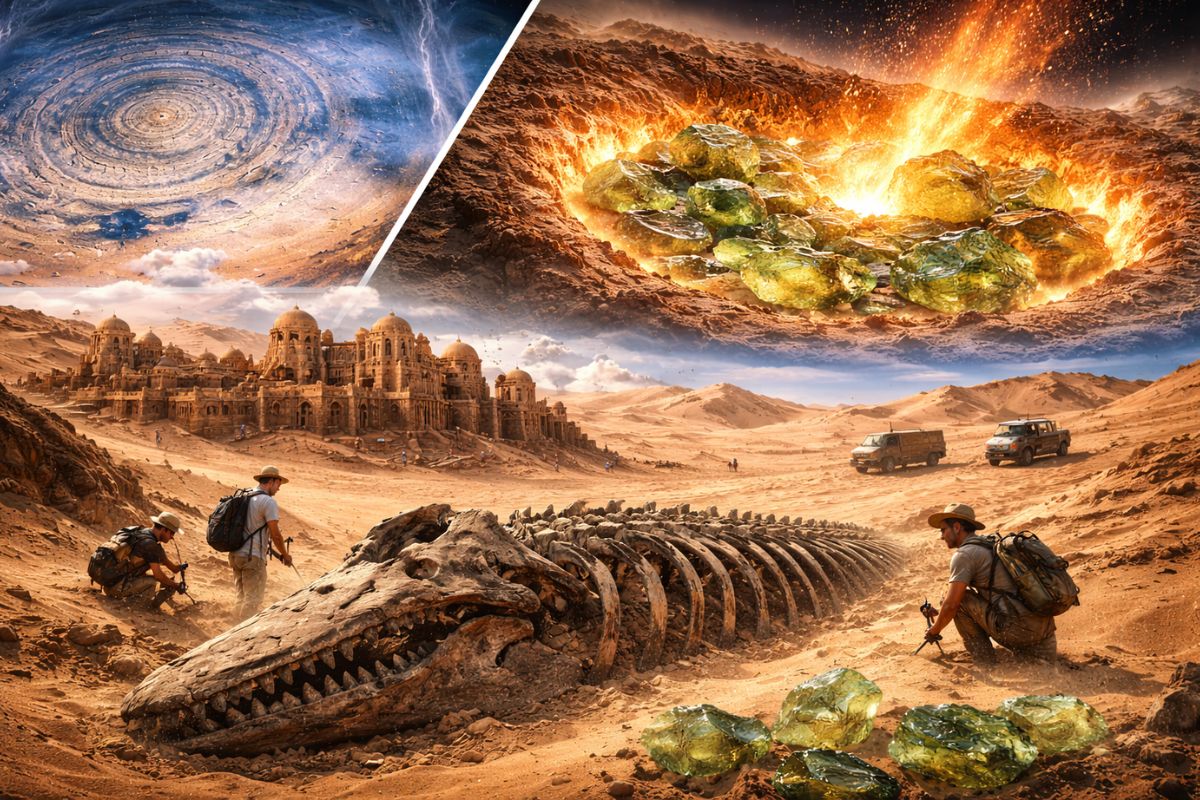
In The Sahara, Marine Fossils, Rock Art, Evidence of Ancient Settlements and Geological Formations Viewed from Orbit Show That The Desert Preserves a Much More Varied History Than The Current Landscape Would Suggest.
The Sahara is often remembered only for its arid areas and vast stretches of sand, but this depiction is limited. At different points in the region, researchers have identified evidence of ancient marine environments, significant environmental changes, and organized human occupations, which transforms the desert into a long-term geological and historical record.
Viewed collectively, this documentation helps to understand the Sahara in a broader and more accurate manner. Instead of relying on fanciful theories, what stands out are the data gathered by institutions such as NASA, UNESCO, and the European Research Council.
The “Eye” of The Sahara Is a Real Geological Formation

One of the most well-known examples is the Richat Structure in Mauritania, also called the “Eye of The Sahara.”
-
After decades of failed attempts, Brazil is once again looking to space with an orbital rocket measuring 12 meters, weighing 12 tons, costing R$ 189 million, and scheduled for launch in 2026, in a new race to finally achieve autonomous access to orbit.

-
The Earth will plunge into a few minutes of darkness in broad daylight in August 2026, when a total solar eclipse transforms the sky into one of the most impressive astronomical phenomena in recent years.

-
How the terraforming of Mars can transform the planet: artificial aerosols can increase the temperature by up to 35°C in 15 years, creating conditions for liquid water.

-
Scientists drilled nearly 8,000 meters into the ocean floor above the fault that caused the 2011 tsunami in Japan and discovered that a layer of clay 130 million years old was responsible for making the wave much worse than any model had predicted.

The formation is about 40 to 45 kilometers in diameter and appears as a large set of concentric rings, which explains why it has become a visual reference for astronauts and Earth observers, according to NASA.
Despite popular speculation, the Richat Structure is not a lost city. According to NASA, it is a geological feature associated with an eroded dome over time, exposing rock layers that created its circular appearance.
The Sahara Also Preserves Whale Fossils

In Egypt, Wadi Al Hitan, known as the Valley of Whales, contains fossils of archaeocetes, an extinct group of primitive whales.
UNESCO describes the site as the most important site in the world for demonstrating this stage of evolution, when the ancestors of whales transitioned from a terrestrial life to a fully marine life.
These fossils help explain why the Sahara cannot be seen merely as a static space. The presence of marine animal remains in the midst of the desert confirms that parts of this territory were connected to environments very different from the current ones in remote geological times, according to UNESCO.
The Rocks of The Sahara Record Environmental Changes and Human Presence


Another important point is in Tassili n’Ajjer, Algeria. The site features more than 15,000 drawings and rock engravings that, according to UNESCO, record climatic changes, animal migrations, and the evolution of human life on the edge of the Sahara over millennia.
This collection shows that the desert also serves as a repository of human memory. The images preserved in the rocks indicate that the landscape and ways of life in the region have changed significantly over time, reinforcing the historical complexity of the Sahara without reducing it to a single explanation.
Ancient Cities Were Able to Organize Themselves Inside The Desert
The Sahara also holds traces of settlements linked to the Garamantes in southern Libya. Satellite imagery and archaeological work have helped identify the remains of urban structures, walls, and occupation systems that reveal a social organization more sophisticated than was long believed for the interior of the desert, according to studies published by the European Research Council.
According to the European Research Council, these discoveries have helped correct the notion that the region was merely peripheral or empty. The remnants show stable occupation, adaptation to the environment, and the use of hydraulic and agricultural solutions, even in a scenario of significant natural limitations.
The Sahara Is More Than A Landscape of Sand
When these evidences are viewed together, the Sahara emerges as a region of multiple layers.
There are geological forms visible from space, fossils essential to the evolutionary history of whales, rock art documenting environmental changes, and signs of ancient societies that managed to establish themselves in the desert.
The result is a more solid and less sensationalist portrait. The Sahara does not need to be treated as a legend to impress. Scientific and heritage sources already show that the region preserves important remnants of the natural and human history of North Africa.
In your opinion, what stands out the most in the Sahara: the fossils, the ancient cities, or the formation visible from space?




Seja o primeiro a reagir!