





 Portuguese
  English
  Spanish
  5 min of reading
  0 comments


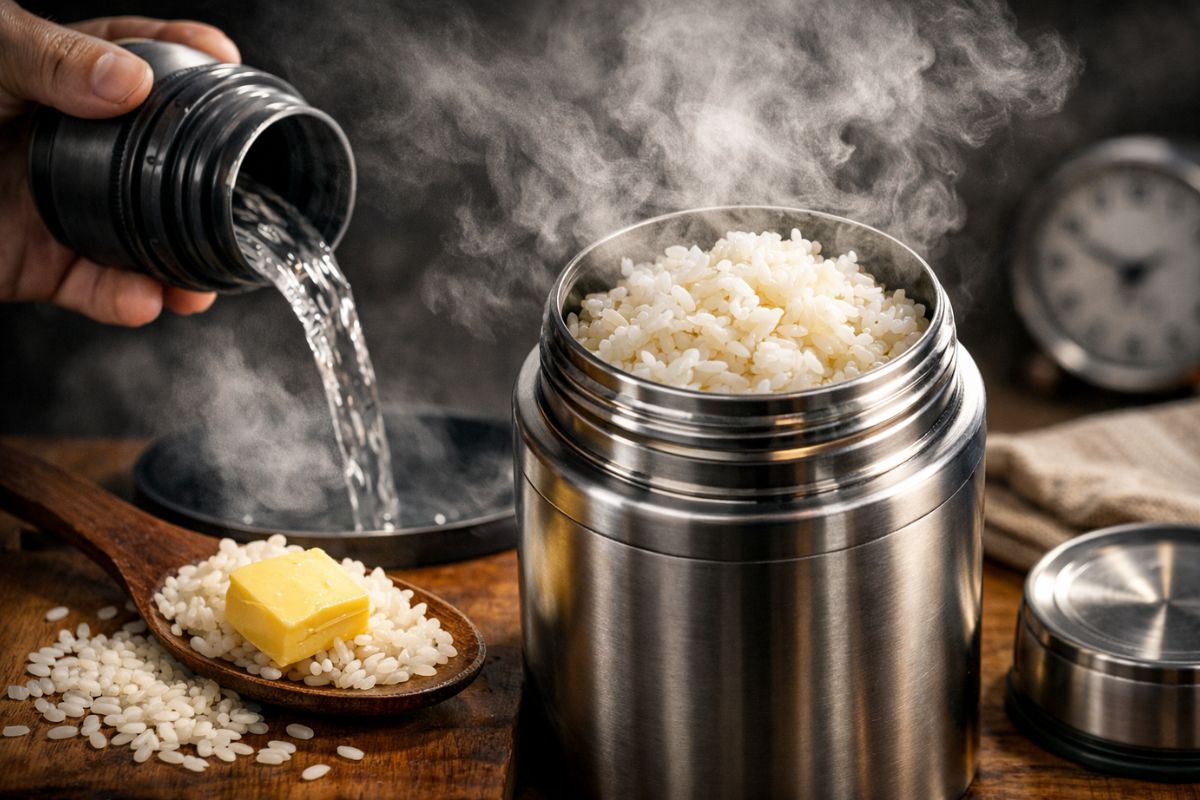
With a Quick Preheating, One Measure of Washed Rice, Two Parts of Boiling Water, and a Little Bit of Butter, the Thermos Becomes an Improvised Pot: the Grain Cooks Slowly, Retains Heat, and Delivers, Hours Later, a Light, Fluffy, and Steamy Lunch Even When You Are in the Car, at Work, or Out.
You don’t need a stove to arrive in the middle of the day with hot food: a well-used thermos can become a “silent cooker”, one of those that keep working while you go about your life. The logic is simple and almost absurd: seal rice with boiling water, give it time, and let the heat do the rest.
The result, when it works, is the kind of practical surprise that changes the routine of those who live outside their homes: open the lid and find soft, hot rice smelling of butter. And the best part is that it doesn’t depend on a miraculous trick, but rather on order, measures, and patience.
Why the Thermos Can Cook Rice Without Fire
The central point is that the thermos does not “create” heat; it holds the heat you put inside. When you put in boiling water and preheat the interior beforehand, the metal and internal walls stop “stealing” temperature from the preparation right at the beginning, which is when the rice needs it the most.
-
Italian researchers have detected what appears to be a second Sphinx buried under the sands of Egypt, and satellite scans reveal a gigantic underground megastructure hidden beneath the Giza Plateau for over 3,000 years.

-
There are 4,223 drums and 1,343 metal boxes concreted with 50-centimeter walls that store the radioactive waste from Cesium-137 in the worst radiological accident in Brazil, just 23 kilometers from Goiânia, with environmental monitoring every three months.

-
Giant Roman treasure found at the bottom of Lake Neuchâtel in Switzerland reveals an advanced trade system, circulation of goods, and armed escort in the Roman Empire about two thousand years ago.

-
He buried 1,200 old tires in the walls to build his own self-sufficient house in the mountains with glass bottles, rainwater, and an integrated greenhouse.

From there, cooking happens slowly, as if it were a covered pot that no one stirs: the grain absorbs water gradually, softens, releases starch, and gains volume. Time is your stove, and the seal is what keeps this process going for hours.
The Step That Separates Perfect Rice from “Meh” Rice: Preheat Everything

Before thinking about measures, the secret is to prepare the thermal environment. The idea is to put boiling water into the thermos and let it rest for a few minutes. This raises the internal temperature and prevents the cooking water from cooling down too quickly when it touches the metal.
The same reasoning applies to the measuring cup (or container you use to measure the water). Preheating the measure with a bit of hot water helps keep the water really hot when it goes into the thermos, without losing temperature in this “back and forth.”
Measures and Proportions: How Much Rice, How Much Water, and Where Does It Fit
The proportion used is straightforward: two parts of water to one part of rice. In the practical example, it was half a cup of rice for one cup of water. And this was done in a container of 473 milliliters, a size that helps visualize the volume without exaggeration.
If you want to understand the “how much” realistically: the thermos needs to have space for the rice hydrating and for the water to circulate among the grains. A little air up top is normal, so you should not fill it to the brim as if it were just liquid.
Wash the Rice the Right Way (and the Detail of Boiling Water for Rinse)
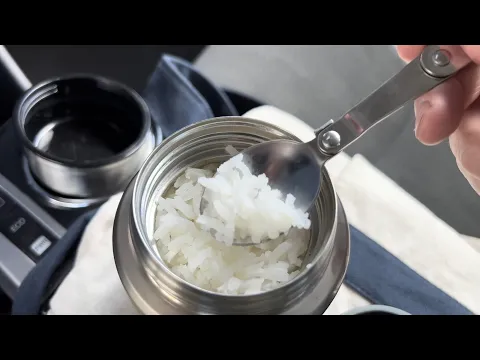

Washing the rice is not just fuss: it’s part of the method because it removes excess loose starch and helps make the result lighter.
The process includes washing and then doing a final rinse with boiling water, precisely to raise the temperature of the rice before it enters the thermos.
Here, a practical care comes in: use a small strainer (or something that doesn’t let the grains escape), because you’ll need to pour out the water without losing rice.
And after the final rinse, there’s a detail that not many remember: take any grains stuck in the grooves of the container’s mouth to be able to seal it well.
Butter, Sealing, and the “Incubation” of 4 to 5 Hours
With the rice already clean and hot, the butter goes in for flavor, and then the boiling water preferably goes in measured from the preheated cup.
You pour it into the pot with the rice, seal it, and let it sit. Do not keep opening, stirring, or “checking”, as each opening drops the accumulated heat.
The recommended time is between four and five hours. The word “incubate” fits because the preparation remains isolated, working on its own until lunch time.
And if the idea is to keep the heat for even longer, there’s a simple tip: wrap the thermos in a towel to keep even more temperature during transport.
Where This Works Best and Who Benefits Most in Daily Life
It works especially well when you leave early and only eat later: in the car, at work, on long trips, in situations with no kitchen available.
It’s a type of solution that resonates with those who need autonomy: people who live on the street for work, students, drivers, travelers, and anyone who wants an alternative without a stove along the way.
And there’s a quiet gain: preparation happens while you do other things, without occupying counter space and without “watching the pot.” It’s logistics, not magic; you organize the beginning, and the rest becomes routine.
How to Know If It Worked: Texture, Heat, and the Test After Hours
After five hours, the simplest perception is by touch: you can feel a slight warmth on the lid, and the expectation is to find fluffy, light, and soft rice upon opening.
In the reported example, there was also a temperature check with a thermometer, marking 156 degrees, noting that this already counts as “hot lunch.”
The described result was positive in two important points: light and fluffy texture and a “slightly buttery” flavor. And that closes the cycle: the thermos fulfilled its role of holding heat long enough to cook and, in the end, deliver truly hot food.
In the end, the “absurd” part is not the rice; it’s realizing that a thermos, boiling water, butter, and patience can solve an entire lunch without a stove, as long as you respect preheating, washing, proportion, and time. It’s the kind of simple trick that only seems impossible until you open the lid.
And you: would you dare to test this method in your routine?
If you already make lunch outside the house, comment where you would eat this rice (car, work, trip), and what would be your “final touch”: more butter, seasoning, or would you keep it basic?









-

-

2 pessoas reagiram a isso.