





 Português
  Inglês
  Espanhol
  4 min de leitura
  0 comentários


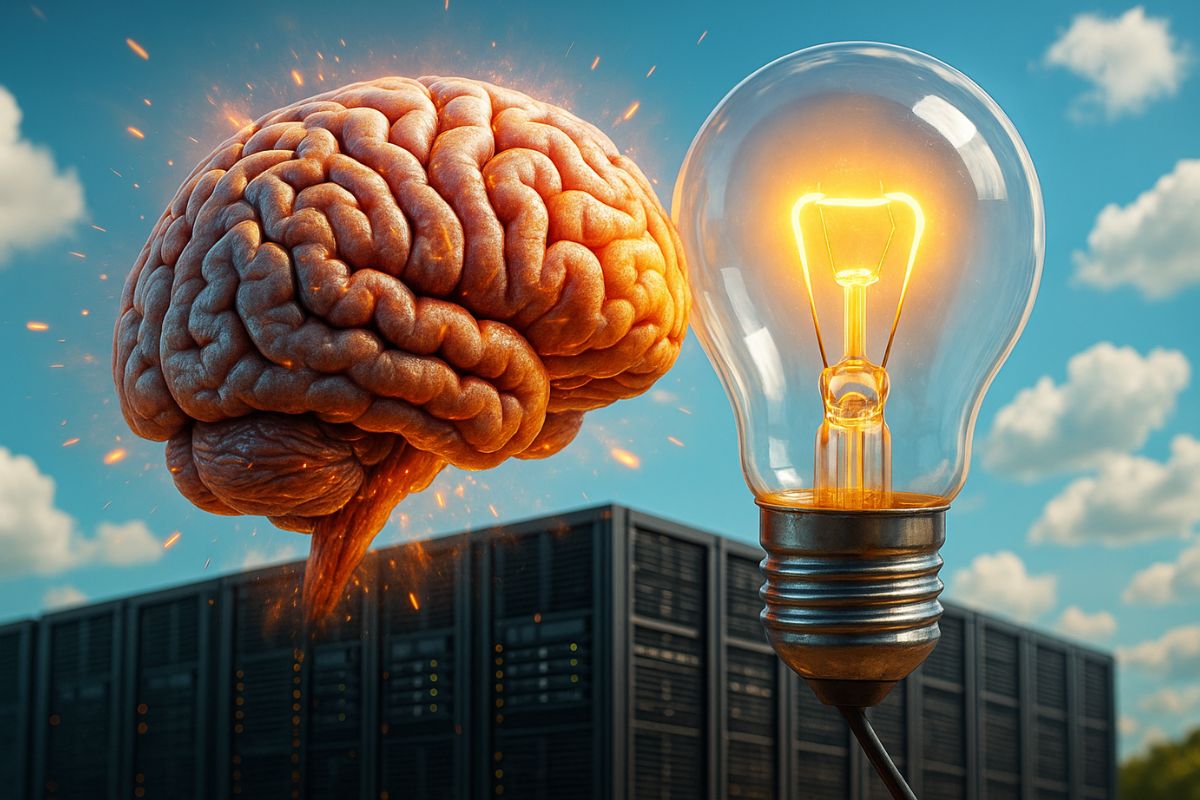
With 100 Billion Neurons and Energy Consumption Lower Than That of a Bulb, the Human Brain is the Most Complex Object in the Universe and Remains the Greatest Challenge for Science and Technology.
The human brain is, in fact, the most complex object in the known universe. It operates on only 20 watts of power, less than a standard light bulb, and performs tasks that no supercomputer can match with such efficiency. This balance between low consumption and high performance has intrigued neuroscientists, engineers, and artificial intelligence experts for decades.
Even with billions of dollars invested in research, there is still no machine capable of replicating human flexibility, creativity, and consciousness. The brain not only processes information; it learns, creates, feels, and adapts—something that technology is still trying to understand and reproduce.
The Complexity That Challenges Science
An adult brain has about 100 billion neurons, each capable of forming thousands of connections, called synapses, with other cells.
-
Drought may be creating stronger superbugs in the soil and helping antibiotic resistance reach hospitals, warns a study highlighting a problem that could grow alongside extreme weather.

-
The biggest scam in history: Napoleon’s France deceived the United States by selling them a territory that was Spanish.

-
Why is the Danakil Desert so dangerous? It has unstable terrain and how extreme temperatures and toxic gases turn the region into one of the most hostile environments on Earth.

-
With a height of 221 meters and a capacity for trillions of liters, Hoover Dam still holds a trick that makes water defy logic.


This immense network creates a dynamic web of communication that sends electrical and chemical signals in milliseconds.
Additionally, the brain possesses neural plasticity, meaning the ability to reorganize and create new connections throughout life.
This plasticity allows for learning new skills, recovering functions after injuries, and adapting to environmental changes, something that supercomputers still cannot imitate.
A Miracle of Energy Efficiency
Despite representing only 2% of body mass, the brain consumes 20% of all the energy in the human body. This is equivalent to about 20 watts—enough to power a household light bulb.
In terms of performance, scientists estimate that it is capable of achieving the equivalent of one exaflop, or one billion billion operations per second.
To achieve something similar, a modern supercomputer would need millions of watts and an industrial cooling system. No current machine combines such processing power with such energy efficiency.
Brain and Supercomputers: An Unfair Duel
Although artificial intelligence has evolved remarkably, the human brain still wins in versatility, adaptation, and consciousness.
While supercomputers rely on fixed algorithms and detailed instructions, the brain learns from experience, creates mental shortcuts, and reinterprets information according to context.
Another decisive factor is emotion: human decisions involve empathy, intuition, and values, dimensions that still escape the binary logic of machines.
Even when the computer wins in calculation speed, the brain wins in meaning—it understands the “why” of things, not just the “how.”
The Brain as Inspiration for the Future of Technology
The efficiency of the human brain has inspired the creation of new research areas, such as neuromorphic computing, which aims to replicate the structure and function of neurons in electronic chips.
Intel, for example, has developed the supercomputer Loihi, designed to imitate parallel processing and low energy consumption of the brain.
Another promising front is biocomputation, which uses brain organoids grown in the lab to simulate real neural networks.
These tiny “artificial brains” can process information with an efficiency millions of times greater than traditional circuits.
These initiatives reinforce a realization: the brain is not just a biological model but a natural engineering manual that humanity is still trying to decipher.
Mysteries That Still Challenge Science
Even after centuries of study, great enigmas remain unanswered. The consciousness, for instance—the ability to perceive, reflect, and feel—is still an absolute mystery.
No one knows for sure how electrical impulses turn into subjective experiences.
It is also not fully understood how memories are stored and retrieved, nor how the human genome encodes trillions of synapses.
And, unlike a computer, the brain does not separate hardware and software: structure and function are one, uniquely integrated and impossible to replicate so far.
The most complex object in the universe remains the most mysterious.
Even with all the advancements in science, the human brain still challenges the logic of modern engineering and computing, showing that true intelligence may depend on something beyond calculation.
And you, do you think machines will ever be able to match human efficiency and consciousness? Or do you believe the brain will remain unparalleled? Leave your opinion in the comments—we want to hear how you see this dispute between biology and technology.









-

-

-

-

-

-

50 pessoas reagiram a isso.