





 Portuguese
  English
  Spanish
 6 min of reading
  0 comments


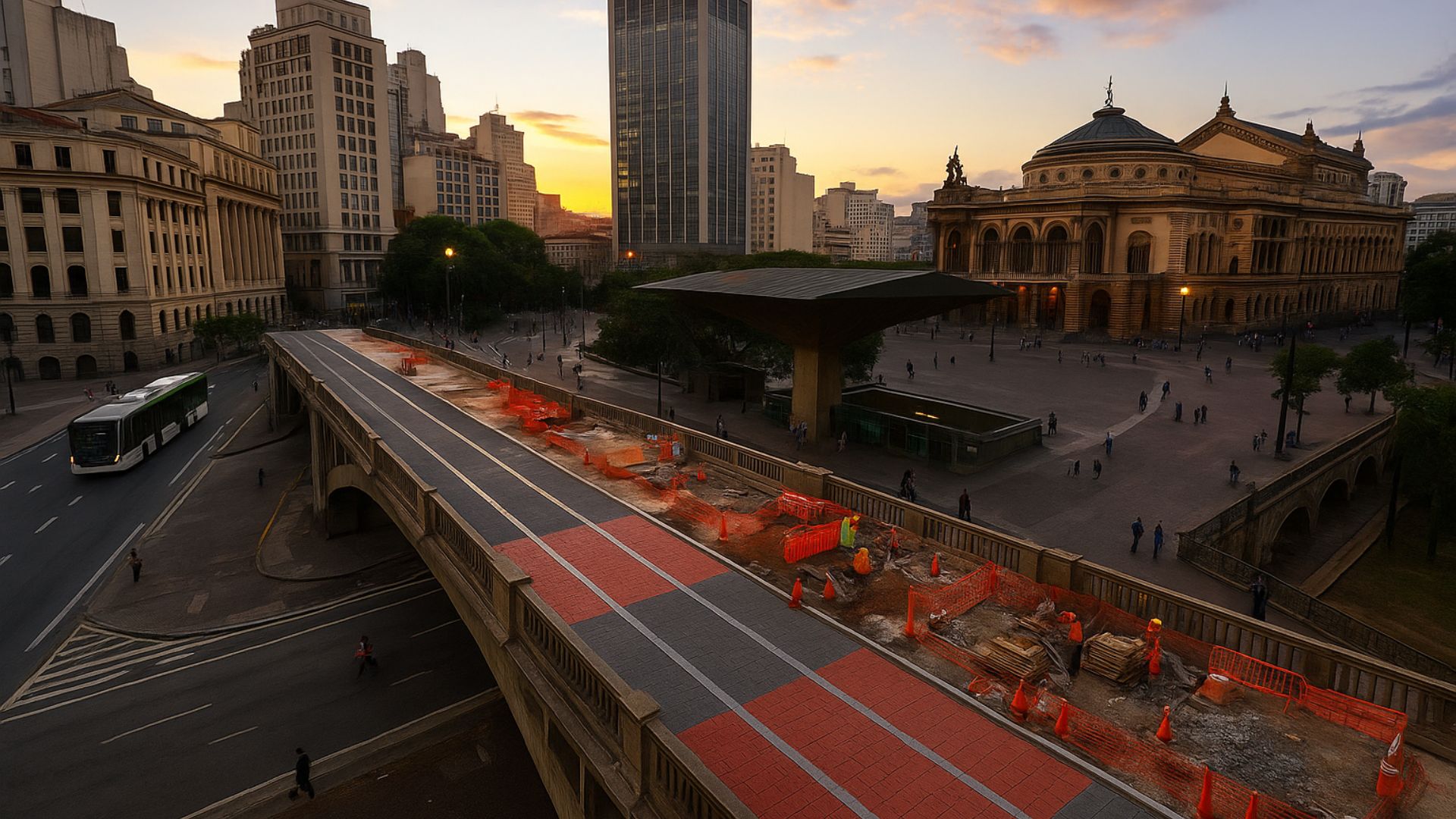
A Large-Scale Project Must Remodel Emblematic Areas of the Center of São Paulo, Including the Viaduto do Chá and the Praça do Patriarca, with Structural, Aesthetic and Heritage Changes Expected in the Coming Months.
An intervention estimated at R$ 70 million is expected to significantly alter the Viaduto do Chá, the Praça do Patriarca, and the surroundings of the Theatro Municipal in the coming years.
The administration of Mayor Ricardo Nunes (MDB) plans to launch the bidding notice for the works this year, which will have a projected timeline of 18 months after the hiring of the winning company and have already accumulated criticism, especially regarding the changes to the awning designed by architect Paulo Mendes da Rocha in the square.
Reforms on the Viaduto do Chá and the Area Around the Theatro Municipal
The project is part of a package of interventions in the historical center of São Paulo and includes the Viaduto do Chá, Praça Ramos de Azevedo, Praça do Patriarca, Galeria Prestes Maia, and areas close to the Theatro Municipal and Shopping Light.
-
The government puts R$ 8.6 billion on the table to change the highway (BR) with 50 overpasses, 28 bridges, 4 tunnels, and 40 km of bike lanes in 180 km of historic duplication.
-
BRL 20.1 Million Bridge Project Kicks Off: 200-Meter Construction to Improve Access in Three Cities in Minas Gerais

-
‘Endless Road’ In Brazil Is One of The Largest In The World: 145 Km Stretch On An Important Highway (BR) Crosses The West Of Bahia And Had 135.9 Km Revitalized With R$ 35.3 Million
-
Engineer From ITA Who Worked at Embraer Leads Free Flow Expansion With National Artificial Intelligence and Technology for Toll Without Barriers in Brazil

The originally estimated value of R$ 58 million was adjusted to R$ 70 million after new technical assessments and detailing of the project’s scope.
Leading the proposal, the municipal secretary of Urban Infrastructure and Works, Marcos Monteiro, states that the starting point was the problems identified in the structure of the viaduct.
According to him, an inspection mainly pointed out leaks that, if not corrected, could compromise the durability of the structure over time.

The requalification of the sidewalks, drainage, and pedestrian circulation areas is part of the same package.
History and Structure of the Viaduto do Chá
The Viaduto do Chá, the first structure of its kind in the capital, inaugurated in 1892, was designed to connect the then-historical center to the region that was expanding westward.
The first version, made of metal and conceived by Frenchman Jules Martin, even charged tolls, earning it the nickname “Viaduto dos Três Vinténs.”
The crossing only became free in 1897.
The current configuration, in concrete and with art deco aesthetics, dates back to 1939 and bears the signature of architect Elisiário Bahiana.
Today, almost a century after the reconstruction, the viaduct shows signs of leakage and requires deeper maintenance.
The city government plans to replace the traditional Portuguese stone pavement of the structure’s sidewalks with granite pavement in red and gray.
The technical justification is to reduce the weight on the viaduct and facilitate maintenance since the installation of Portuguese stones requires specialized labor, which is considered scarce by the municipality.
The intervention also aims to contain the leaks affecting the Galeria Prestes Maia, an underground passage connecting the Praça do Patriarca to the Vale do Anhangabaú that exits under the viaduct.
The company responsible for the gallery, which also manages the Vale, has reported recurring water problems in the space.
New Bus Stop, Tourist Cable Car and Relocation of Kiosks

In addition to the pavement change, the project foresees a bus stop on the Viaduto do Chá and the installation of a deactivated cable car in front of Shopping Light.
The old vehicle will be adapted to function as a tourist information point, in an area close to where there is currently a newspaper stand.
To accommodate the circulation of app-based vehicles and other services, a setback will be created at the entrance of Shopping Light, designated for passenger pick-up and drop-off.
According to the city hall, the solution meets the request of the shopping center itself.
The newsstands located next to the shopping center and in front of the Theatro Municipal will be relocated to the street located at the back of the theater.
A base for the Metropolitan Civil Guard is expected to occupy the space currently used by one of the stands.
Newspaper sellers have criticized the change, alleging possible loss of visibility and foot traffic.
In the same area, the pavement of Praça Ramos de Azevedo will also be replaced as part of the package of works.
Praça do Patriarca and Dispute Over the Historical Awning

At the other end of the viaduct, the Praça do Patriarca will be the target of a series of interventions.
The location houses the Santo Antônio Church, one of the oldest temples in the city and listed as a historical heritage site.
The project includes the reform of the floor, preserving the current mosaic designs both in the central area and along the facades.
The most sensitive point of the debate is under the awning designed by Paulo Mendes da Rocha, implemented during urbanization works in the early 2000s.
Since its installation, the metallic covering has divided opinions.
Critics claim that it reduces the view of the so-called “new center,” while defenders consider it integrated into the urban landscape.
In previous statements, Mayor Ricardo Nunes mentioned the possibility of relocating the awning.
The architect’s family has positioned itself against this.


The son of Paulo Mendes and also an architect, Pedro Mendes da Rocha defended the permanence of the structure and rejected changes that would alter the original project.
Debate on Closing the Galeria Prestes Maia
The upper entrance of the Galeria Prestes Maia, located under the awning at Praça do Patriarca, is another point of discussion.
The initial proposal foresaw a glass enclosure around the access.
Family members and specialists criticized the visual interference.
The Condephaat analyzed the project and rejected the glass enclosure.
The agency suggested a retractable horizontal enclosure on the existing railing, considered less invasive.
Pedro Mendes da Rocha believes that this is the solution that least interferes with his father’s work, although it requires careful technical detailing.

The city hall states it is analyzing the recommendation and should present an adjusted version of the project before the bidding.
Urban Function of the Galeria Prestes Maia
The Galeria Prestes Maia, currently primarily used as a pedestrian passage, has had other functions in the past.
In previous periods, it hosted cultural activities and even had a branch of Masp.
Currently, it lacks a permanent schedule and faces problems of leakage, insecurity, and low occupancy.
The municipal management hopes that addressing the structural problems will contribute in the future to cultural or commercial uses, although there is no detailed plan in this regard.
Bidding, Deadlines and Impact on Daily Life in the Center
The schedule of the City of São Paulo plans to publish the bidding notice this year and to announce the winning companies by May 2026.
From the signing of the contract, the estimated timeline is 18 months of work.
During this period, there will be impacts on pedestrian circulation, buses, app-based vehicles, and local commerce, with adjustments yet to be detailed.






Seja o primeiro a reagir!