





 Portuguese
  English
  Spanish
  5 min of reading
  0 comments


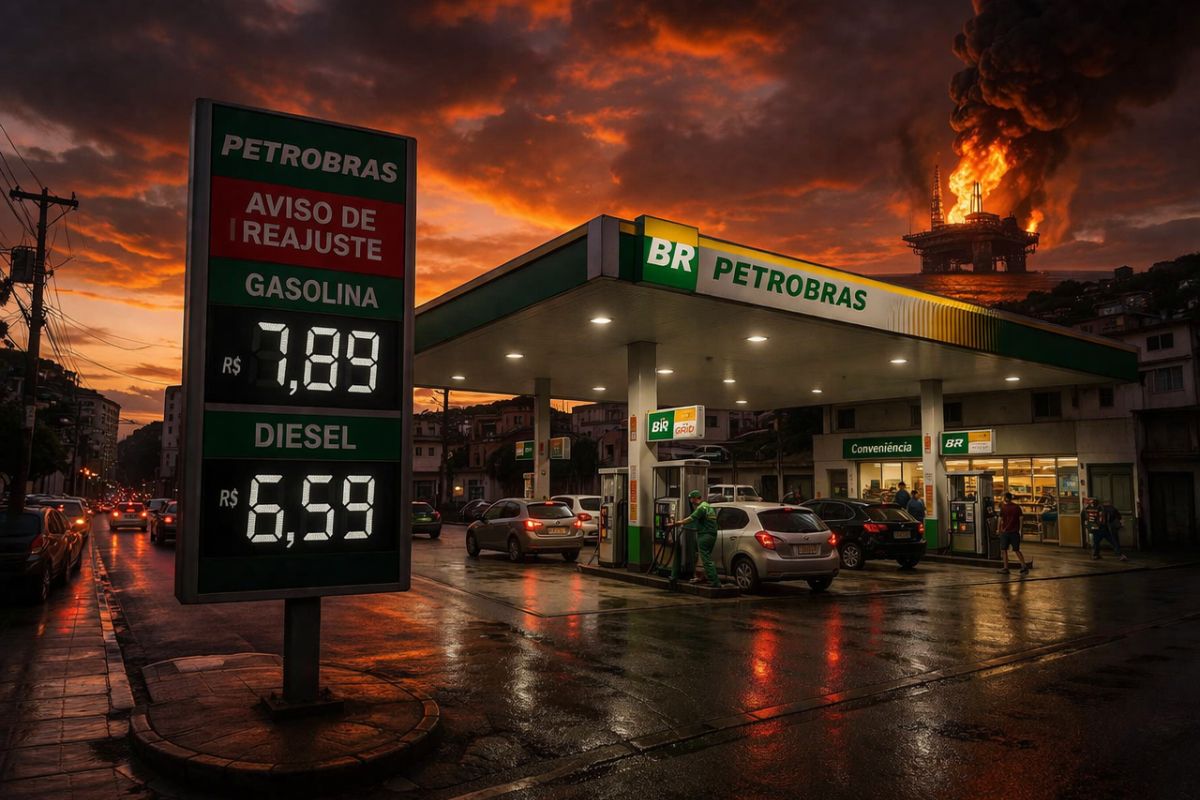
The price of Brent oil reached US$ 115.93 per barrel and the American WTI surpassed US$ 103 this Monday, driven by the war between the United States, Israel, and Iran in the Middle East, and the reflection has already reached the Brazilian pocket with diesel at gas stations rising 2.62% in a week to R$ 7.45 per liter according to the ANP
The price of oil has surged again. The Brent barrel, the main global benchmark, reached US$ 115.93 this Monday, an increase of nearly 3%. The WTI, the American benchmark, rose 3.5% and surpassed US$ 103 per barrel. The oil surge is a direct consequence of the war in the Middle East, which began on February 28 with attacks from the United States and Israel against Iran and has spread throughout the region with no end in sight.
According to g1, the impact of expensive oil has already reached the pockets of Brazilians. Data from the National Agency of Petroleum (ANP) show that the average price of diesel per liter at gas stations rose 2.62% in a week and is sold at R$ 7.45. The rise in oil directly pressures diesel, which is the fuel that powers trucks, tractors, harvesters, and generators in Brazil, and any increase in the barrel translates into higher freight costs, food prices, and practically everything that depends on road transport.
Why oil surged to US$ 115 per barrel
The price of oil is being driven by a combination of factors related to the war in the Middle East. The region is home to some of the largest oil producers in the world, including Saudi Arabia, Iran, Iraq, and the United Arab Emirates.
-
Brazilian city bets on the business environment to generate jobs and attract investments in the energy sector — secretary reveals strategy at Macaé Energy 2026.

-
50 viaducts, 4 tunnels, 28 bridges, and 40 kilometers of bike paths: BR-262 in Espírito Santo will receive 8.6 billion reais for the largest engineering project in the state’s history, inspired by the Immigrant Highway in São Paulo.

-
Brazil produces too much clean energy and doesn’t know what to do with it: over 20% of solar and wind capacity was wasted in 2025 while investors flee and 509 renewable generation projects were abandoned in the last year.

-
Piauí will produce a new fuel that replaces diesel without needing to change anything in the truck’s engine and reduces pollutant gas emissions by half: truck drivers from all over the Northeast are already celebrating the news that will arrive later this decade.


Attacks on energy reserves in the region and the closure of the Strait of Hormuz, through which a significant portion of the world’s oil passes, have created a scenario of uncertainty that has caused prices to soar.
This is not the first time oil has surpassed US$ 115 in the context of this war. The previous Thursday, Brent futures contracts had already reached US$ 114.45 after attacks on energy infrastructure.
The oil market reacts to each new military escalation with price increases, and as long as the war continues with no end in sight, the trend is for the barrel to remain above US$ 100, a level that is already putting pressure on economies worldwide.
What the United States is doing and why it exacerbates the oil crisis
The United States has sent thousands of Marines to the Middle East. The first contingent arrived on Friday aboard an amphibious assault ship, a type of vessel designed to transport troops, vehicles, and aircraft to shore and launch invasions from the sea.
The Washington Post reported that the Pentagon is preparing for ground operations in Iran, including actions by special forces and conventional troops, although President Donald Trump has not yet authorized the plan.
The possibility of an American ground incursion into Iran is what most concerns the oil market. Iran is one of the largest producers in the region, and any direct attack on its territory could further destabilize global supply.
Iran has declared itself ready to respond and accused Washington of preparing a ground offensive while simultaneously talking about negotiations. Each military statement pushes oil prices up and the Brazilian consumer’s pocket down.
How oil at US$ 115 is already increasing the cost of diesel and life in Brazil
The impact of expensive oil in Brazil is first felt in diesel. ANP data show that the average price per liter at gas stations rose 2.62% in just one week, reaching R$ 7.45.
Diesel is the fuel that drives the Brazilian economy: trucks that transport food, agricultural inputs, and goods run on diesel, and every extra cent per liter multiplies throughout the entire chain.
The National Agency of Petroleum stated that the supply of diesel in the country is guaranteed until the end of April, which indicates concern about what may happen from May if the war continues and oil remains at this level.
If the price of oil remains above US$ 100 for consecutive weeks, the pressure on food, transportation, and electricity prices in Brazil is likely to intensify, especially affecting lower-income families.
The negotiations that aim to prevent an even greater escalation
As oil prices rise and fighting continues, Pakistan is trying to act as a mediator between Washington and Tehran. The Pakistani Prime Minister spoke with the Iranian president, and the country’s chancellor met with representatives from Turkey and Egypt.
Turkey is also working on a proposal to reopen the Strait of Hormuz, a measure considered essential to relieve pressure on oil prices and reduce tensions affecting global maritime transport.
The United States presented a 15-point ceasefire plan, which included the reopening of the Strait of Hormuz and limits on the Iranian nuclear program. Iran rejected the proposal and presented its own conditions.
As negotiations progress slowly, fighting continues to be intense: this Sunday, an agricultural inputs factory in southern Israel was hit by an Iranian missile.
Each new attack reinforces the uncertainty that keeps oil at historic levels and Brazilian diesel increasingly expensive.
A war far from Brazil that has already reached your car’s tank
Oil at US$ 115 per barrel is not just a financial market news. It is diesel at R$ 7.45 at the gas station, it is higher freight costs, it is more expensive food on the supermarket shelf.
As long as the war in the Middle East has no end and the Strait of Hormuz remains closed, oil will continue to pressure prices in Brazil and worldwide.
The possibility of an American ground incursion into Iran could worsen the scenario even further. Oil is the thermometer of this crisis, and it is boiling.
Have you felt the impact of expensive oil in your daily life? Is diesel at R$ 7.45 affecting food prices in your city? Do you think the war will worsen before it gets better? Leave a comment and share this article with those who need to understand why everything is getting more expensive.








Seja o primeiro a reagir!