





 Portuguese
  English
  Spanish
  5 min of reading
  0 comments


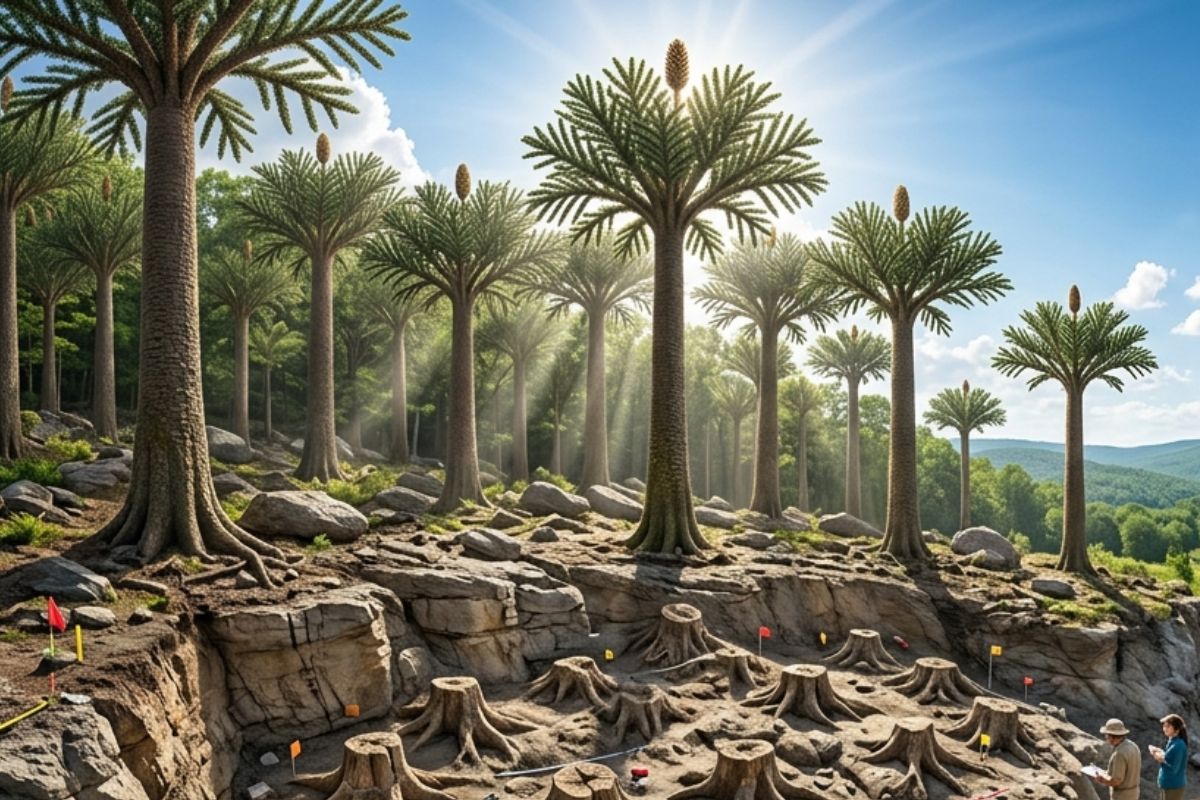
Tree called Wattieza lived about 385 million years ago, reached up to 10 meters, had no leaves or seeds, and only had its complete form reconstructed after the enigma started in 1870
The oldest tree known to science has a name, age, and a look that breaks any modern expectation. It is called Wattieza, lived during the Devonian period about 385 million years ago, reached up to 10 meters in height, and had no leaves or seeds.
What turned this tree into one of the greatest enigmas of paleobotany was a simple detail: for over a century, scientists had only part of the puzzle. The fossil stumps of Gilboa, in New York, were unmistakable, but the crown and branches that would explain the entire plant had disappeared, until a decisive find led to the solution published in 2007.
The enigma begins in 1870 with the fossil stumps of Gilboa
It all started in 1870, when workers repairing roads in Gilboa, New York, detonated rocks and found fossilized tree stumps embedded in the soil. The trunks were in a growing position and grouped together, as if they were still part of a living forest.
-
A 48-square-meter house assembled in hours with 4,000 bricks made of recycled plastic that does not absorb moisture, has natural thermal insulation, and costs less than 90,000 reais in a complete kit.

-
Luciano Hang revealed that Havan’s air fleet has already accumulated more than 20,000 landings, 10,000 flight hours, and 6 million kilometers traveled, and he says that without the planes, the company would never have grown so quickly.

-
A historical discovery in the Andes Mountains reveals a gold deposit valued at 770 billion reais hidden over 4,000 meters above sea level on the border between Chile and Argentina, and the whole world is watching.

-
With just joint compound, white glue, and pigment, you can make a homemade paint that yields double the conventional amount, saves up to 70%, and leaves the wall with a finish that no one would believe wasn’t store-bought paint.


The problem was that the upper part of each tree was not there. The stumps remained, proof of a primitive forest, but without the complete structure that would allow for a confident identification of the species.
Therefore, for over 130 years, Gilboa remained a mystery: it was known to be the oldest known trees, but no one could reconstruct the total form.
The missing clue appears in 2005 a few kilometers away

The turning point occurred in 2005, when researchers found a complete trunk fossil about 16 kilometers from Gilboa, approximately 8 meters long, with preserved branches.
It was the kind of find that changes the game because it not only brings fossilized wood but also the architecture of the plant.
Paleobotanist Linda VanAller Hernick from the New York State Museum and Professor Christopher Berry from Cardiff University realized that the striations at the base of the new fossil perfectly matched the stumps of Gilboa.
It was the missing physical connection to unite a known part and another that no one could prove.
What was revealed in 2007 and why it ended the mystery
With the comparison of the striations and the confirmation of the fit, the story gained a formal conclusion: in April 2007, the publication of the results associated the unknown upper part of the Gilboa stumps with Wattieza, a genus that until then was known only from fallen branches, without knowing which plant they belonged to.
Before this solution, the stumps had been referred to by another name, Eospermatopteris. After the reconstruction work, it became clear that the “crown” that was missing belonged to Wattieza. The oldest tree on the planet finally gained a complete body.
What the Wattieza tree looked like and why it looks like a palm tree, but is not
The Wattieza belongs to the group of Cladoxylopsida, extinct relatives of modern ferns and horsetails, and not of palms. The visual similarity exists, but it is merely appearance.
This tree had a thin, smooth trunk, without thick bark, and could reach 8 to 10 meters in height, with about 0.5 meters in diameter at the base. At the top, it carried a tuft of fronds, structures similar to those of modern ferns, which periodically fell to the ground.
Why it had no leaves or seeds
What makes this tree so different from the current ones is the way it performed photosynthesis and reproduced. It had no true leaves and did not produce seeds.
Photosynthesis occurred mainly through the branches and fronds at the top, not through flat leaves. Reproduction was done by spores, as happens with ferns and horsetails. It is a very ancient plant logic, from a time when the “model” of tree was still being invented by evolution.
Where this tree lived and what the first forests on the planet were like
The Wattieza lived in the Middle Devonian, between 397 and 382 million years ago, in muddy swamps at the margins of an inland sea that covered what is now the northeastern United States. The forests it formed were dense, with trunks spaced regularly, almost like trees in a modern plantation.
This scenario helps to understand the impact of the emergence of the first forests. It was not just a new type of plant; it was a new form of landscape, with vegetation cover on an unprecedented scale for Earth.
The tree that helped change the planet’s climate
The primitive forests of Wattieza had effects that went beyond botany. The expansion of these plant formations extracted enormous amounts of CO₂ from the atmosphere, helped cool the global climate, and accelerated the weathering of rocks, releasing nutrients into the oceans.
This process is associated with the possibility of having contributed to the Late Devonian mass extinction, one of the five largest extinction events in the history of life. The oldest tree on the planet may have helped transform the world to the point of altering the conditions of the environment itself.
The Wattieza left descendants among today’s trees
Even being the oldest tree known, the Wattieza does not represent a lineage with direct descendants among the trees that exist today. It is treated as an extinct evolutionary branch.
It also outlasted the Archaeopteris, a tree with true leaves and more similar to modern ones, by an estimated margin of 15 to 25 million years. This reinforces how much Wattieza belongs to an early and experimental phase of forest evolution.
And you, if you could see this 10-meter tree with no leaves or seeds live, do you think you would recognize it as a “tree” or would it seem like a completely alien plant?







Seja o primeiro a reagir!