





 Portuguese
  English
  Spanish
  11 min of reading
  0 comments


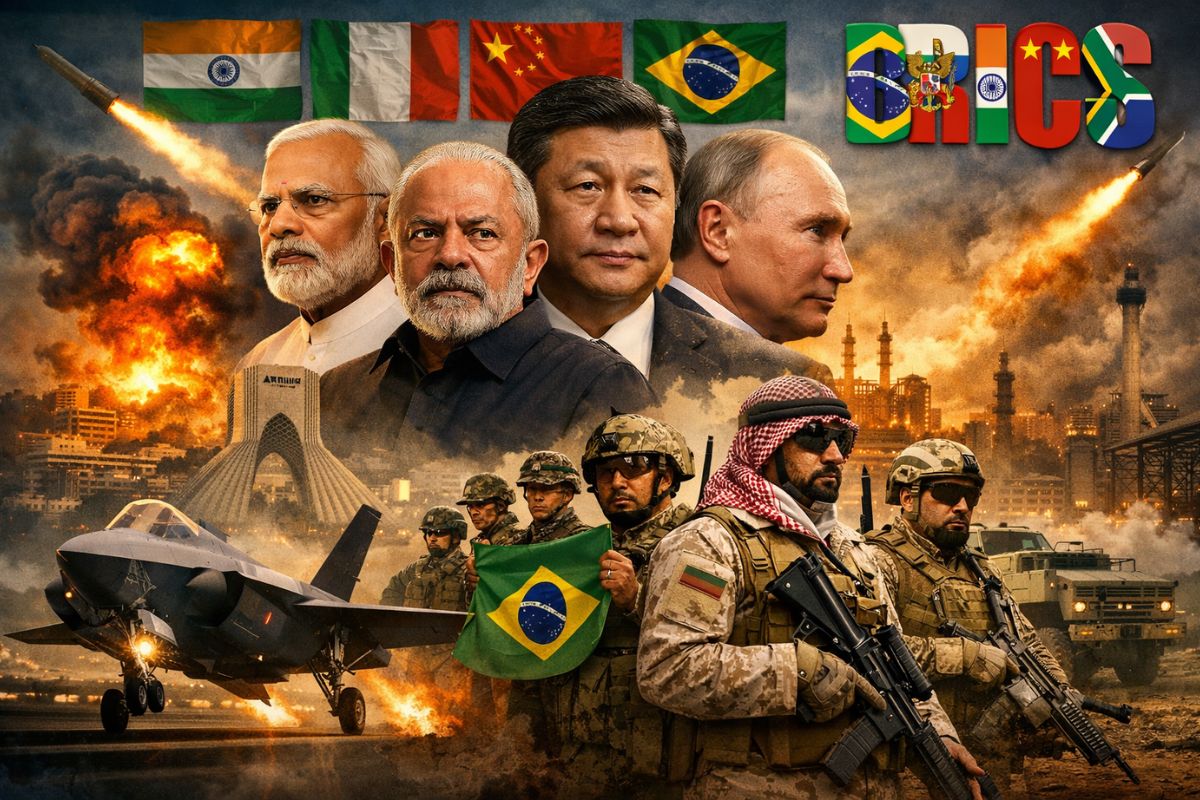
Unable to Formulate a Unified Reaction, Brics Enters a New Political Crisis as the Conflict Between Iran, the United States, and Israel Spreads Throughout the Gulf, Affects Partners Within the Bloc, Tests India’s Presidency, Exposes Limits of Recent Expansion, and Weakens Its Image as an International Common Liaison.
The Brics has returned to the center of a crisis that goes beyond the diplomatic field and reaches its own capacity to act as a bloc. The war in Iran has not only heightened tensions in the Middle East but also laid bare the difficulty for its ten members to sustain a common position when their strategic, economic, and political interests point in different directions.
This impasse has taken on even more visible contours because the United States and Israel’s offensive against Iran has been followed by an Iranian retaliation that has affected Gulf countries, including the United Arab Emirates, in addition to other targets in the region. Thus, the conflict has ceased to be an external issue and has started to directly impact members and partners within the bloc, making any unified discourse much more difficult.
A Regional War That Has Become a Political Survival Test for the Bloc
The central point of the crisis is simple to understand: Brics brings together countries with very distinct interests, and the current war has made these differences emerge almost immediately. On one side, Brazil, Russia, and China condemned the offensive led by the United States and Israel against Iran. On the other, India and the United Arab Emirates focused their statements on criticizing the Iranian retaliatory actions, while South Africa adopted a more cautious and broad tone.
-
Lula’s government opens 13,000 positions for teachers in Brazil and creates more than 24,000 federal jobs, with an impact of R$ 5.3 billion by 2026.

-
A Chinese electric vehicle technology giant wants to invest up to R$ 200 million in a city in Santa Catarina, and the mayor returned from China with a signed document that guarantees the immediate opening of a CNPJ and the start of operations in Brazil.

-
A beach town in Santa Catarina will distribute 4 tons of sardines completely free of charge to the population next Thursday, with a limit of 2 kilograms per person, and the distribution will end when the stock runs out.

-
A YouTuber bought all the Easter eggs from the market, from the cheapest to the most expensive, weighed each one on the scale, and discovered that some brands deliver extra grams while others charge a fortune for little chocolate.


This lack of convergence has so far prevented the issuance of a joint declaration. For a bloc that tries to present itself as a cohesive voice of the Global South, collective silence weighs almost as much as a formal division.
When members cannot even align their language on a crisis affecting countries within their own group, the coordination discourse loses strength, and the external image weakens.
The problem becomes greater because the current war has more sensitive characteristics than the previous episode. In the 2025 crisis, the bloc managed to issue a joint statement condemning the Israeli attacks and advocating for dialogue.
Now, the scenario has changed because Iran’s response has reached targets in Gulf countries, creating an environment in which some members feel more threatened by the Iranian reaction than by the initial offensive conducted by Israel and the United States.
In practice, this has shifted the discussion. The question has ceased to be merely about who started the escalation and has begun to include who is paying the immediate price in the region. When civil airports, refineries, and urban structures suffer damage, the margin for a homogeneous diplomatic position shrinks even further.
What Has Changed Between the Reaction of 2025 and the Current Impasse
The comparison with last year helps to understand why Brics seemed more cohesive before and now appears stuck. According to the G1 portal, in June 2025, during the 12-day war initiated by Israel against Iran, the ten countries of the group managed to issue a joint statement classifying the Israeli attacks as violations of international law and the UN Charter and advocated for channels of dialogue to de-escalate the situation.
At that moment, there were internal divergences, but they did not prevent the construction of a minimum common denominator. The bloc managed to speak in institutional language because the immediate interests of the members were not yet pressured with the same intensity. However, the current crisis has become more complex as it involves Iranian attacks against Gulf countries and amplifies the risk to routes, infrastructure, and governments close to members of the group.
This detail changes a lot. When Iran states that it is targeting the U.S. presence in these countries, but the recorded damage also affects civilian facilities and structures not directly linked to U.S. military operations, the conflict gains a more sensitive dimension. For Gulf governments, the reading ceases to be purely geopolitical and also becomes a matter of domestic security and national stability.
This is precisely where Brics gets stuck. The expanded bloc was designed to increase political and economic weight, but real crises require cohesion, not just size. And the war in Iran is showing that growing in number of members does not automatically mean gaining strategic unity.
Accelerated Expansion Increased Influence but Also Amplified Divisions
The current rift did not arise from nowhere. It is also a consequence of the expansion process experienced by Brics between 2023 and 2025 when the group incorporated new members and began to gather countries with very different regional agendas, alliances, and vulnerabilities. The gain in representativeness was evident, but the political cost of this expansion began to appear more clearly.
Since its inception, Brics already carried significant differences. Brazil, Russia, India, and China were initially brought together by the perception that they held growing economic weight and potential to influence the global order. With the entry of South Africa and later new members like Egypt, Ethiopia, the United Arab Emirates, Iran, and Indonesia, the bloc became broader but also more heterogeneous. The plurality that seemed a strength in negotiation times has become an obstacle in times of crisis.
The very fear of losing cohesion had already been mentioned internally. Brazil attempted to resist expansion due to fears of losing prominence, and Celso Amorim stated that the group could not expand indefinitely without risking weakening its unity. The current war reinforces this warning with a concrete and high-impact example.
The most delicate point is that some of the new members carry very specific rivalries, alliances, and regional pressures. When a bloc includes both Iran and Gulf Arab countries exposed to its military power, the chance of conflicting interests is no longer theoretical. And, in an open crisis, this jumps to the center of the diplomatic scene.
India in the Presidency and the Refusal to Confront Israel and the United States
The rotating presidency of Brics is with India, and this helps to explain part of the stagnation. New Delhi maintains close relations with the United States and Israel, which reduces the political space to lead a direct condemnation of the offensive against Iran. Among Brazilian diplomats, expectations were already low regarding the convening of a meeting to articulate a common position of the bloc.
Narendra Modi has adopted a stance that illustrates this calculation well. Instead of emphatically condemning the Israeli attack that killed Ali Khamenei, the Indian prime minister focused his remarks on the consequences of the Iranian retaliation concerning Saudi Arabia, the United Arab Emirates, Bahrain, Kuwait, Qatar, and Oman. He also reported a conversation with Benjamin Netanyahu and advocated for a quick end to hostilities without indicating equivalent contact with Iranian authorities.
This choice carries political weight because India is not just another member. As president of Brics, the country had the chance to try to organize a collective reaction but preferred a line that avoids directly confronting Israel and the United States. This not only limits the bloc’s tone but also signals to other members that, at least for now, there will be no decisive push for a tougher joint position.
The Indian opposition criticized this behavior, but the external calculation seems clear. India seeks to preserve its bridges with Washington and Tel Aviv, avoid unnecessary wear with strategic partners, and at the same time not completely sever ties with the multilateral logic of Brics. The result is a policy of containment, although insufficient to produce unity.
Brazil, Russia, and China Condemn, but Each with Its Own Logic
If India opted for caution regarding Israel and the United States, Brazil, Russia, and China took a different path. The three condemned the offensive against Iran, but not exactly for the same reasons. In Brazil’s case, the position was presented in traditional diplomatic language, with explicit condemnation of the attacks and defense of negotiation as the only viable path to peace.
The Itamaraty was direct in mentioning the United States and Israel by name. Later, in a second statement, it also condemned the Iranian retaliation against Gulf countries and reinforced the defense of the sovereignty of third states, in addition to expressing solidarity with the affected countries. This dual statement showed an attempt to preserve legal coherence: condemning the initial offensive and then rejecting the escalation of the conflict through retaliatory attacks.
Russia and China were also explicit against the Israeli-American action. Moscow classified the attack as unprovoked armed aggression against a sovereign state and described it as irresponsible and premeditated. Beijing used similar language, stating that the attacks were not authorized by the UN Security Council and violate international law.
But there is an important detail. Neither Russia nor China showed signs of willingness to go beyond verbal condemnation. Both have their own interests with Iran, whether through military partnership in the Russian case or oil purchases in the Chinese case, but their behavior indicates that neither intends to incur greater costs to assist Tehran directly. This limits the practical weight of their statements and shows that even the countries with the harshest rhetoric calibrate their movements with caution.
Emirates, Saudi Arabia, and the Gulf Transform the Crisis into an Internal Dilemma
The Iranian attack on Gulf countries made the crisis even more sensitive because it affected the immediate surroundings of governments that have close relations with Washington, central energy interests, and a growing role in regional dynamics. The United Arab Emirates, a member of Brics, suffered damage caused by Iran, while Saudi Arabia, invited to the bloc, responded by warning that it reserves the right to respond.
At the same time, Abu Dhabi stated that it ruled out military action against Iran and called for a solution through the United Nations. This contrast shows how the region seeks to combine strategic caution with defense of its own security. Gulf countries do not want to become an open field for a prolonged war between Iran, Israel, and the United States, but they also cannot ignore attacks on their territory or sensitive structures.
Experts believe that Iran’s strategy of spreading the war to the Gulf monarchies seeks to pressure these governments to demand a ceasefire from the United States. The logic would be simple: increase the regional cost of the American presence and force Washington’s allies to act politically for containment. However, this tactic deepens the Brics problem because it turns nearby or bloc member countries into direct victims of the escalation.
In addition to the UAE and Saudi Arabia, Iranian missiles and drones have targeted sites in Bahrain, Qatar, Oman, Jordan, Syria, Iraq, and Kuwait. The broader the impacted area, the harder it becomes to sell the idea that the conflict remains localized or politically manageable. For Brics, this means dealing not only with divergent discourse but also with very different perceptions of immediate threat.
Brazil Tries to Preserve Balance Without Breaking Diplomatic Clarity
Among the original members, Brazil stood out as the only democracy to explicitly condemn the offensive by the United States and Israel by naming both countries. This position maintained Brazil’s diplomatic tradition of advocating for a negotiated solution and respect for international law but also demonstrated an effort not to passively accept military actions amid a negotiation process.
At the same time, the Brazilian government sought to avoid that this condemnation be read as an unrestricted endorsement of Iran. The second note from the Itamaraty, which criticized the Iranian retaliation against Gulf countries and civilian areas, revealed a principled stance: reject the escalation, regardless of who executes it. This position attempts to preserve Brazil’s credibility as a diplomatic actor that condemns violations without adhering to the logic of automatic blocs.
This movement also impacts Brics. Brazil has been demonstrating concern about the accelerated expansion of the group and the possibility of losing cohesion. Now, in light of the impasse, its position seems to occupy an intermediate space between direct criticism of the initial offensive and the refusal to normalize the advancing conflict over other states in the region.
In practice, Brazilian diplomacy attempts to sustain two messages simultaneously: the first is that the U.S. and Israel attacks against Iran worsen the scenario; the second is that the Iranian response against Gulf countries also amplifies the conflict and violates sovereignties. It is a challenging attempt at balance but consistent with the logic of de-escalation advocated by Brasília.
The Other Members Show That the Group No Longer Operates at the Same Pace
Indonesia adopted generic language, lamenting the failure of negotiations between the United States and Iran and offering to mediate. Ethiopia remained discreet and expressed solidarity with Kuwait. Egypt, an ally of the United States, avoided commenting on the initial offensive and preferred to call for restraint while urging Iran to stop attacks against targets in the Gulf.
These responses show that Brics today does not function as a uniform diplomatic reflection organism. Each capital reacts according to its regional position, alliances, exposure to the conflict, and strategic objectives.
The bloc continues to exist as a space for coordination, but the war in Iran has made it clear that this coordination has concrete limits when the crisis strikes sensitive nerves of security and foreign policy.
In other words, the expansion of Brics has produced a grouping that is more representative but less predictable. This does not necessarily mean the collapse of the bloc, but it indicates that rapid consensus tends to become rarer, especially on issues that cross regional rivalries and asymmetrical relations with major powers.
For this reason, the contrast with 2025 weighs so heavily. Previously, internal divergence could be managed and converted into a joint statement. Now, the multiplication of competing interests hinders this type of synthesis. The problem is not just the absence of a declaration; it is what this absence says about the real capacity of Brics to act as a political front in serious crises.
What the Crisis Reveals About the Future of Expanded Brics
The war in Iran revealed an uncomfortable truth for Brics: size and influence are not enough when there is a lack of a minimum cohesion to respond to events that put members and partners in the line of fire. The bloc remains relevant as a space for economic and political articulation, but the current crisis has shown that its geopolitical ambition runs into difficult contradictions to hide.
When India avoids confronting Israel and the United States, Brazil condemns the attacks, Russia and China criticize the offensive without advancing beyond words, the Emirates seek to contain the damage, and other members follow their own lines, the picture is clear. Brics does not disappear, but it begins to operate as an increasingly complex coalition, where convergence and divergence coexist all the time.
In the short term, this undermines the group’s image of unity. In the medium term, it may force members to discuss how far possible expansion can go without sacrificing common reaction capacity. And in the long term, the lesson could be even harsher: a bloc that gathers powers, democracies, authoritarian regimes, regional rivals, and partners with distinct ties to Washington may need to accept that not every crisis will produce a unified voice.
The war in Iran, therefore, not only increased instability in the Middle East. It also served as a mirror for Brics. And what appeared in that reflection was a larger, more ambitious, more diverse bloc that is, at the same time, much more exposed to its own internal fractures.
In your understanding, does Brics still manage to act as a cohesive political force, or has recent expansion already made the group too large to speak the same language in crises of this magnitude?









-

-

-

-

5 pessoas reagiram a isso.