





 Portuguese
  English
  Spanish
  5 min of reading
  0 comments


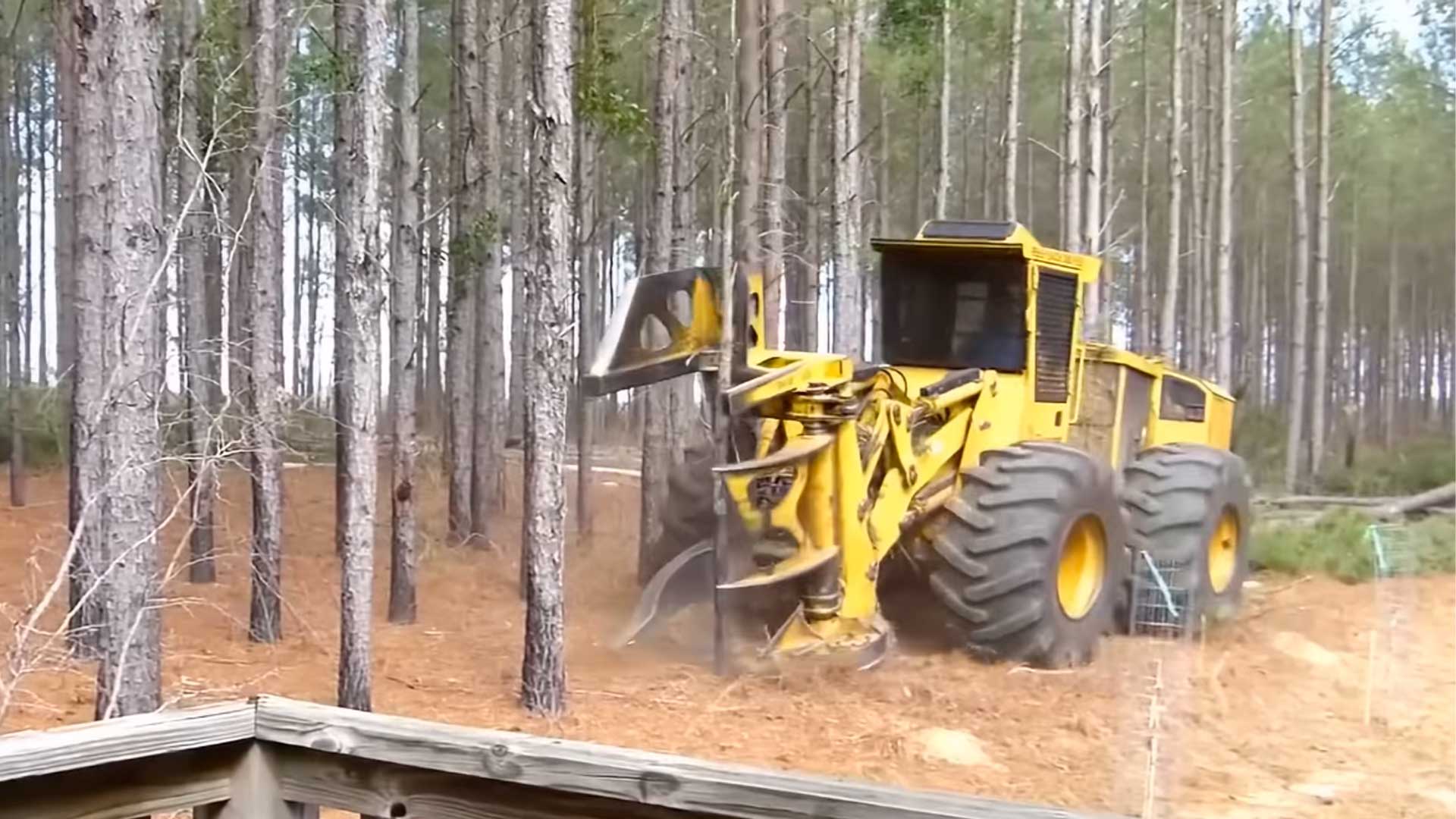
Forest Equipment with Sawmill Head Accelerates Tree Felling and Log Movement, Changing the Pace of Area Opening and Operation Control
The felling of trees with saw heads mounted on heavy machinery has gained visibility because it turns a previously slow job into a high-cadence operation. Instead of manual cutting, the tree is grabbed by a hydraulic claw and cut at the base, with the ability to guide the fall and stack logs in sequence, depending on the set used.
This mechanization is common in formal forest harvesting chains, especially in planted areas, but can also be used to accelerate area opening when there is pressure for speed and little supervision. The result is a debate that mixes productivity, safety, and traceability of wood.
In the global context, the urgency of the issue is reflected in the numbers. The FAO indicates that deforestation has decreased in recent decades but remains at a high level, with recent estimates around tens of millions of hectares per decade.
-
With a cost per shot close to zero, the DragonFire laser could change naval warfare in 2027 and provide British ships with nearly unlimited defense against drones.

-
A British startup creates tires that generate electricity in electric vehicles when passing over potholes, speed bumps, and cracks.

-
Scientists have created robots made with living cells that have their own nervous system, swim on their own, explore the environment, and self-organize without any genetic engineering, and now they want to do the same with human cells.

-
Students create a solar-powered ambulance that operates without a plug, without fuel, and still keeps medical equipment running in remote areas.


What makes these machines so discussed is not only their power but also the combination of cutting speed, the ability to hold large trees, and integrated logistics to remove wood on an industrial scale.
How the Tree Cutting Machine with Hydraulic Chainsaw and Saw Head Works
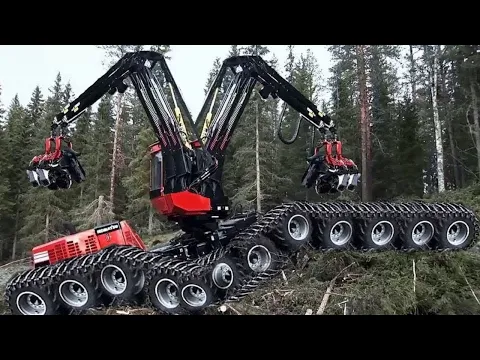

In practice, there are two sets that the public confuses as if they were the same thing. One is the directional felling head, described as a claw with a bar saw positioned to cut and also control the direction of the fall.
Another common set is the harvester, used to fell and process the tree, with feed rollers and knives that debranch and measure the log. Manufacturer catalogs describe the saw set as a hydraulic chainsaw integrated into the head, along with tension and chain lubrication systems designed for continuous operation.
In models aimed at larger trees, technical sheets indicate values that help to understand the scale. One example of a head specifies hydraulic chain saw, long bars, and chain speed in the range of tens of meters per second, as well as maximum cutting diameters reaching hundreds of millimeters, depending on the configuration.
This technical package explains why the cutting seems instantaneous. The machine not only saws; it holds the trunk, compensates with hydraulics for the resistance of the wood, and reduces the downtime between one felling and the next.
Mechanized Deforestation Process with Feller Buncher and Harvester Instead of Manual Chainsaw
The cycle begins with planning access and yards, as extraction needs routes for the equipment. Forest harvesting guides treat the operation as a step-by-step process that includes felling, extraction, processing, and loading, with variations depending on the system adopted.
During felling, the saw head makes the cut close to the stump and can accumulate or organize logs in bunches, facilitating the work of the machine that follows. When the system is of the harvester type, processing can occur right there, with debranching and cuts at defined lengths to meet the sawmill or the pulp industry.
Next comes the removal stage. In some scenarios, wood is dragged by skidders, articulated machines aimed at pulling logs to the loading point. In others, especially in cutting and processing at defined lengths, forwarders load logs in their own compartment and transport internally to the yard.
The operation concludes with loading for trucks and transportation, which can occur continuously if logistics are aligned. Studies and technical materials describe that harvesters and forwarders often work in tandem, synchronizing production within the block with removal to the roadside.
When the objective is rapid area opening, the same chaining can be used with less environmental care, widening trails, compacting soil, and reducing the time between felling and removal, making regulatory action more difficult if there is no efficient tracking and monitoring.
Why the Productivity of These Machines Changes the Pace of Deforestation and Impact on the Ground
The productivity gain is evident because mechanization combines functions and reduces direct human exposure to the falling trunk. Operationally, this means more trees per hour, greater predictability of production, and fewer interruptions, especially in areas where the cutting diameter is within the capacity of the head.
The collateral effect is that the pace of change in the landscape can increase significantly when felling becomes a “production line.” The FAO emphasizes that, despite the historical slowdown, deforestation remains relevant on a global scale, which maintains the pressure for wood origin control and management practices.
On the ground, heavier machines can increase the risk of compaction, trail formation, and reorganization of woody debris, which alters fire behavior and regeneration, especially when the operation is poorly planned. The central point is that the same technology can serve both responsible management and accelerated felling without criteria.
Safety and Oversight When the Hydraulic Chainsaw Is Inside a Cutting Head
The main risk change is that the operator is in the cabin, but the saw remains a critical component. Safety codes and guidelines highlight that any intervention in hydraulic systems and parts powered by them requires lockout and verification procedures, which include harvester heads.
The operational risk also extends to the surroundings. A large tree has enough energy to cause serious accidents if the fall is misdirected, and the cycle speed reduces the time to correct communication and positioning errors.
On the environmental control side, the challenge is tracking origin and authorization, as mechanization shortens detection windows in the field. When the wood exits quickly, oversight relies even more on satellite imagery, route intelligence, and reliable documentation throughout the chain.
The discussion that divides opinions is straightforward. These machines reduce accidents by distancing workers from manual cutting and professionalize harvesting, or they facilitate deforestation on a large scale when they fall into the wrong hands without control. Leave a comment saying what you think and whether technology is helping to protect forests or just making deforestation more efficient.







-

-

-

-

-

7 pessoas reagiram a isso.