





 Portuguese
  English
  Spanish
  3 min of reading
  0 comments


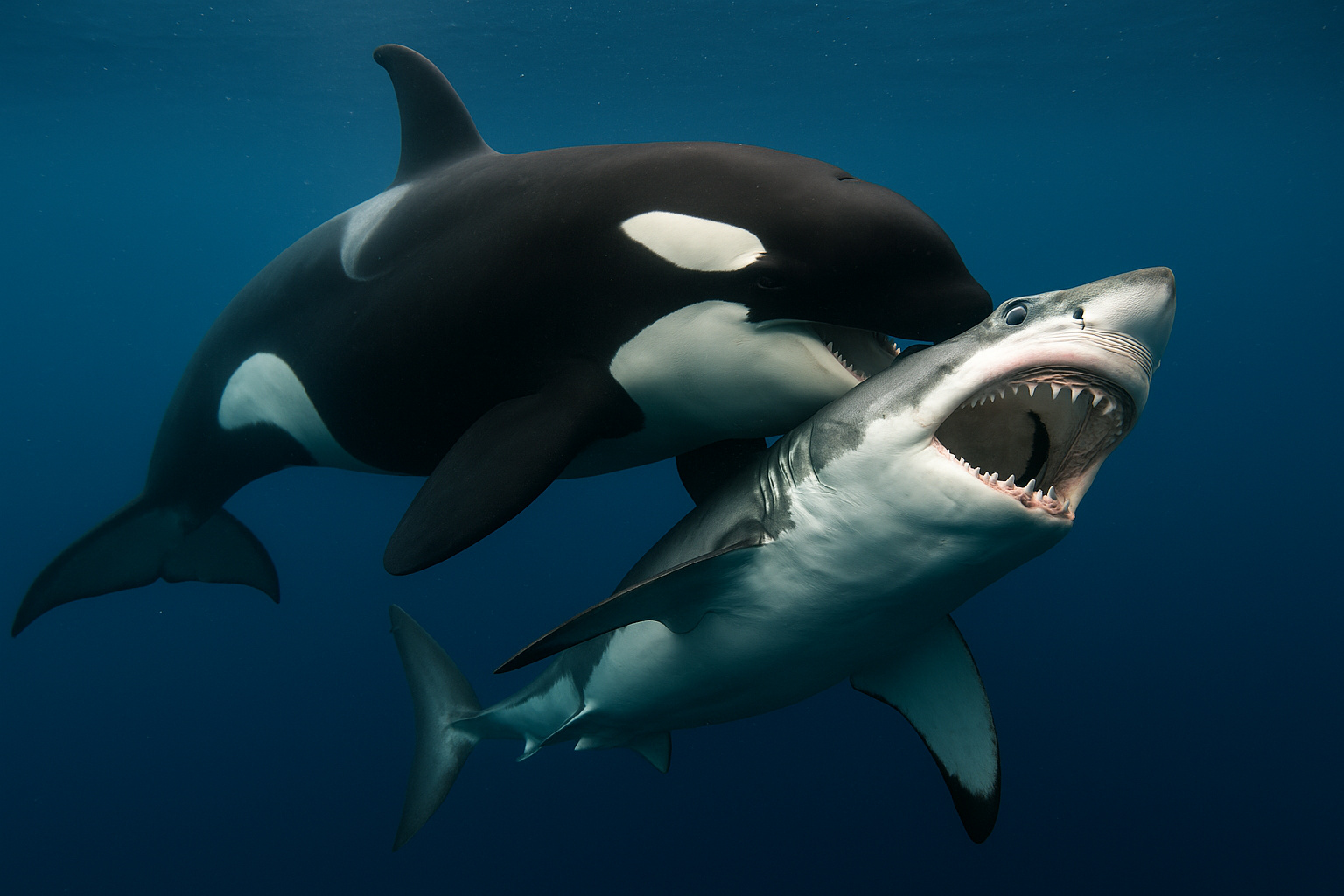
Researchers Record For The First Time On The Mexican Coast The Strategy Of Orcas To Catch Sharks
In a groundbreaking discovery, researchers from Mexico and the United States documented orcas hunting juvenile great white sharks in the Gulf of California.
The study, published on November 3, 2025 in the journal Frontiers in Marine Science, was conducted by biologists Jesús Erick Higuera-Rivas, Francesca Pancaldi, and Salvador Jorgensen.
The observation represents the first evidence of this predatory behavior on the Mexican coast.
This discovery enhances the understanding of the intelligence and adaptability of orcas (Orcinus orca).
Coordinated And Highly Effective Hunting Strategy
During their analysis, researchers recorded orcas employing a complex and collaborative technique.
They saw the great white shark (Carcharodon carcharias) upside down, inducing a state of tonic immobility.
In this state, the animal becomes paralyzed and defenseless, allowing the orcas to remove the liver and other nutrient-rich organs.
Immediately afterward, they abandon the carcass.
This behavior, according to scientists, demonstrates remarkable cognitive ability and strategic planning.
Moreover, the observed group — known as the “Moctezuma Pod” — works together to reduce risks.
The orcas focus their attacks on young sharks, which are less capable of reacting.
According to recordings made by drones and underwater cameras, each member of the orca team plays an essential role in the capture.
Seasonal Attacks And Predictable Behavior
Scientists identified two confirmed occurrences of hunting: the first in August 2020 and the second in August 2022.
This temporal repetition indicates a seasonal pattern.
The phenomenon may be related to the birthing season of juvenile great white sharks in the Gulf of Mexico.
Nonetheless, experts emphasize that more research is needed to determine the frequency of attacks.
They also aim to understand its influence on the local dynamics of shark populations.
According to Salvador Jorgensen from California State University, “adult sharks react quickly to orcas, abandoning areas for months.”
“Juveniles, however, seem inexperienced in front of these predators,” he stated.
This observation suggests that escape reactions may depend on social learning and not just natural instincts.
-
From sertanejo star to international investor: Ana Castela invests millions in a mansion in the USA, creates a themed accommodation in Orlando, and shows that the “boiadeira” also wants to grow away from the stage.

-
The 10 most stunning motorhomes in the world: a $3 million trailer with a rooftop nightclub and garage for a Ferrari, “palaces on wheels” with Italian marble, private cinema, and five-star hotel luxury for billionaires.

-
Trump wanted to spend $400 million on the White House, but the courts prohibited the million-dollar construction.

-
How the Egyptians erected giant structures like pyramids, temples, and obelisks without modern technology, cranes, or engines still amazes the world and reveals the power of engineering based on ramps, levers, ropes, and colossal organization.


Ecological Implications And New Scientific Perspectives
The documented behavior reinforces the idea that orcas are among the most intelligent predators in the oceans.
According to Higuera-Rivas, the strategy of flipping sharks highlights the capacity for learning and cultural transmission across generations.
Moreover, the discovery redefines the hierarchy of marine predators.
Great white sharks have always been seen as the “kings” of the seas, but orcas demonstrate tactical superiority.
Researcher Francesca Pancaldi from the Interdisciplinary Center for Marine Sciences in Mexico stated that understanding these interactions is crucial.
She emphasized the importance of identifying critical habitats and creating environmental protection areas.
According to Pancaldi, “extraordinary feeding behaviors, like this one, help develop management plans to mitigate human impacts.”
These measures are also essential to preserve the marine ecological balance.
Threats And Environmental Changes
The study also suggests that climatic factors, such as warming waters, may influence the movements of juvenile great white sharks.
Phenomena such as El Niño may also make these animals more vulnerable to experienced predators.
Understanding the causes of this new dynamic is essential to assess the impact of climate change on marine life in the Mexican Pacific.
In light of this scenario, scientists advocate for continuous and international monitoring of orca and shark populations.
They seek answers to a question that challenges modern marine biology: how can the balance between two of the planet’s largest predators be altered by such rapid environmental changes?








-

Uma pessoa reagiu a isso.