





 Portuguese
  English
  Spanish
  10 min of reading
  2 comments


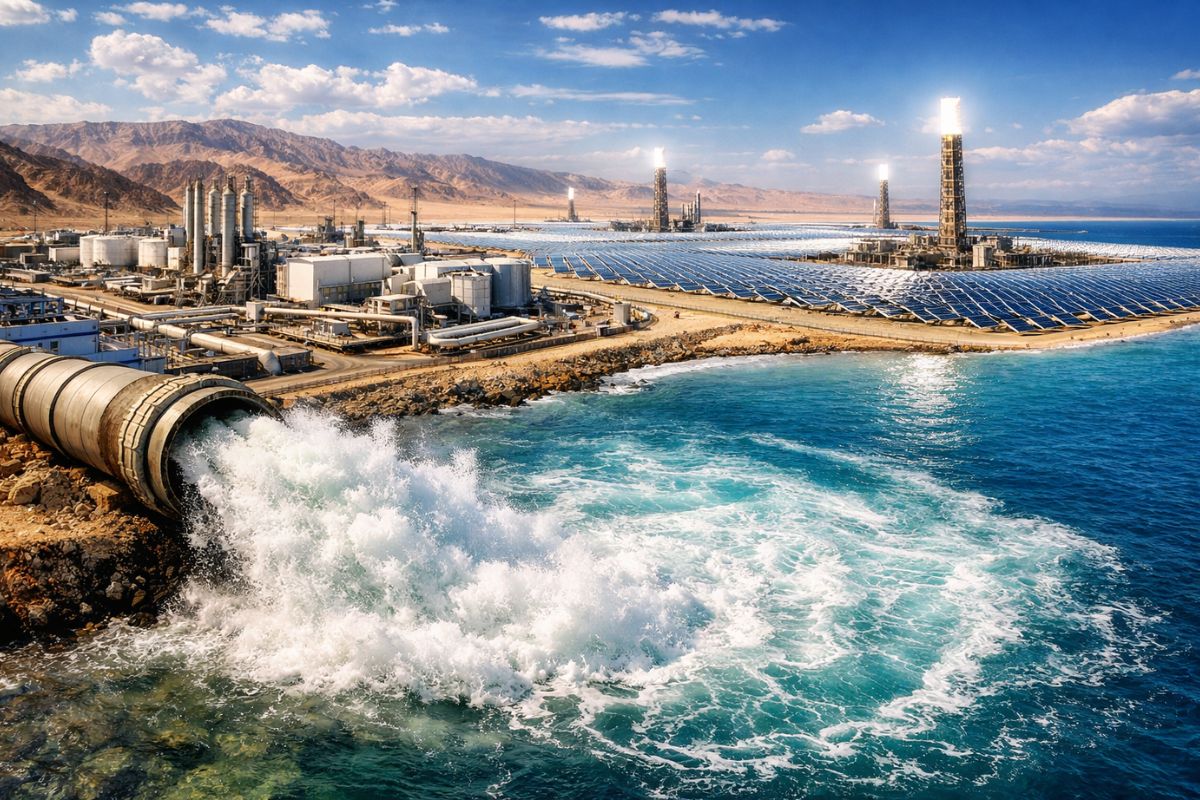


Region Concentrates Nearly Half of the World’s Desalination Capacity, Generates Over 50% of the Planet’s Brine, and Invests Billions in Solar-Powered Megaprojects to Try to Meet the UN Sustainable Development Goal 6 for Clean Water.
Global desalination has ceased to be a technological curiosity and has become critical survival infrastructure in the Middle East. In a region that is home to about 6% of the global population but has at most 2% of the planet’s renewable freshwater, countries like Saudi Arabia, the United Arab Emirates, Qatar, and Kuwait have come to heavily rely on seawater converted into drinking water. Today, the Middle East accounts for 46.9% of the contracted capacity and 41.8% of the operational desalination capacity worldwide, producing tens of millions of cubic meters of water daily.
This advancement is what prevents extreme water stress from turning into social collapse in the region. But it comes at a high cost. Half of all highly concentrated brine generated by global desalination is dumped right there, into the seas surrounding the Middle East, while solar-powered megaprojects attempt to reduce costs, emissions, and environmental impacts. The result is a real-world laboratory: the region has become a showcase of the limits, promises, and contradictions of desalination as a pathway to fulfill SDG 6, which promises water and sanitation for all.
Why the Middle East Became the Epicenter of Desalination
The water crisis in the Middle East is not a future hypothesis. Fifteen of the 25 countries with “extremely high” water stress in the world are in this region, using 80% or more of all available renewable water. According to recent estimates, 83% of the population in the Middle East already lives under severe water scarcity, with projections reaching 100% by 2050.
-
With a cost per shot close to zero, the DragonFire laser could change naval warfare in 2027 and provide British ships with nearly unlimited defense against drones.

-
A British startup creates tires that generate electricity in electric vehicles when passing over potholes, speed bumps, and cracks.

-
Scientists have created robots made with living cells that have their own nervous system, swim on their own, explore the environment, and self-organize without any genetic engineering, and now they want to do the same with human cells.

-
Students create a solar-powered ambulance that operates without a plug, without fuel, and still keeps medical equipment running in remote areas.


The combination of an arid climate, overexploitation of aquifers, saltwater intrusion, sewage contamination, and prolonged droughts has drained traditional sources like groundwater, rivers, and reservoirs. At the same time, population growth and economic development have continuously increased demand.
In this context, global desalination did not emerge out of environmental altruism or out of SDG 6. It was born as an emergency response to the lack of water, and the Middle East was the place where this response advanced most significantly in scale, technology, and funding.
Half of Global Desalination, Half of the Brine
The numbers illustrate the region’s centrality. Globally, global desalination amounts to around 128 million m³ per day in contracted capacity, of which 69.3 million m³ per day are effectively operational.
Only the Middle East concentrates 60.1 million m³ per day in contracted capacity and 28.96 million m³ per day in operational capacity, dominating the global map of plants.
This massive production comes with an inevitable byproduct: brine. For every cubic meter of freshwater, a significant volume of extremely salty and often warmer water, laden with chemicals used in the process, is left over.
The global production of brine from operational plants reaches 104.2 million m³ per day. Of this total, 52.83 million m³ per day are generated in the Middle East, equivalent to 50.68% of the brine produced by global desalination.
Countries such as Saudi Arabia, the United Arab Emirates, and Qatar lead this ranking, dumping colossal volumes of brine into the sea, often mixed with effluents from power plants or treated sewage before discharge.
In practice, half of all liquid waste from desalination on the planet concentrates in a few sensitive points, such as the Persian Gulf and the Red Sea, which have shallower, warmer, and saltier water, with little renewal from the open ocean.
Billions in Giant Plants and the Water Bill
To sustain this water transition, the Middle East has opened its wallet. Between 2006 and 2024, countries in the region invested about 53.4 billion dollars in capital expenses for desalination, equivalent to 47.5% of total global investment during that period.
Operational expenses exceeded 49.3 billion dollars, representing 36.1% of accumulated global spending.
Over time, these investments have reduced the cost of desalinated water. In the Middle East, the average price of seawater desalination between 2014 and 2024 has been around 0.59 dollars per m³, a bit below the global average of 0.62 dollars per m³.
A decade earlier, these values were 18% to nearly 29% higher, showing the direct effect of technological gains and scale.
And expansion is far from stopping. Between 2024 and 2028, it is projected that global desalination will add another 44.7 billion dollars in new capital investments, along with 57.1 billion dollars in operational costs.
Alone, the Middle East is expected to contract 20.9 million m³ per day in additional seawater desalination capacity, about 53.1% of all the new global capacity projected. The regional operational capacity is expected to surge to 41 million m³ per day by 2028, an increase of 41.6%.
This advancement will come in the form of impressively scaled megaprojects, such as the future Jubail 2 replacement plant in Saudi Arabia and the Basra water supply plant in Iraq, both with a projected capacity of 1 million m³ per day.
The logic is clear: concentrate desalination in large industrial hubs, integrated with energy generation, distribution networks, and increasingly, solar parks.
The Environmental Impact of Brine: The Blind Spot of the Equation
Meanwhile, concern is growing over the environmental cost of concentrating half of global desalination in an ecologically fragile region. Most of the plants in the Middle East operate with an average recovery rate of about 25%.
This means that of the total volume of seawater taken in, only a quarter becomes freshwater. The rest returns to the environment as brine.
The most common and cheapest way to deal with this waste is through direct discharge into the sea, via outfalls equipped with diffusers that attempt to quickly dilute the saline plume.
In locations without coastal access, evaporation ponds come into play, which require large areas and incur high costs for waterproofing to prevent soil contamination.
Even with well-designed outfalls, the specific conditions of the Persian Gulf and the Red Sea exacerbate the problem. Shallow, saline, warm waters with little renewal create brine accumulation zones, raising local salinity and temperature, reducing dissolved oxygen, and stressing coastal ecosystems.
Studies show that small changes in the positions of discharge points can reduce annual average salinity concentration in critical areas by up to 1.10 to 1.55 units, underscoring the engineering project’s weight in this impact.
Natural events also expose the system’s vulnerability. Between 2008 and 2009, a massive algal bloom forced the shutdown of several plants in the Persian Gulf and the Sea of Oman, including five plants in the United Arab Emirates and reverse osmosis facilities in Oman, which had filters and membranes severely fouled.
When the region relies on global desalination for drinking water, any prolonged interruption becomes a direct risk of supply shortages.
From Brine Problem to Brine Resource
To reduce the environmental and economic burden of brine, a growing front of research is trying to turn the waste into a source of value, aligning global desalination, circular economy, and climate goals.
Laboratory trials in Kuwait, for example, showed that the brine from two plants could theoretically generate hundreds of tons of annually recoverable metals and salts, with estimated benefits in the hundreds of millions of dollars per year.
In Saudi Arabia, it is projected to invest about 2.1 billion dollars by 2030 in “brine mining” projects to recover bromine, lithium, potassium, magnesium, calcium, and sodium, strategic inputs for the oil and gas, petrochemical, pharmaceutical, and metallurgy industries.
The idea is that instead of being just an environmental liability, brine becomes an industrial raw material and even an ally in carbon dioxide sequestration. In practice, however, this valorization faces significant obstacles. Concentrations of many of these elements are much lower than in traditional ores, requiring the processing of gigantic volumes of brine.
Techniques such as membrane crystallization, selective sorption, electrochemical extraction, and controlled precipitation are energy and capital-intensive. In many scenarios, the cost of recovering these minerals still exceeds the market value of the final product, especially when considering the complexity of the ion mixture, material wear, and the need for multiple separation stages.
To move beyond the laboratory and achieve real scale, brine mining depends on strong public policies, stricter restrictions on raw discharge into the sea, incentives for the circular economy, and pilot projects at an industrial scale.
It is this set of decisions that will determine whether the Middle East will be just the largest producer of brine or also the cradle of a new industry for water and mineral resources.
Solar Energy, Global Desalination, and the Race for SDG 6
Another axis of transformation is energy. Seawater desalination consumes a lot of electricity, and much of it still comes from fossil fuels.
In a region with some of the highest solar insolation rates on the planet, integrating solar energy with desalination has become a strategic priority, both to reduce costs and to bring desalinated water closer to the goals of SDG 6 and the Paris Agreement.
Studies classify solar-powered desalination as “highly applicable” across all Middle Eastern countries, combining water scarcity, high irradiation, and availability of saline water. In practice, this has already translated into concrete projects.
The United Arab Emirates and Saudi Arabia have been operating reverse osmosis plants coupled with large photovoltaic fields since 2008, in hybrid configurations connected to the grid.
The Taweelah plant, for example, is now one of the world’s largest reverse osmosis installations, with a capacity of about 0.9 million m³ per day, integrating solar generation with potable water production.
Dubai is advancing on the Hassyan project, planned to be the largest reverse osmosis plant in the world operating exclusively with renewable energy.
Saudi Arabia, in turn, is relying on projects like Jubail 3, which combines 0.6 million m³ per day of desalination with a solar plant of 45.5 MW, and the AlKhafji plant, noted as the largest solar-powered desalination plant in the world.
Other countries are following the same path. Oman installed a 17 MWp solar park to supply the Sharqiyah plant during the day. Israel aims for 30% of its electricity from renewable sources by 2030, with part of this effort linked to desalination.
Egypt is preparing four desalination plants powered by renewable energy as part of a plan to reach 8.8 million m³ per day in desalination capacity by 2050. In Palestine and Yemen, projects supported by the European Union and UNDP combine photovoltaic fields and desalination in highly vulnerable areas.
Even so, desalinating with solar is far from trivial. The intermittency of solar generation requires sophisticated control systems, inverters capable of handling pressure variations, hybrid operation strategies with the grid, and often capacity reserves to ensure consistent water quality.
Factors such as dust, degradation of panels, and extreme heat reduce system efficiency. Additionally, the high costs of energy storage still limit the ability to operate plants entirely independent of the electrical grid.
Research, Patents, and Who Leads Innovation
The Middle East’s position in global desalination is not limited to building plants. The region has also become an important hub for research, technological development, and intellectual property.
Since the 1960s, about 3,000 patents and 17,000 scientific publications related to desalination have emerged with participation from Middle Eastern institutions.
Globally, the United States, South Korea, Japan, and China lead in patent volume. Within the region, Saudi Arabia and Israel account for over 80% of local deposits, representing 3.4% of all desalination patents in the world.
Saudi technical universities, the oil company ARAMCO, and the state SWCC share prominence with institutions like Ben-Gurion University, the Technion, and companies like IDE Technologies.
The most recurring themes in these patents reveal the region’s strategic focus: more efficient reverse osmosis, use of solar thermal energy, new membrane materials, hybrid processes, and brine valorization.
There are works involving nanocomposites, graphene, MOFs, biomimetic membranes with aquaporins, nanofiltration processes to separate multivalent ions, and advanced solutions against fouling and biofouling.
In practice, this means that the Middle East is not only the largest consumer of global desalination but also one of the main places where the next generation of technologies aimed at making this process cheaper, cleaner, and more sustainable is tested at full scale.
Subsidies, Politics, and the Future of Desalinated Water
None of the infrastructures described above exists in a vacuum. Subsidies, tariffs, conflicts, and government decisions shape both the expansion and use of global desalination in the Middle East.
In the Gulf Cooperation Council countries, such as Saudi Arabia, the UAE, Kuwait, and Bahrain, desalinated water is heavily subsidized.
This helps ensure access for the population and makes intensive water sectors like irrigated agriculture, industry, and tourism viable. However, it can also distort price signals, encourage waste, and delay the transition to even more efficient technologies.
Some governments are starting to reassess this model. Oman, for example, began phasing out subsidies for water and electricity in 2021 to stimulate efficient use. Jordan and Cyprus, although they do not offer direct subsidies, support desalination projects to reduce operational costs.
In countries like Palestine and Yemen, amid prolonged conflicts, the expansion of desalination heavily relies on international aid, multilateral loans, and donations, making water security even more vulnerable to political and economic shocks.
On the research side, most of the 17 countries in the region fund desalination studies with national resources, complemented by regional and international funds from Europe, Asia, and North America.
The way this money is distributed among membrane innovation, renewable energy, brine management, and tariff policies will define whether desalination remains an “expensive band-aid” or can evolve into a more sustainable structural solution.
What the World Can Learn from the Middle East
The case of the Middle East shows that global desalination can indeed guarantee water in regions where the water crisis is permanent. At the same time, it clearly exposes the trade-offs: energy, brine, coastal impact, fiscal cost, technological dependence, and vulnerability to extreme events.
On one hand, the region proves that it is possible to keep megacities, industries, and agriculture operating in the midst of the desert with the support of desalination plants; on the other hand, it becomes clear that this is only sustainable when tied to some pillars: a cleaner energy matrix, responsible brine management, robust governance, tariffs that signal the real value of water, and continuous investment in innovation.
As more countries face prolonged droughts and depletion of water resources, the Middle East’s experience with global desalination tends to serve as a reference, both as a model to follow and as a warning of what happens when the technical solution is not accompanied by a long-term environmental and social vision.
And you, looking at this growing dependence on giant plants, brine, and solar energy, do you think global desalination is becoming a sustainable solution or merely an emergency resource to buy time amid the global water crisis?







Do you see another habitable planet nearby!
O próprio ser humano tentando concertar algo que está destruindo