





 Portuguese
  English
  Spanish
  4 min of reading
  0 comments



Get To Know The Details Of The Colossal Structure Supporting The Golden Gate Bridge, A Marvel Of Engineering With Enough Steel Wires To Circle The Planet
The Golden Gate Bridge, inaugurated in 1937 in San Francisco, USA, is one of the greatest icons of global engineering. Its support, however, relies on a technical feat often invisible to the eye: two main cables that together contain 129,000 kilometers of steel wires. This impressive distance is enough to wrap around the equator more than three full times.
These cables are not just long; they are the result of meticulous design and construction that overcame the challenges of the time. They represent the backbone of the structure, ensuring its flexibility and resistance against strong winds and seismic activity of the Golden Gate Strait. Understanding their composition is unraveling one of the secrets to the longevity of this monumental bridge.
Engineering In Numbers, The Exact Specifications Of The Main Cables
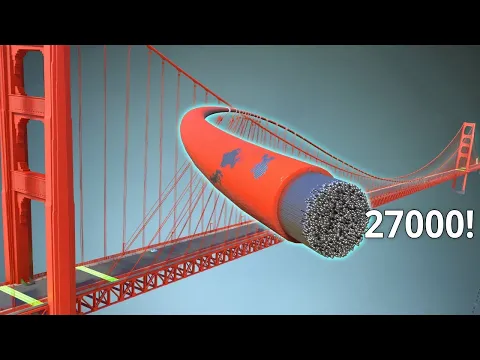
The strength of the Golden Gate Bridge lies in impressive data. Each of the two main suspension cables has a diameter of 36 3/8 inches, equivalent to 0.92 meters. This massive structure is, in fact, a precise grouping of thousands of smaller components.
-
How to build a floating island from scratch with reeds, giant blocks, and stakes in the lake in a process that needs to be repeated almost every day.

-
New CCR concrete paving technology promises roads up to 3x more durable, less maintenance, and cost reduction in Brazil.
-
A forgotten cord on the floor of a basement in Vienna leads a plumber to a box containing 30 kilograms of gold with Mozart’s face, hidden before World War II. The treasure, worth 2.3 million euros, was just centimeters away from a worker who ignored the sign a day earlier.
-
Made from recycled plastic, plastic wood is gaining space in the construction industry because it does not rot, resists moisture, and reduces maintenance costs over the years.
Each cable is meticulously formed by 27,572 individual galvanized steel wires. These wires are organized into 61 distinct bundles, averaging 452 wires per bundle. The total weight of both cables, including the suspenders and accessories, reaches 24,500 tons. The failure of a single wire does not compromise the integrity of the entire cable, a demonstration of redundancy and intelligent design to ensure maximum safety.
The Wires That Really Wrap Around The Equator More Than Three Times
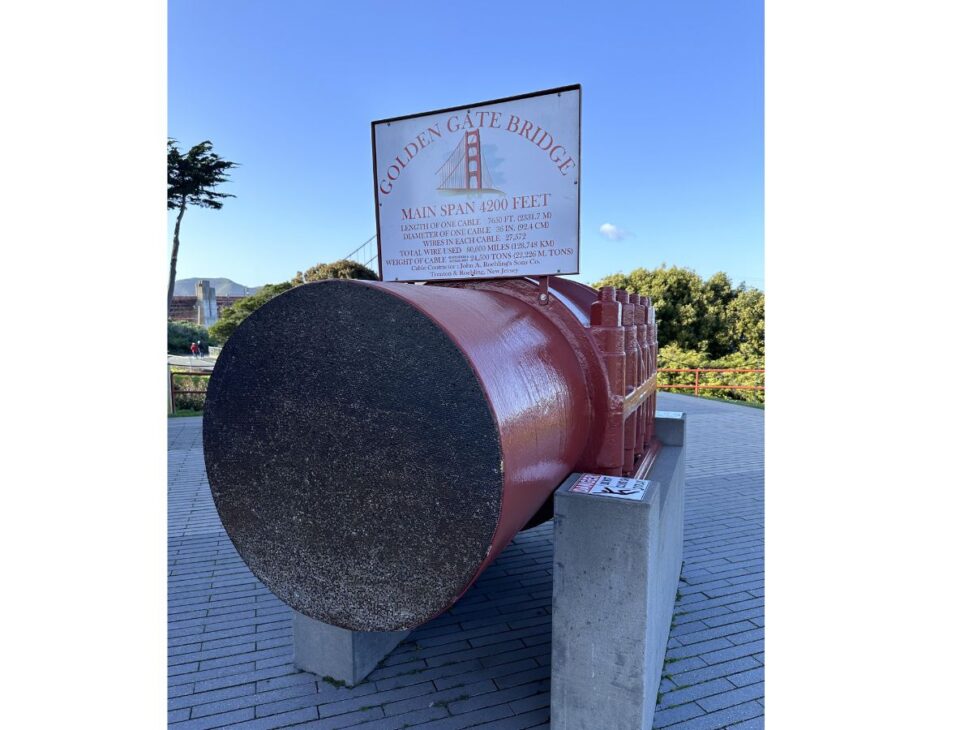
The claim that the bridge’s wires could encircle the Earth is a proven fact. The equatorial circumference of our planet is 40,075.017 kilometers, according to geographical data. The total length of steel wires in the bridge’s cables is 129,000 kilometers.
A simple calculation confirms the popular assertion with high precision. By dividing the total length of the wires by the circumference of the Earth (129,000 km / 40,075 km), the result is approximately 3.22. This means that the steel contained in the bridge’s cables would wrap around the planet more than three times, a testament to the monumental scale of the materials used.
The Wiring Of The Golden Gate Bridge Cables In 1935
Unlike what one might imagine, the gigantic cables did not arrive ready at the construction site. They were built directly over the strait, using an innovative method for the time known as “cable spinning”, overseen by the company John A. Roebling and Sons, the same one that built the Brooklyn Bridge.
The cables were not prefabricated and transported. The process, which began in October 1935, involved pulling one steel wire at a time from one anchorage to the other, passing over the tops of the towers. This task was repeated more than 27 thousand times for each cable. Notably, the team completed the wiring on May 20, 1936, after only 6 months and 9 days, finishing the work eight months ahead of schedule.
Corrosion And Continuous Maintenance Since 1968
The durability of the Golden Gate Bridge relies on a constant battle against the elements. As early as 1968, inspections detected corrosion in the outer wires of the main cables. Investigations concluded that it is virtually impossible to completely seal a cable, as moisture inevitably seeps in over time.
Water is identified as the “worst enemy of the cable”, as it reacts with pollutants, causing the corrosion of the steel. To combat this issue, a modern dehumidification system was implemented. It injects dry air inside the cables, maintaining the relative humidity below 40%, a level at which corrosion practically ceases. This proactive maintenance is crucial to ensuring the bridge’s integrity for future generations.
How The 1933 Work Established New Standards

The construction of the bridge, which began on January 5, 1933, during the Great Depression, was groundbreaking not only in engineering but also in workplace safety. The chief engineer Joseph Strauss was determined to “cheat death”, implementing all known safety measures.
Workers were given hard hats, respirators to avoid inhaling lead fumes, and safety glasses. The most famous measure was the installation of a massive safety net under the bridge, which cost 130 thousand dollars at the time.
This net saved the lives of 19 men, who became known as the “Halfway-to-Hell Club”. Despite the 11 fatalities, the project set a new and increased safety standard for civil engineering.







-

-

-

-

-

30 pessoas reagiram a isso.