





 Portuguese
  English
  Spanish
  6 min of reading
  1 comment


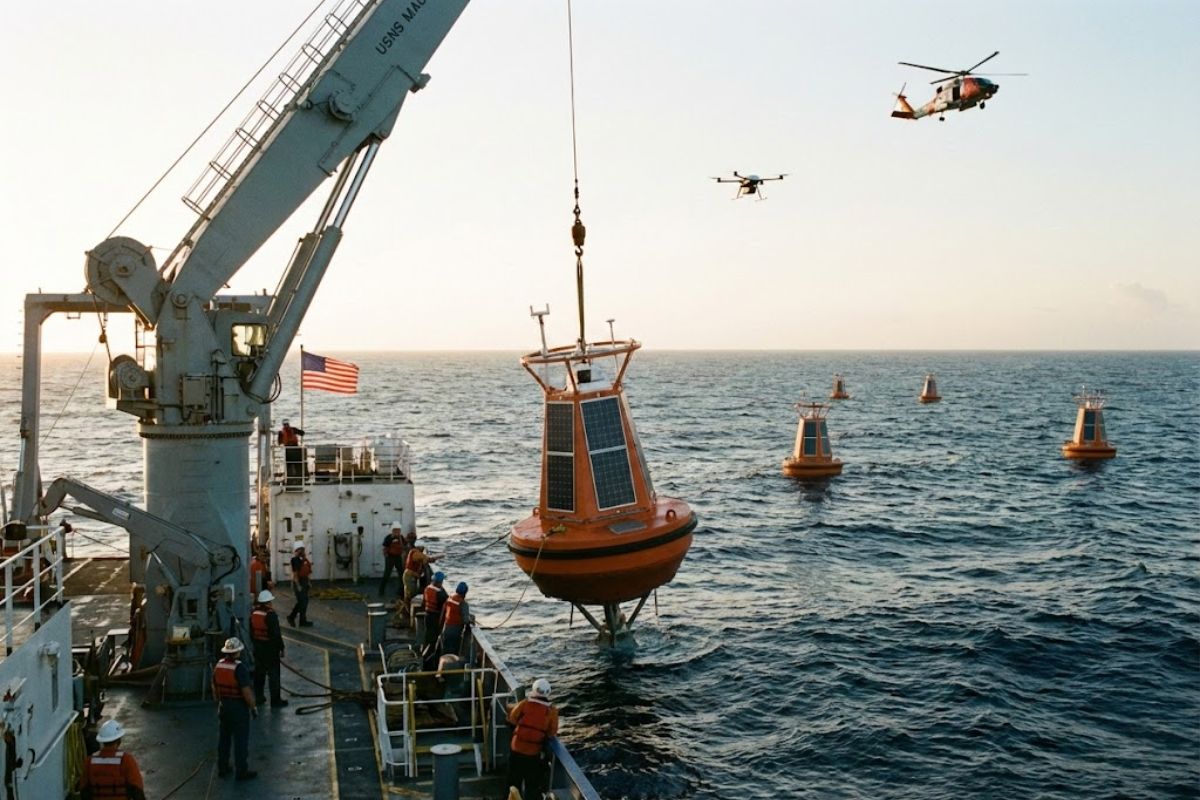


Smart Buoys In The Ocean Were Installed By The Naval Postgraduate School In July 2025 In Monterey Bay, California, Using PowerBuoy From Ocean Power Technologies With 5G From AT&T, METOC Sensors, HD Infrared Cameras And Radar. In January 2026, Units Also Support Missions In San Diego, With Hybrid Communication And Embedded AI.
The smart buoys in the ocean have come to be regarded as strategic infrastructure by the United States, combining energy generation, connectivity, and continuous surveillance in a single floating device that operates nonstop, even far from shore.
The most detailed case occurs in the Monterey Bay, California, where a self-sustaining buoy called PowerBuoy, implemented in July 2025 by the Naval Postgraduate School, operates as an oceanic data tower 24 hours a day, 7 days a week, collecting and transmitting real-time information, with expanded use for San Diego.
Where It Happened And How The Buoy Was Positioned At Sea

The main deployment was made in the Monterey Bay, off the coast of California, in the United States.
-
NASA issues a warning for the feared Godzilla El Niño that could change the planet’s climate in 2026 with extreme warming of the Pacific capable of causing devastating droughts in some regions and historic floods in others simultaneously.

-
Archaeologists discover a 100-meter ship graveyard in a submerged Greek city, and what has appeared on the seabed of Libya could change what was known about this ancient port.

-
You buy the refrigerator and still have to see ads: Samsung starts displaying advertising on appliances and generates negative reactions among consumers.

-
What can really trigger large volcanic eruptions? Research suggests that gas returning to the magma may be more dangerous than gas escaping from it.





The unit floats about 3 nautical miles from shore, approximately 5.5 km, and is located 5 miles north of the Naval Postgraduate School campus in Monterey.
The buoy is anchored at a depth of about 70 meters, equivalent to 230 feet, at a point described as strategically located south of the bay’s underwater canyon.
The anchoring was designed to keep the equipment in place and ensure that antennas and sensors function even with the constant roll of the sea.
What Is The PowerBuoy And Why It Became A Reference

The PowerBuoy is a self-sustaining buoy manufactured by Ocean Power Technologies and used as an advanced communication, surveillance, and data collection platform.
It is described as the first floating 5G base station in U.S. waters, operating as a connectivity hub at sea.
The concept is to create a structure that performs three tasks at once: generate energy, power electronics and sensors, and send data to shore in real time.
This transforms the smart buoys in the ocean into a kind of “floating tower,” with the capability to function in both research and maritime security and monitoring.
How The Buoy Generates Energy To Operate Nonstop

Operation 24/7 relies on energy autonomy, and the system uses renewable sources to keep everything powered and charge internal batteries.
The buoy uses solar and wind energy to power internal systems and high-capacity marine batteries, described as LiFePO4 type.
There is a detailed energy configuration cited for the operating model: solar panels with a capacity of 4.1 kW and two vertical axis wind turbines.
In some configurations, there is also the option for energy generation through wave motion, converting mechanical oscillation into electricity with a direct drive generator, depending on the arrangement chosen for each mission.
The nominal energy storage capacity is presented in a range of 44 to 88 kWh, which helps explain how the buoy maintains sensors, local processing, and data transmission without relying on fuel replenishment.
The “Bubble” 5G At Sea And The Defined Coverage Radius
The most striking component of the smart buoys in the ocean is connectivity.
In partnership with AT&T, the PowerBuoy acts as a 5G base station at sea, providing high-speed internet and real-time data transmission for vessels and users in the area.
The coverage is described as a “bubble” with a radius of approximately 800 meters, enough to cover an operational perimeter close to the equipment, allowing vessels to transmit data without relying solely on traditional satellites.
This changes the logic of the sea as a low connectivity zone, at least within the action radius.
Hybrid Communication To Avoid Failure When The Sea Becomes A Problem
To ensure resilience, the system does not rely on a single communication path. In addition to 5G, the buoy uses Starlink satellite antennas as a backup layer.
Data transmission back to shore can occur via medium-range microwave link or via satellite, depending on the operational scenario.
This redundancy is crucial because the sea is an environment where signals are inherently unstable.
The buoy needs to keep antennas aligned, deal with oscillation, and maintain constant communication for the equipment to be useful as an oceanic data tower.
Surveillance And Sensors: What The Buoy Sees Above And Below The Surface
The surveillance package includes surface radars, high-definition infrared cameras, and oceanographic and meteorological sensors, known as METOC sensors.
This allows for continuous monitoring of surface activities and environmental data collection in parallel.
The buoy is described as capable of observing and measuring variables such as temperature, salinity, and wind speed, as well as recording movements and patterns on the surface with radar and imaging.
This set of features enhances the system’s utility for both research and maritime surveillance operations.
Embedded Artificial Intelligence And Autonomous Processing In 2026
The PowerBuoy uses the artificial intelligence suite Merrows, from Ocean Power Technologies itself, to process data autonomously.
The goal is to reduce dependence on manual analysis and allow the buoy to perform classification and continuous monitoring, acting as an “edge compute” system at sea.
In operational terms, this means the buoy can process data locally before sending it to shore, prioritizing alerts and conserving bandwidth, as well as maintaining constant surveillance without requiring human intervention for every detected event.
What Is The Purpose: Maritime Domain Awareness And Permanent Monitoring
The project has a declared objective linked to Maritime Domain Awareness, the concept of maintaining continuous visibility of what occurs in maritime areas.
The goal is to enable military and security agencies, such as the Coast Guard, to monitor activities and identify “malicious actors” and movements in protected areas without relying on constant patrols.
This type of application turns the smart buoys in the ocean into a fixed extension of surveillance, combining sensors, communication, and energy autonomy to reduce coverage gaps.
Expansion In January 2026: From Monterey To San Diego
In addition to the point in Monterey, there is described expansion to San Diego, California, in January 2026, with a focus on national security missions, supporting operations related to the Coast Guard and the U.S. Department of Homeland Security.
The logic is to replicate the structure at new strategic coastal points, creating a network of platforms capable of providing real-time data and tactical connectivity, reinforcing the role of the smart buoys in the ocean as monitoring and communication infrastructure in areas where continuous surveillance is treated as a priority.
What Is Impressive In Practice: Waves, Energy, Data And Surveillance In A Single Device
What makes the system relevant is the combination of functions.
The buoy is not just an oceanographic sensor nor just a signal repeater.
It is described as a platform that merges renewable generation, high-capacity batteries, 5G, backup satellite, METOC sensors, radar, and infrared cameras, with artificial intelligence processing data locally.
This creates a model of constant presence at sea, with low direct human support, capable of operating as infrastructure in locations where sending ships, maintaining crew, and performing continuous maintenance is expensive and time-consuming.
In your opinion, will the smart buoys in the ocean become a standard for surveillance and connectivity at sea, or will the dependence on maintenance and the limitations of 5G coverage keep this technology restricted to specific points?







Wow I have been following OPT over 20 years and this is the best article on Powerbuoy I have ever read. Good job to the author, Bruno Teles. I will add that it has the capability via a surface and sub-surface docking station to recharge and provide secure coms to UAV,USV and UUV.