





 Português
  Inglês
  Espanhol
  4 min de leitura
  0 comentários


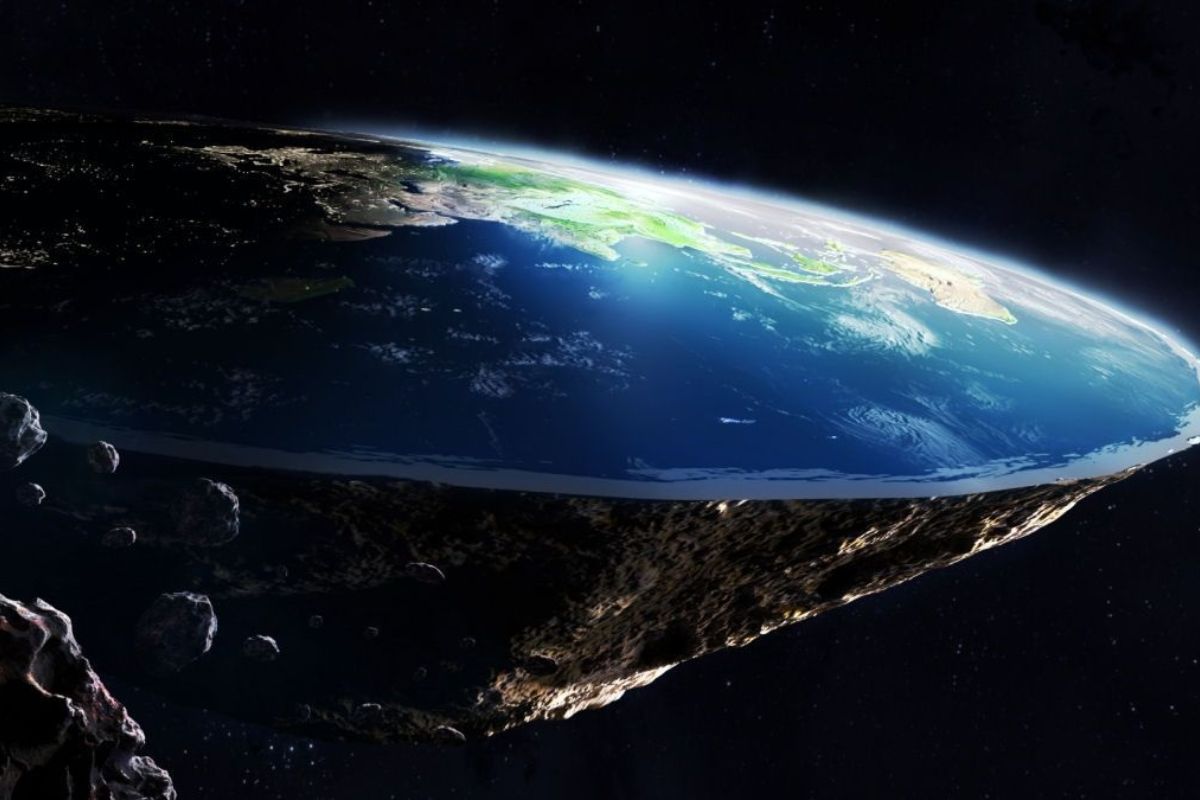
From Laser Gyroscopes to Homemade Rockets, We Analyze the Most Famous Attempts to Prove That the Earth Is Flat and the Science Behind Their Spectacular Failures.
The idea that the Earth is a flat disk covered by a dome, with the North Pole at the center and an ice wall at the edge, is a theory that, despite being disproven for centuries, gains new followers in the internet age. Driven by a deep distrust in established science, some of its most fervent defenders decided to go beyond discussion and create their own experiments to prove their worldview.
However, the result was a series of ironic failures, where the search for evidence of a flat Earth ended up, time and again, providing robust evidence to the contrary. Let’s analyze the engineering and science behind four of these famous experiments.
The $20,000 Gyroscope That Felt the Rotation of the Earth
In the 2018 documentary “The Earth Is Flat” (Behind the Curve), one of the most emblematic moments is led by flat Earth YouTuber Bob Knodel. He invested $20,000 in a ring laser gyroscope, a high-precision instrument.
-
The world’s first octopus farm wants to open in the Canary Islands and is already provoking an international reaction: the plan aims to produce 3,000 tons per year.

-
Drought may be creating stronger superbugs in the soil and helping antibiotic resistance reach hospitals, warns a study highlighting a problem that could grow alongside extreme weather.

-
The biggest scam in history: Napoleon’s France deceived the United States by selling them a territory that was Spanish.

-
Why is the Danakil Desert so dangerous? It has unstable terrain and how extreme temperatures and toxic gases turn the region into one of the most hostile environments on Earth.


- The Hypothesis: If the Earth were stationary, the gyroscope should not detect any rotation.
- The Experiment: Knodel activated the equipment and let it spin.
- The Unexpected Result: To his surprise, the gyroscope consistently detected a 15-degree per hour drift.
- The Scientific Conclusion: This number is not random. It is exactly the speed at which the Earth rotates on its own axis (360 degrees divided by 24 hours). Instead of proving that the Earth was stationary, the expensive equipment accurately proved the planet’s rotation.
The Light Test That Revealed the Curvature
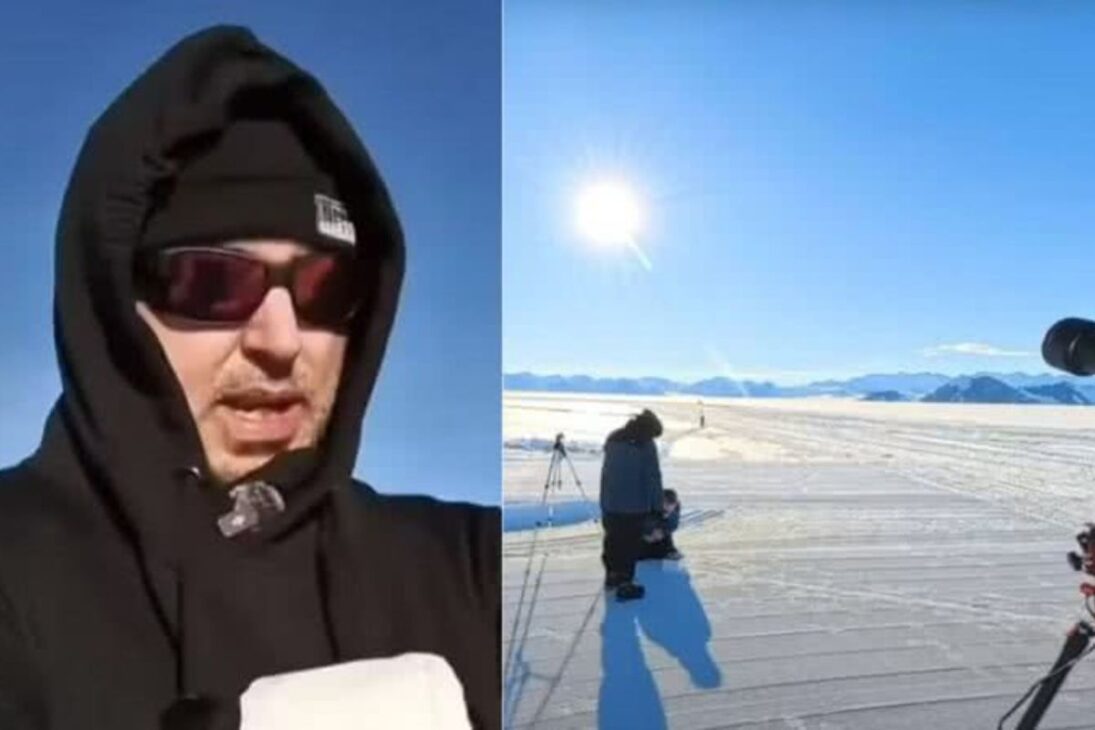
In the same documentary, another group, led by Jeran Campanella, devised an experiment to prove that the Earth has no curvature.
- The Hypothesis: If the Earth were flat, a beam of light emitted from one point should be seen at the same height at another point.
- The Experiment: They used two plates with a hole in each, both positioned exactly 5.18 meters above sea level. One person with a powerful flashlight stood on one side and a camera on the other, miles apart.
- The Unexpected Result: The light did not appear on the camera. When the person with the flashlight raised it above their head, the light was perfectly captured.
- The Scientific Conclusion: The experiment proved the curvature of the Earth. The initial light was being blocked by the “hump” of water caused by the planet’s curvature. When elevated, the light passed over this obstruction.
The Boat That Disappears on the Horizon
One of the simplest tests involves observing a boat moving away at sea.
- The Hypothesis: On a flat Earth, the boat should just get smaller, but never disappear “in half.”
- The Experiment: Film boats moving away with superzoom cameras.
- The Unexpected Result: In all tests, the result is the same: the boat begins to disappear first from the base (the hull), and only then from the top (the mast).
- The Scientific Conclusion: This is a direct effect of the curvature of the Earth. The boat is following the curve of the planet, and its hull is the first part to be obstructed by the horizon line.
The Tragic Mission of “Mad” Mike Hughes’ Homemade Rocket
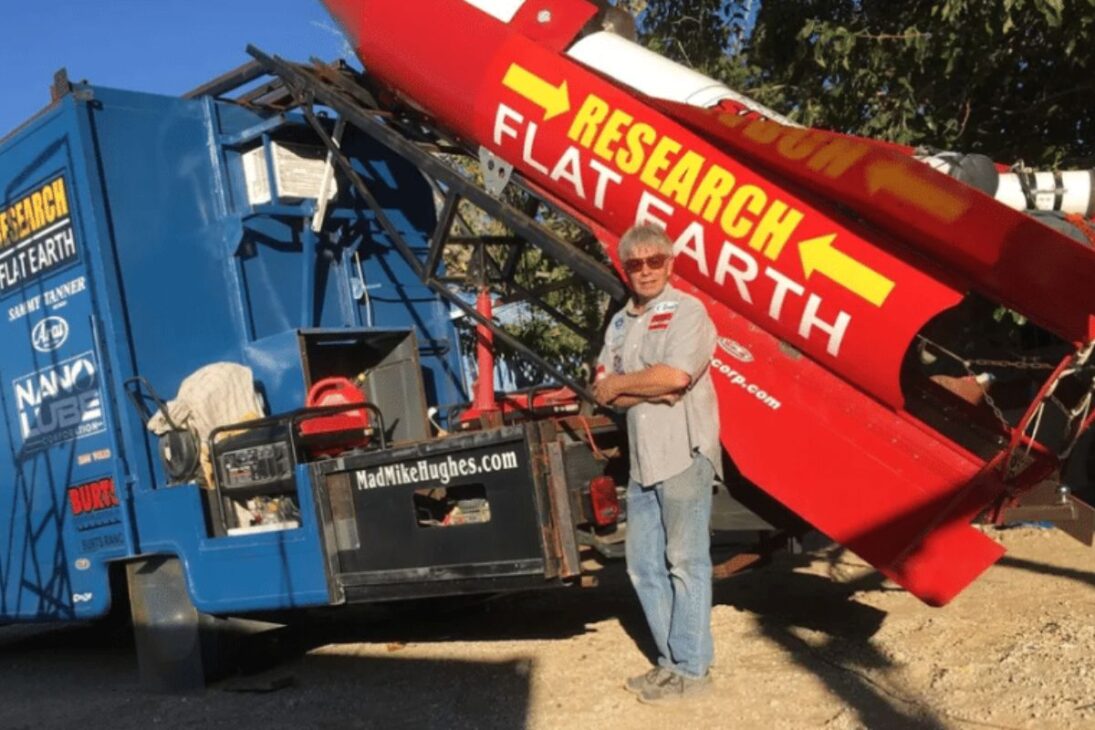
The most extreme case was that of “Mad” Mike Hughes, an American inventor and daredevil. His mission was to build a homemade rocket to go high enough to photograph the “flat disk” of the Earth.
- The Project: Hughes built a steam-powered rocket in his backyard, with an estimated cost of $18,000.
- The Fatal Accident: In February 2020, during a launch attempt for the Science Channel’s “Homemade Astronauts” program, the rocket lifted off, but the landing parachutes were deployed prematurely and fell off. Without the parachutes, the capsule with Hughes inside fell at high speed in the California desert, resulting in his instant death.
The story of Mike Hughes is a grim reminder of how conviction can lead to tragic consequences, especially when it ignores engineering and safety principles. His experiments, like the others, instead of refuting science, ended up reinforcing, in ironic ways, the evidence of the world as it is.
Which of these failed experiments did you find most impressive? What drives someone to risk their own life to prove a theory? Share your thoughts!







-

Uma pessoa reagiu a isso.