





 Português
  Inglês
  Espanhol
  4 min de leitura
  10 comentários


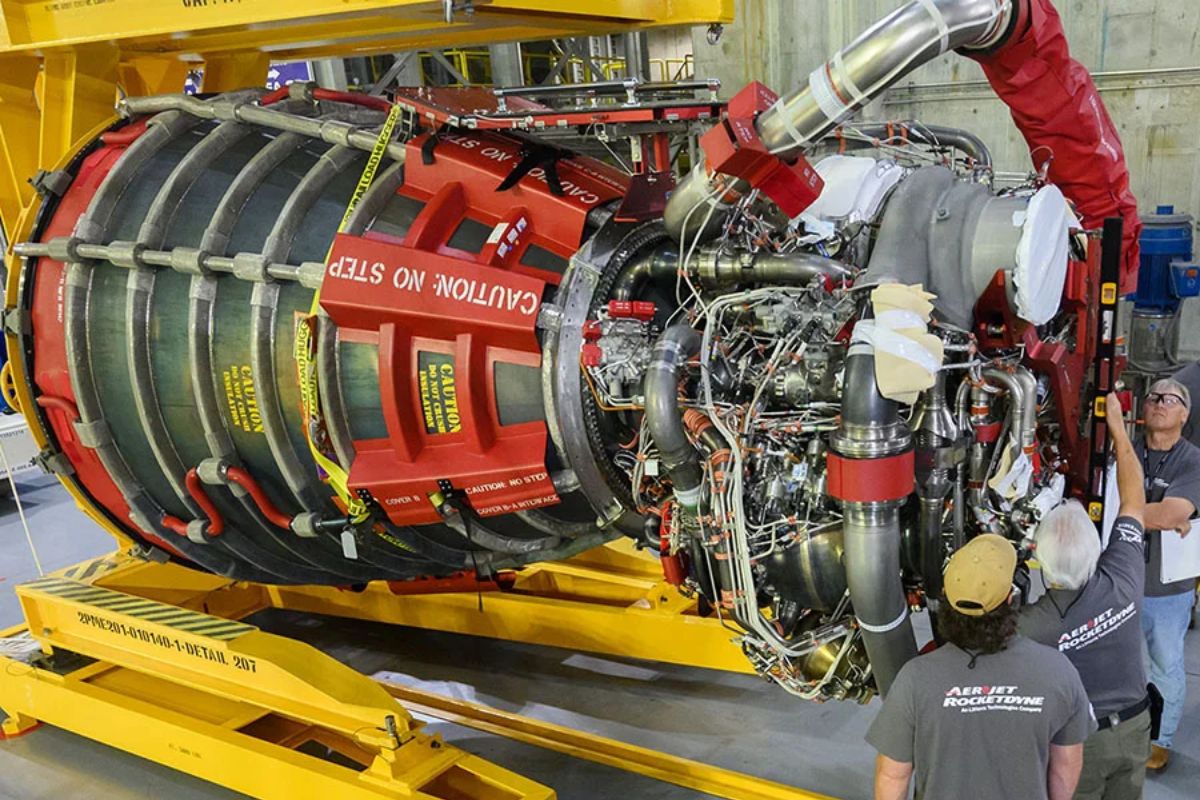


With A Force 15% Greater Than The Apollo Saturn V, NASA’s SLS Rocket Is An Impressive Power Machine, But The Rocket’s Engines And Their Costs Spark Debates About The Future Of Space Exploration.
The return of humanity to the Moon is being driven by the most powerful rocket ever built, NASA’s Space Launch System (SLS). At the heart of this colossal machine are the rocket engines that promise to take the astronauts of the Artemis II mission beyond Earth orbit for the first time since 1972. With an impressive thrust of 8.8 million pounds at liftoff, the SLS is an engineering marvel.
However, behind the brute force lies a complex story of repurposed technology, astronomical costs, and a debate over its design. This article will unravel the secrets of the rocket engines SLS, the real fuel consumption, and how it compares to its legendary predecessor, the Saturn V.
The Artemis II Mission In April 2026: The Historic Crew That Will Make A 10-Day Flyby Of The Moon
The Artemis II mission, set to launch no earlier than April 2026, will be the first crewed flight of the program. Lasting approximately 10 days, the mission will not land on the Moon but will perform a flyby to test all the systems of the Orion spacecraft with four astronauts on board.
-
With more than 635,000 doctors, Brazil sees competition increasing in large cities, and recent graduates are competing for shifts at an accelerated pace while the countryside still faces shortages.

-
The world’s first octopus farm wants to open in the Canary Islands and is already provoking an international reaction: the plan aims to produce 3,000 tons per year.

-
Drought may be creating stronger superbugs in the soil and helping antibiotic resistance reach hospitals, warns a study highlighting a problem that could grow alongside extreme weather.

-
The biggest scam in history: Napoleon’s France deceived the United States by selling them a territory that was Spanish.


The crew, announced by NASA on April 3, 2023, marks a historic milestone in space history. Commanded by Reid Wiseman, it includes Victor Glover, who will be the first Black person to travel to the Moon; Christina Koch, the first woman; and Jeremy Hansen from the Canadian Space Agency, the first non-American to achieve the feat. The main objective is to validate life support systems before landing missions like Artemis III.
The SLS Rocket Engines

The SLS architecture is a fusion of proven technology with new adaptations. The rocket’s core stage is equipped with four RS-25 engines, the same ones that powered the Space Shuttle in 135 missions. For the SLS, these engines have been modified to operate at 109% of their original power. They burn a mixture of liquid hydrogen (LH2) and liquid oxygen (LOX).
However, more than 75% of the thrust at liftoff comes from the two solid rocket boosters (SRBs). Standing 54 meters tall each, they are the largest and most powerful solid fuel rockets ever made. Derived from the Space Shuttle’s SRBs, they have been enlarged with a fifth propellant segment to give the SLS the extra thrust needed to lift off.
The Truth About The Consumption Of 13 Tons Of Fuel Per Second At Liftoff
One of the most impressive figures of the SLS is its power. The combined thrust of the four RS-25 engines and the two SRBs reaches 8.8 million pounds-force, which is 15% more than the thrust of the Saturn V rocket that took Apollo program astronauts to the Moon.
This power, however, comes at a fuel cost. Contrary to some popular estimates, consumption is not 25 tons per second. The real calculation, based on NASA data, shows that the rocket engines SLS consume a total of 13 metric tons of propellant per second at liftoff. Of this total, almost 11 tons come from the solid fuel of the SRBs, while the other 2 tons are from liquid hydrogen and oxygen from the RS-25 engines.
Why Did The Saturn V Rocket, With Less Thrust, Carry More Payload To The Moon Than The SLS?

While the SLS is stronger at liftoff, it carries less payload to the Moon than the Saturn V. The Apollo rocket could send about 45 tons on a lunar trajectory, while the SLS, in its current configuration, sends only 27 tons.
The explanation lies in the design. The Saturn V used a first stage with kerosene engines, a much denser fuel, making it more efficient for overcoming the atmosphere. The SLS, by using liquid hydrogen (less dense) from the start, requires enormous and heavy tanks.
The SRBs, despite being powerful, are inefficient and become dead weight after two minutes. In summary, the Saturn V was more efficient for the marathon to the Moon, while the SLS is stronger at the initial “launch”.
The Cost Of US$ 4 Billion Per Mission And The Future Of NASA’s Program With The Block 1B And Block 2 Versions
The SLS is a controversial project. Dubbed the “Senate Rocket”, it was conceived with the directive from the U.S. Congress to use components from the Space Shuttle to theoretically cut costs and preserve jobs in the industry. The result, however, is a rocket that costs more than US$ 4 billion per launch, including the Orion capsule.
The future of the Artemis program depends on the evolution of the rocket engines and the vehicle itself. The Block 1B version is planned, which will have a more powerful upper stage and increase the payload capacity to the Moon to about 38 tons, and the Block 2, with even more advanced solid boosters. These upgrades are crucial for the SLS to compete with commercial alternatives like SpaceX’s Starship and fulfill the promise of returning humanity to the Moon sustainably.






Pero como le hicieron para almacenar más de 18 millones de galones de combustible? En un cohete de 110 metros de largo por 9 de ancho? Más los astronautas, equipos para sus experimentos, vehículo lunar y mil cosas más ??
Y qué pasó con el regreso? No tenían plataforma de lanzamiento, los cientos de técnicos de apoyo que estaban en tierra, los millones de galones de combustible, tampoco el cohete Saturno que ya lo habían desechado, como hicieron el milagro?
A dúvida que fica é: Cabe em um Chevette?
Bebem 25 toneladas de combustível SÓLIDO. KKK