





 Portuguese
  English
  Spanish
  5 min of reading
  0 comments


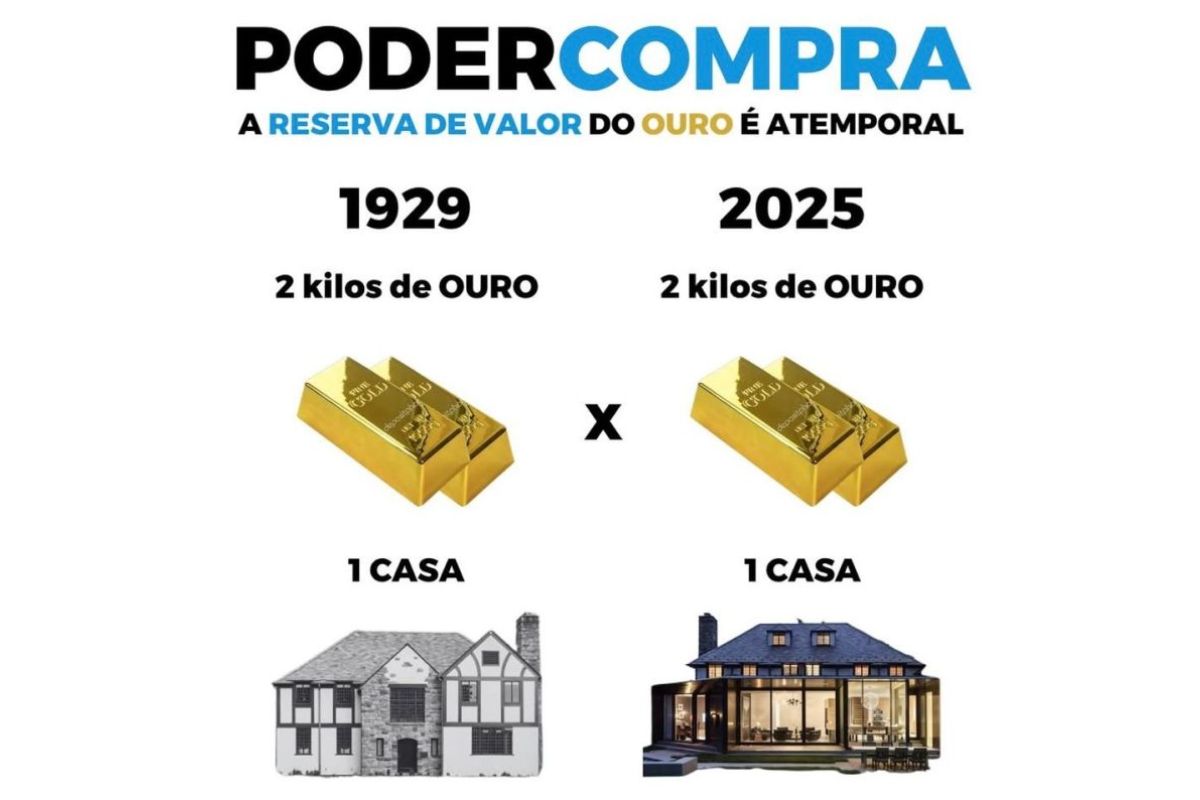
Gold Continues to Preserve Purchasing Power Over Decades and Shows, Better Than Any Graph, the Difference Between Screen Price and Real Value in a World of Changing Currencies, Economic Plans, and Persistent Inflation.
Contrary to popular belief, gold is not a shortcut to getting rich quickly, but rather a classic instrument to prevent wealth from silently eroding over time. The recurring comparison is simple and powerful: nearly a century ago, a certain amount of gold could buy a house; today, an equivalent amount of gold still buys a property of similar standards. What has changed drastically are the currencies, not the metal.
According to career mentor Jeferson Motta, this relative stability of gold’s purchasing power contrasts with the trajectory of national currencies that have been born, disappeared, and lost real value. When the investor focuses only on the nominal figure in the bank account, they ignore that their money is, above all, a promise of value, subject to inflation, political decisions, and economic shocks. Understanding this mechanism is fundamental to separate speculation from wealth protection.
Gold, Price, and Purchasing Power: What Is Really at Stake
In the short-term discourse, gold almost always appears linked to its quotation: it rises, falls, hits a new high, loses momentum.
-
Brazilian city bets on the business environment to generate jobs and attract investments in the energy sector — secretary reveals strategy at Macaé Energy 2026.

-
50 viaducts, 4 tunnels, 28 bridges, and 40 kilometers of bike paths: BR-262 in Espírito Santo will receive 8.6 billion reais for the largest engineering project in the state’s history, inspired by the Immigrant Highway in São Paulo.

-
Brazil produces too much clean energy and doesn’t know what to do with it: over 20% of solar and wind capacity was wasted in 2025 while investors flee and 509 renewable generation projects were abandoned in the last year.

-
Piauí will produce a new fuel that replaces diesel without needing to change anything in the truck’s engine and reduces pollutant gas emissions by half: truck drivers from all over the Northeast are already celebrating the news that will arrive later this decade.

But the correct starting point is different.
What makes gold relevant is not the price itself, but its ability to purchase similar goods and services over decades.
It is this “mirror” of purchasing power that reveals the concept of real value.
The classic example illustrates this well. In a distant past, a certain amount of gold was enough to buy a house.
After many decades, with changes in currency, inflation, and crises, the same amount of gold, updated in price, is still enough to acquire a property of equivalent standards.
This is not a magic number, but a historical regularity: gold generally tracks the rising costs of real assets.
In practice, this means that gold functions less as a “multiplier” of wealth and more as a “freezer” of purchasing power.
Those who expect explosive short-term returns often end up disappointed. Those who see the metal as a wealth preservation component tend to evaluate their results over much longer windows, of 10, 20, or 30 years.
Currencies Change, Promises Change, Gold Remains
The history of Brazilian currency is an open-air laboratory of how paper money can transform over time.
Reis, Cruzeiro, Cruzado, Cruzeiro Real, URV, Real: each name and standard change hides a process of loss of purchasing power, inflation adjustments, and public account reorganizations.
For those who only held local currency, the trajectory was one of erosion; for those who diversified into real assets, the impact was different.
Gold, being a physical asset traded globally, does not depend on the credibility of a single jurisdiction.
It is not immune to price volatility, but it cannot be “declared” null overnight by a simple change in domestic rules.
When an investor holds part of their wealth in gold, they are, in practice, anchoring part of their wealth in something that is not limited to the logic of a single currency or a single government.
This does not mean romanticizing the metal. Gold does not pay interest, does not distribute dividends, and does not replace the need for productive assets in a portfolio.
However, in high inflation environments, crises of confidence, or cycles of currency devaluation, it tends to be a relevant counterpoint for those who do not want to see their savings “shrink” in real terms.
Saving Money or Saving Value: What Is the Difference?
When someone leaves resources only in checking or savings accounts, they are accepting a silent premise: that the issuer of the currency and the financial system will manage to preserve the purchasing power of that balance over time.
In practice, what is being saved is paper, trust, and a promise of value, not the value itself.
The problem is that promises change. Interest rates rise or fall, inflation accelerates or slows down, economic policies are revised.
Over long periods, the combination of these factors tends to erode what the nominal balance represents in real life: fewer items available, fewer services, less wealth.
It is at this point that the role of protection assets, including gold, comes in.
By incorporating gold into a long-term strategy, the investor is trying to answer a different question: “how much of what I have will continue to be worth something in 10, 20, or 30 years?”.
The logic shifts from merely accumulating numbers in statements to preserving consumption capacity and access to essential goods in the future.
Gold in a Portfolio: Protection, Not a Unique Solution
Even with all the evidence of preserving purchasing power, gold is not a magic solution nor does it replace a well-designed wealth structure.
It is one piece within a larger set, combining three pillars: liquidity, protection, and growth.
Liquidity is met by easily tradable assets, such as cash, short-term bonds, or equivalent instruments.
Growth, in turn, relies on productive assets, such as companies, real estate, personal businesses, and technological innovation.
Gold preferably enters the protection layer, helping to cushion shocks, systemic crises, and cycles of loss of confidence in currencies.
A balanced allocation takes into account risk profile, time horizon, and specific goals.
Excessive gold may mean lack of exposure to growth opportunities; total lack of gold may leave the investor vulnerable to extreme scenarios of loss of purchasing power.
The decision, therefore, is technical and strategic, not emotional.
Real Value, Financial Freedom, and Conscious Decisions
In the end, discussing gold is discussing what we understand by wealth. If wealth is viewed only as a number that grows on a screen, any price increase seems satisfactory.
But if wealth is understood as the capacity to maintain a certain standard of living over time, the conversation shifts: the concept of real value, consistent purchasing power, and protection against shocks comes into play.
Gold, in this context, is not a protagonist, but rather an important supporting actor.
It helps to anchor the portfolio in something that withstands decades of monetary changes, but does not replace planning, financial education, investment discipline, and diversification.
The true “shielding” of wealth arises from the combination of these factors, not from a single asset.
This type of analysis is primarily financial education and economic reflection, not individual investment recommendation.
Each person has their own reality, and decisions should be made based on study, risk profile, and, when necessary, qualified professional guidance.
In your view, should gold have a fixed place in any long-term portfolio or does it only make sense in certain scenarios of crisis and uncertainty?









Seja o primeiro a reagir!