





 Portuguese
  English
  Spanish
  5 min of reading
  0 comments


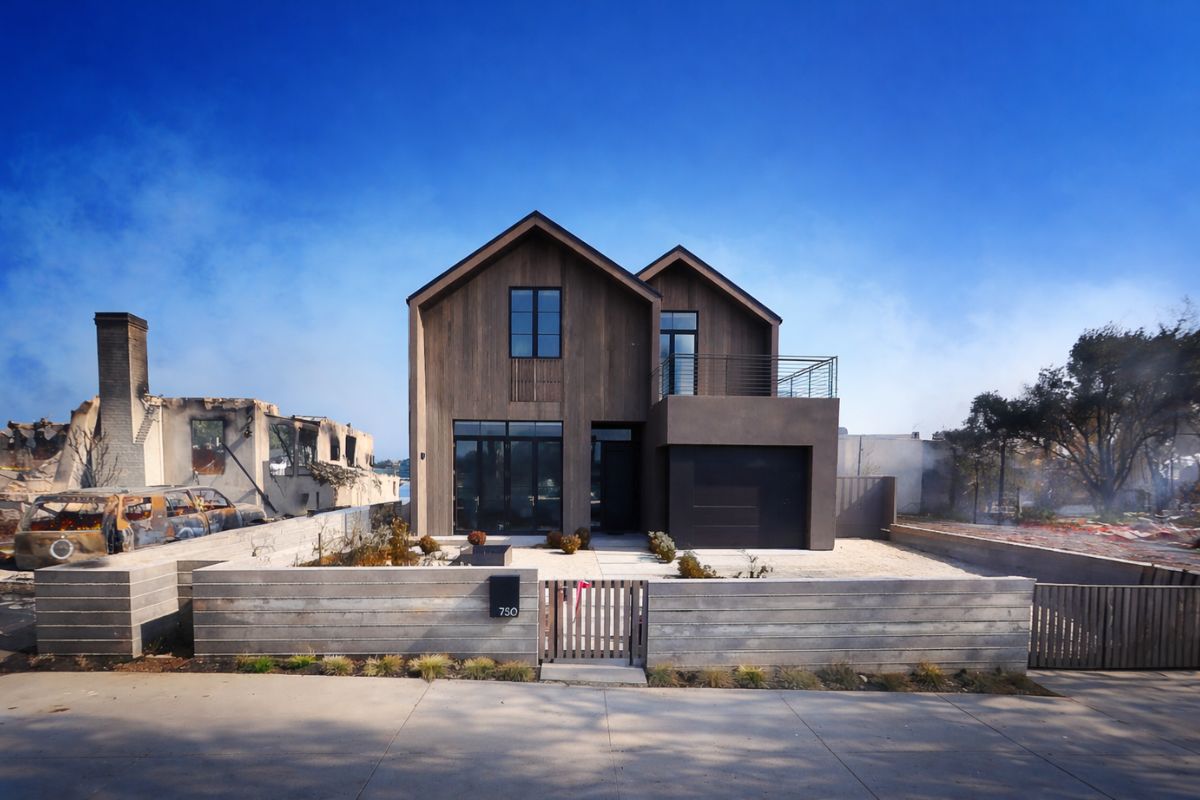
In Pacific Palisades, the wind-driven fire in January 2025 turned blocks to ashes, but a newly completed home crossed the aisle of embers with a Class A roof, no eaves, and nearly total sealing, exposing, in practice, the failures of old neighborhoods and reconstruction rules.
In January 2025, Pacific Palisades, in Los Angeles, became an involuntary laboratory of urban risk when a wind-driven fire hit a wildland-urban interface neighborhood. Numbers released for the physical toll varied from over 1,200 to over 12,000 buildings destroyed, with estimated damages of US$ 250 billion, while a new home remained virtually intact amidst the ruins and charred foundations.
The contrast became an operational question for architecture, firefighting, and public management: which choices in lot deployment and construction detailing reduce ignition from embers and collapse from radiant heat, and how much of this is replicable without dismantling the character of the neighborhood and without shifting cost and risk to the community.
Urban Geography That Fuels The Fire

The neighborhood has established itself as a scenic area since 1928, anchored on the slopes and ridges of the Santa Monica Mountains, reinforcing its position as a wildland-urban interface.
-
Friends have been building a small “town” for 30 years to grow old together, with compact houses, a common area, nature surrounding it, and a collective life project designed for friendship, coexistence, and simplicity.

-
This small town in Germany created its own currency 24 years ago, today it circulates millions per year, is accepted in over 300 stores, and the German government allowed all of this to happen under one condition.

-
Curitiba is shrinking and is expected to lose 97,000 residents by 2050, while inland cities in Paraná such as Sarandi, Araucária, and Toledo are experiencing accelerated growth that is changing the entire state’s map.

-
Tourists were poisoned on Everest in a million-dollar fraud scheme involving helicopters that diverted over $19 million and shocked international authorities.

This fit within the terrain, which enhances the landscape, also creates corridors that accelerate the fire front when winds reach extreme levels.
In the described incident, winds of up to 160 km/h were channeled by roads like tunnels, feeding flames with oxygen and facilitating jumps between homes.
The rotated road network and the elongated shape of the neighborhood also created evacuation bottlenecks, reducing useful exits and complicating team access when routes became congested.
The Engineering Of The New Home Against Embers And Winds

The new home replaced a three-bedroom missionary residence about a year before the event with a larger structure of 3,400 square feet, featuring five bedrooms, attributed to architect Greg Chason.
In everyday life, design decisions seemed radical but were put to the test when winds pushed the fire and created a continuous exposure environment to embers.
The first technical target was the immediate surroundings. Where there was vegetation touching the walls, creating a fuel continuity, the lot gained 9 meters of defensible space, with vegetation removed and replaced by gravel.
A concrete fence molded in boards reinforced the discontinuity, reducing the fire’s support points to advance toward the facade, and limiting the landscaping’s role as a thermal “bridge” to the building.
Class A Roof And Sealed Envelope: Where The New Home Gained Time

The second target was vulnerability from radiant heat when nearby structures burn, raising the chance of ignition even without direct flame contact.
Even homes with masonry and clay tiles can fail if they have projecting wooden eaves and flammable exterior materials, especially when lots are close together and the heating effect becomes domino.
The response in this project was to eliminate eaves and create a more continuous outer skin, with a metal roof, special substrate, and fire-resistant insulation, resulting in Class A roofing in flame propagation.
The volume orientation was also used to block dominant winds from the north, reducing airflow and decreasing direct ember impact on vulnerable spots.
The third target was embers carried by the wind, associated with most losses when they find openings and start internal ignition. There is reference that studies indicate that up to 90% of residential losses in wildfires start with embers.
The old house had several lateral ventilation openings, roof ventilation, and chimneys, classic entry points for embers.
The new envelope adopted nearly total sealing and minimal ventilation, reducing the chance of ignition from inside out and also limiting smoke infiltration that, in many survivors, precludes occupancy without heavy cleaning.
Code 7A, Accelerated Reconstruction, And The Risk Of Repeating The Fire
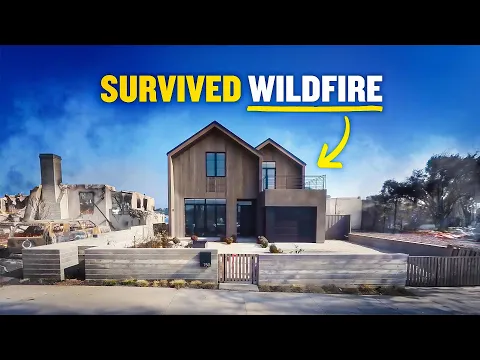

Part of the performance connects to formal requirements: new constructions in exposed areas in California must comply with Chapter 7A, in effect since 2008, with requirements for materials, openings, and components vulnerable to fire.
This helps explain why the new house was pushed to a level not required of neighboring century-old homes, which remained with solutions from a different era, often with eaves, gaps, and exposed ventilation.
The problem is that post-fire reconstruction often operates under a “comparable” replacement logic, preserving zoning, set-backs, and distances between neighbors.
When the urban fabric remains dense, any flaw increases collective risk from radiant heat and ember generation, especially under strong winds.
There is also mention of procedural flexibility by emergency order to accelerate works, which can reduce technical scrutiny just when the repetition of the fire ceases to be a remote hypothesis.
Compensations That Appear After The Fire
Survival did not come without social and usage costs. The new house is less charming for those who value historical continuity, and the yard swapped grass for gravel, altering the typical leisure experience.
Windows cease being elements to open and close often when the strategy is to reduce openings, and the nearly total sealing changes the everyday relationship with breeze, noise, and view.
At the same time, fire-resistant choices can bring collateral gains in energy efficiency, due to thicker walls and a sealed envelope.
The dilemma becomes not just individual: the question becomes how an entire neighborhood reduces ignition from embers, limits propagation under winds, and preserves urban identity without turning each lot into an isolated exception.
What Other Regions Are Trying To Do Before The Next Fire
There is mention of guidelines in fire-prone areas in Ventura County, combining wider streets, strategic landscaping, and smarter materials to achieve performance without a fortress appearance.
The goal is to increase fire resistance without destroying the neighborhood’s legibility, avoiding that a technical solution becomes a social rupture.
After devastating fires in Australia in 2019, communities also sought to integrate safety into the historical fabric, attempting to preserve local character while raising standards for ember and radiant heat protection.
In parallel, infrastructure appears as a structural piece of the problem: underground power, strategic water reserves, and evacuation and firefighting routes can separate survival from total loss, even when the wind pushes the fire in the worst-case scenario.
In the case of Pacific Palisades, the new house became a marker of contrast between what is already technically possible on the lot and what is still lacking at the neighborhood scale.
With the next fire treated as a matter of time, the discussion shifts from aesthetics versus safety to governance: where to build, how to regulate, and how to finance changes that respond to winds, embers, and density without pushing the risk from a house to the entire street.
Would you accept living in a new house with nearly total sealing, no eaves, and a Class A roof, even losing part of the “neighborhood vibe”, if it reduced the real risk in the next fire? In one sentence, what would you not give up: operable windows, a traditional yard, or the chance to cross winds and embers without losing everything?










Seja o primeiro a reagir!