





 Portuguese
  English
  Spanish
  5 min of reading
  0 comments


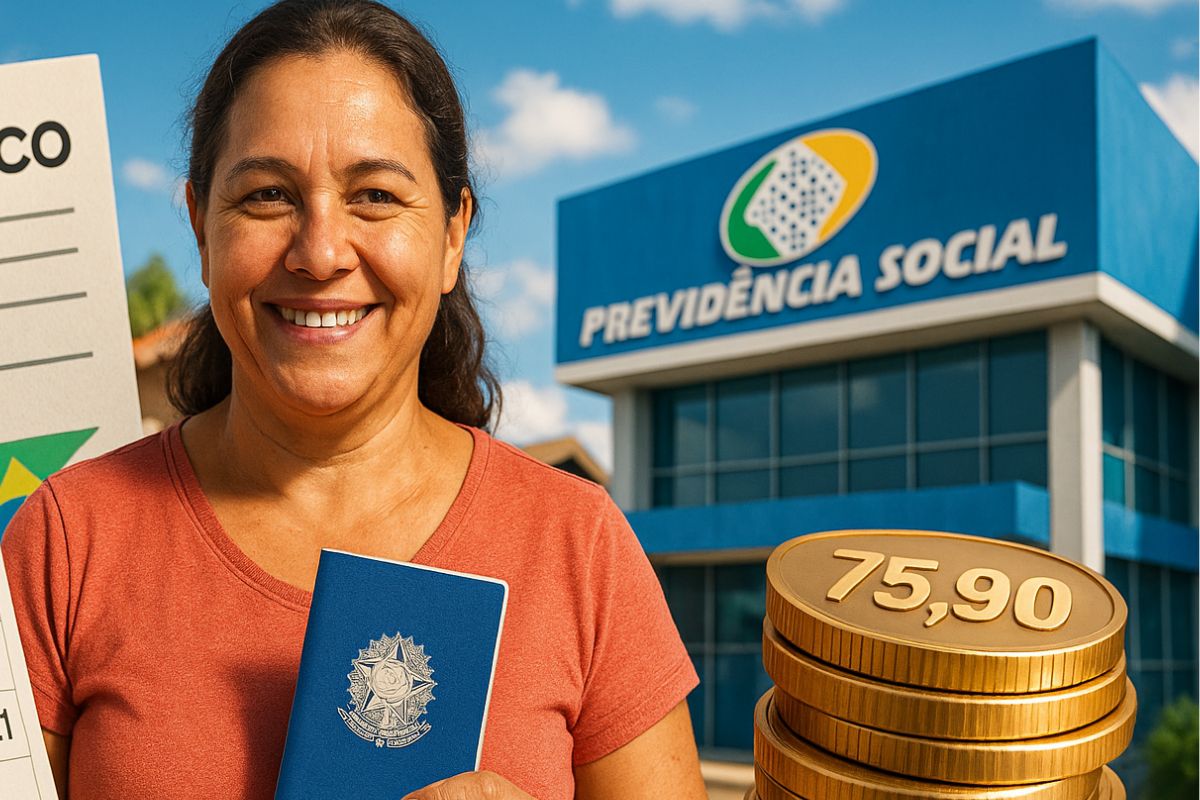
Retirement with R$ 75.90 per month ensures security for low-income housewives at INSS, with a 5% contribution and protection for illness, old age, the entire Brazilian family today.
With only 5% of the minimum wage, housewives registered in CadÚnico can contribute to INSS, ensure retirement by age, sick pay, death pension, and protection in cases of incapacity, avoiding dependence on family and securing minimum lifelong income in the future as long as they keep their contributions up to date and can prove low income.
Retirement paying R$ 75.90: how this low value guarantees INSS protection
For many people, retirement still seems like a distant and expensive dream. But the INSS rule for low-income contributors proves otherwise. By paying R$ 75.90 per month, the housewife registered in CadÚnico as low-income can ensure complete social security protection without needing to work formally.
This contribution model was designed precisely for those who take care of the home, have no income of their own, or live in a family with an income of up to two minimum wages. With discipline in contributions, this person acquires rights to benefits such as sick pay, retirement by age, and death pension for dependents, ensuring a minimum level of security in cases of illness, old age, or the provider’s death.
-
Havan buys historic football land in Blumenau for a million-dollar amount protected by a confidentiality clause and is already planning to change even the layout of streets to build a megastore in half-timbered style costing 80 million reais.

-
Mercado Livre “opens the vault” and announces a record investment of R$ 57 billion in Brazil in 2026, a value 50% higher than the previous year, with an expansion plan that includes 14 new logistics centers, totaling 42 units in the country and hiring an additional 10,000 employees.

-
How investment in technology can revolutionize the national economy and enhance industrial gains, according to a study that highlights the direct impact on productivity, innovation, and wealth retention within Brazil.

-
The largest food company on the planet, JBS, has just opened a 4,000 square meter laboratory in Florianópolis to develop customized proteins that modulate muscle mass gain, immune response, and metabolic performance.


Who can contribute 5% and have the right to retirement
The first step is to understand that not everyone can pay R$ 75.90 per month and have retirement with this reduced rate. INSS requires some basic conditions:
- Be registered in CadÚnico
- Prove that the family has a monthly income of up to two minimum wages
- Be classified as low-income, as a housewife without own income
- Contribute to INSS using code 1929 on the official payment slip
Without this registration and without being classified as low-income, the payment with 5% may be disregarded or may not generate all desired effects.
The correct registration transforms a small amount into a great shield of social protection.
What benefits does this contribution guarantee at INSS
Many people think that this modality only serves for retirement, but it goes far beyond that. By regularly contributing 5% of the minimum wage, the housewife gains rights to:
- Sick pay, if temporarily unable to work or perform usual activities
- Permanent incapacity retirement, if unable to perform any activities
- Retirement by age, as long as the time and age requirements are met
- Death pension for dependents, in case of death
All these benefits are based on one minimum wage, but the impact of this income in times of crisis is huge.
In cases of illness, disability, or death, a guaranteed minimum wage can mean the difference between having the basics to survive or being completely dependent on family and others.
Rules to obtain retirement by age with 5%
The low-income modality with 5% does not unlock immediate retirement. It follows the general retirement rules by age of INSS. Today, the requirements are:
- 65 years of age for men
- 62 years of age for women
- At least 15 years of contribution, adding all valid contributions
This means that it is not enough to pay a few months hoping to guarantee lifelong income. It is a long-term project, requiring planning and consistency.
The sooner a person starts to contribute, the sooner they accumulate the minimum required time for retirement.
The importance of insured quality and the 12 contributions
An essential point that many people overlook is the so-called insured quality. To access INSS benefits, including sick pay and death pension for dependents, one must be up to date with contributions or within the grace period.
In practical terms, this means that:
- At least 12 monthly contributions are required to qualify for various benefits
- Going many years without contributing causes a person to lose insured quality
- When insured quality is lost, benefits like death pension may not be granted, even if there are old contributions
Starting to pay only when illness appears or when the family is already in despair is often too late. Social security is not a patch, it is prevention.
The case of Mr. João: when delaying contributions costs a lifetime
The example of Mr. João shows, in practice, the extent of the risk of delaying contribution. He always worked odd jobs, never contributed to INSS, and had no retirement planning.
When he fell ill, the family sought guidance, but many years had passed since he last contributed.
The wife was advised to start contributions as soon as possible, precisely to try to recover social security protection.
She only started making payments when his health condition was already very serious. In the fourth month of contribution, Mr. João passed away. Result:
- There were no 12 recent contributions
- He did not have insured quality
- The widow was not entitled to the death pension
- The family was left without INSS income, even after starting to pay
This kind of story repeats in thousands of homes across Brazil.
Without contribution, there are no benefits. And contributions made too late do not make up for years of neglect.
Why the contribution of R$ 75.90 should be a priority in the household
When someone takes care of the house, the children, the partner, or the parents, they are working. The problem is that this work does not show up on the payroll, does not appear on the paycheck, and if no one contributes to INSS, it does not generate retirement or pension.
That is why so many experts recommend that, whenever possible:
- The husband, partner, or children help to pay the 5% contribution
- The family treat this amount as a fixed bill, like water, electricity, or groceries
- The housewife organizes to keep CadÚnico updated
R$ 75.90 may seem little today, but it can be the money that guarantees medicine, food, and paid bills in the future, at a time when the person may no longer be able to work or may not even be present to take care of the family.
Retirement as Life Insurance in Life
Thinking about retirement is not a luxury, it is survival. INSS works like insurance:
- If you pay, you have rights
- If you don’t pay, you have no protection, even in dramatic situations
The low-income contribution with 5% is precisely the entry point for those who have always heard that social security is for those who earn well.
It transforms a housewife without her own income into an insured person of INSS, with formally recognized rights.
In the future, this can mean:
- Having retirement by age, even without ever having worked formally
- Guaranteeing death pension for children and partners
- Having rights to sick pay or permanent incapacity retirement, if health fails
The question is not whether you can afford to contribute, but whether you can afford to be without any protection.


Are you already contributing to your retirement with the reduced rate of 5% or are you still delaying this decision that could completely change your security in the future?








Seja o primeiro a reagir!