





 Portuguese
  English
  Spanish
  3 min of reading
  0 comments


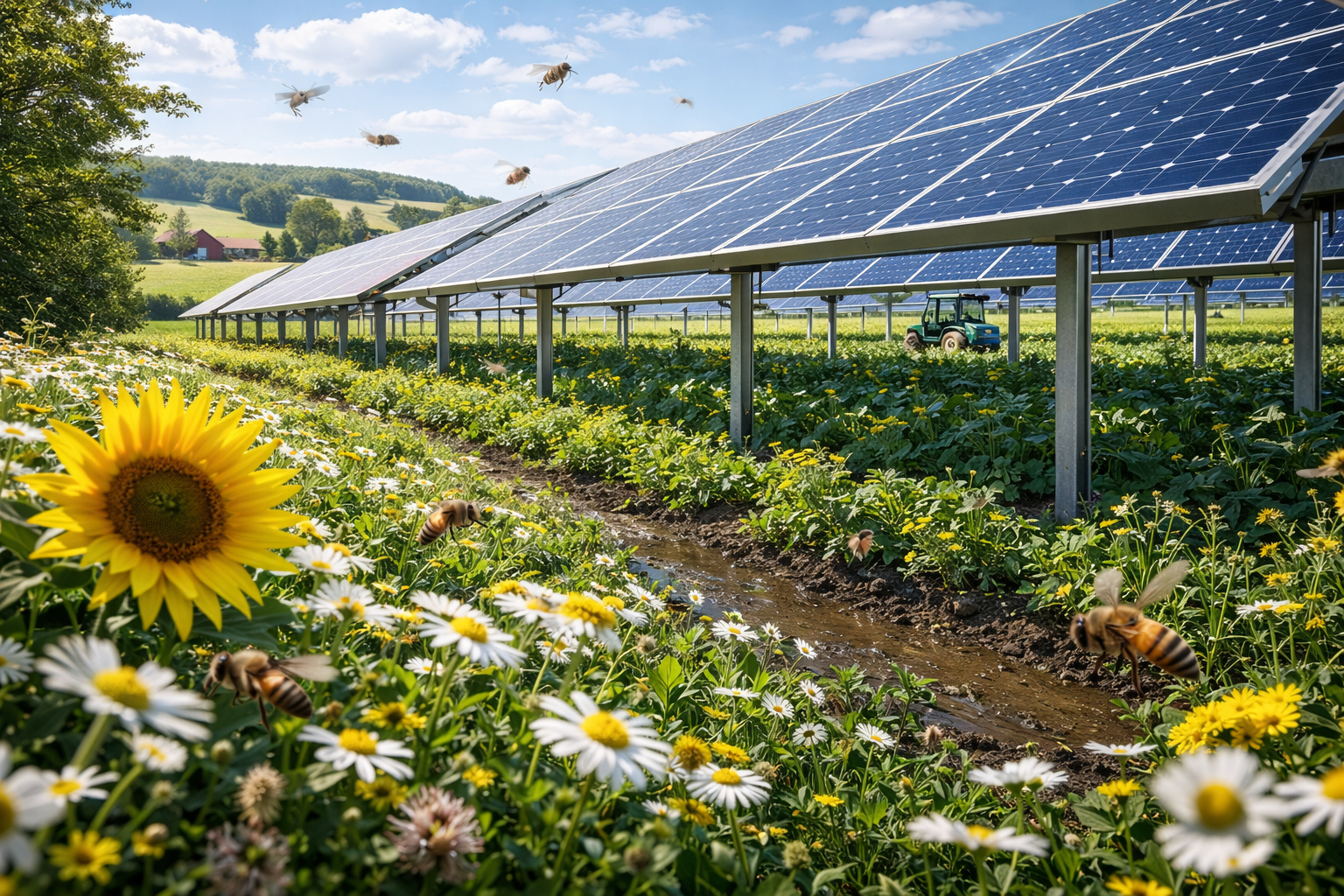
The Adoption of Solar Panels in Agricultural Areas Revealed That Renewable Energy Generation Can Coexist with Rural Production, Promoting Environmental Benefits, Soil Balance, and Strengthening Biodiversity Over the Years
The installation of solar panels on large agricultural farms was initially thought of solely as a solution to expand clean energy generation. However, five years after implementation, the observed effects went beyond electricity. The areas gradually began to function as natural refuges for bees, indicating that agriculture and renewable energy could coexist with significant environmental gains.
Furthermore, this unexpected result drew the attention of researchers and farmers. Thus, it became evident that agrovoltaics, when well planned, contributed to ecological balance, soil protection, and agricultural productivity, as per studies conducted since the 2010s.

Agrovoltaics Advances After Decades of Studies and Cost Reduction
The practice of agrovoltaics began to be studied back in the 1980s, when researchers started to evaluate the simultaneous use of land for cultivation and energy generation. However, at that time, high costs and technological limitations hindered its widespread adoption.
-
While Brazil wants to end the 6×1 work shift, the president of Argentina wants 12 hours for his workers, increasing political tension in the country.

-
The village where two rivers run side by side without mixing in Santarém and Alter do Chão reveals some of the most beautiful freshwater beaches on the planet.
-
Mars is accelerating, and scientists have discovered that the planet’s day is getting shorter, revealing surprising signs of internal activity.

-
Artemis 2 is set to launch on April 1 at 7:24 PM to orbit the Moon with four astronauts, but a class X solar flare and coronal mass ejection could interfere with communications and threaten the launch.


This scenario gradually changed, especially starting in 2018, with technological advancements and reduction in photovoltaic system costs. As a result, farms began to integrate solar panels without abandoning agricultural production, increasing the economic viability of the model.
Soil Changes Created More Stable Conditions for Crops
With the installation of solar panels, direct changes occurred in the soil. The structures began to create partial shade areas, reducing water evaporation and protecting plants from excessive heat.
As a consequence, the soil retained more moisture and thermal stability, benefiting crop development, according to agronomic analyses conducted between 2019 and 2024.
Reduction of Chemicals Favored Environmental Balance
In addition to physical changes, these areas began to receive fewer chemical interventions. With less frequent spraying and greater presence of spontaneous vegetation, the environment became more balanced over time.
This new scenario began to directly favor pollinators, especially bees, which found safer conditions to establish themselves.
Bees Find Shelter and Expand Regional Pollination
Environmental research indicated that the spaces beneath the panels gathered shade, plant diversity, and reduced pesticide use, creating an ideal habitat for pollinators.
As a result, the bee population increased significantly over the years. This growth was not restricted to the covered areas but also began to impact the neighboring fields, enhancing agricultural pollination.
Productive Gains and Natural Pest Control
With more bees in circulation, nearby crops showed better productive performance. The more efficient pollination contributed to agricultural gains and strengthened ecological balance.
Another relevant effect was natural pest control, which reduced the need for chemical pesticides, lowering costs and environmental impacts, according to assessments consolidated until 2025.
Model Unites Economic Return and Preservation of Biodiversity
In addition to environmental benefits, agrovoltaics generated additional economic return through solar energy production. Thus, farmers began to count on a complementary source of income.
With the advancement of taller panels, adjustable modules, and technologies compatible with agricultural machinery, experts in renewable energy and sustainable agriculture indicate that this model is likely to expand, uniting clean energy, rural productivity, and biodiversity preservation.









-

Uma pessoa reagiu a isso.