





 Portuguese
  English
  Spanish
  9 min of reading


The Brazil is advancing at full speed in the hydrocarbons sector reforms. The latest proposals include reducing local content demands, liberalizing the gas market, and boosting field sales to attract new investors. These measures aim, in part, to help Petrobras further reduce its debt and focus more on growth in the deep-water pre-salt areas. Companies like Shell and others described some of the developments early last year at the Brazil-UK Oil and Gas Seminar in London.
According to Décio Oddone, director-general of the National Agency of Oil, Natural Gas and Biofuels (ANP), the country’s oil and gas sector has undergone major transformations in the past three years in response to the events of 2014. At that point, Petrobras was in financial crisis due to a combination of paralyzing debt, a corruption scandal, falling oil prices, and the fact that the government had suspended new bidding rounds for the past five years. As a result, the number of new wells and activities in general outside Brazil declined.
To reverse the decline, the ANP, in conjunction with the government, began adopting a series of measures that included opening the pre-salt to new players and holding bidding rounds more regularly. The bidding rounds of 2017 and 2018 were a tremendous success, Oddone stated: “Wood Mackenzie stated that between 2016-18 there were about 100 bidding rounds in 82 countries, resulting in the awarding of 3,000 exploration blocks. Of these, only 72 were in Brazil – but these blocks attracted US$ 7.5 billion from the global bidding of US$ 9 billion. So, Brazil ended up with 75% of the financing available in these deals. But that is still not enough, so we must continue to do things the right way.”
-
Offshore industrial demand in Macaé surges with the recovery of oil and gas and could grow by up to 396% by 2026 in the Campos Basin.
-
Brazilian giant expands borders in the Southeast: Petrobras confirms new oil discovery in ultra-deep waters in the pre-salt of the Campos Basin.

-
Alert in the global energy market: Severe tropical cyclone hits the coast and disrupts gas production at major plants in Australia, threatening global supply.

-
Petrobras finds high-quality oil in the pre-salt at 113 km from RJ and reignites expectations about strategic reserves in the Campos Basin.


During the second half of 2019, the ANP planned three licensing rounds, with auctions expected at the end of the same year. The first was the 16th Concession Bidding Round, with 36 blocks on offer in the pre-salt in the southern zone of Camamu-Almada, Campos, Jacuípe, Pernambuco-Paraíba and Santos basins, plus other blocks in northeastern Brazil. The focus of the 6th Production Sharing Round was the most attractive pre-salt blocks in the Aram, Bumerangue, Cruzeiro do Sul, North of Brava and Southwest of Sagittarius areas in the southeast. Finally, and potentially the most lucrative, was the Transfer of Rights Round covering some of the most coveted pre-salt prospects in Brazil.
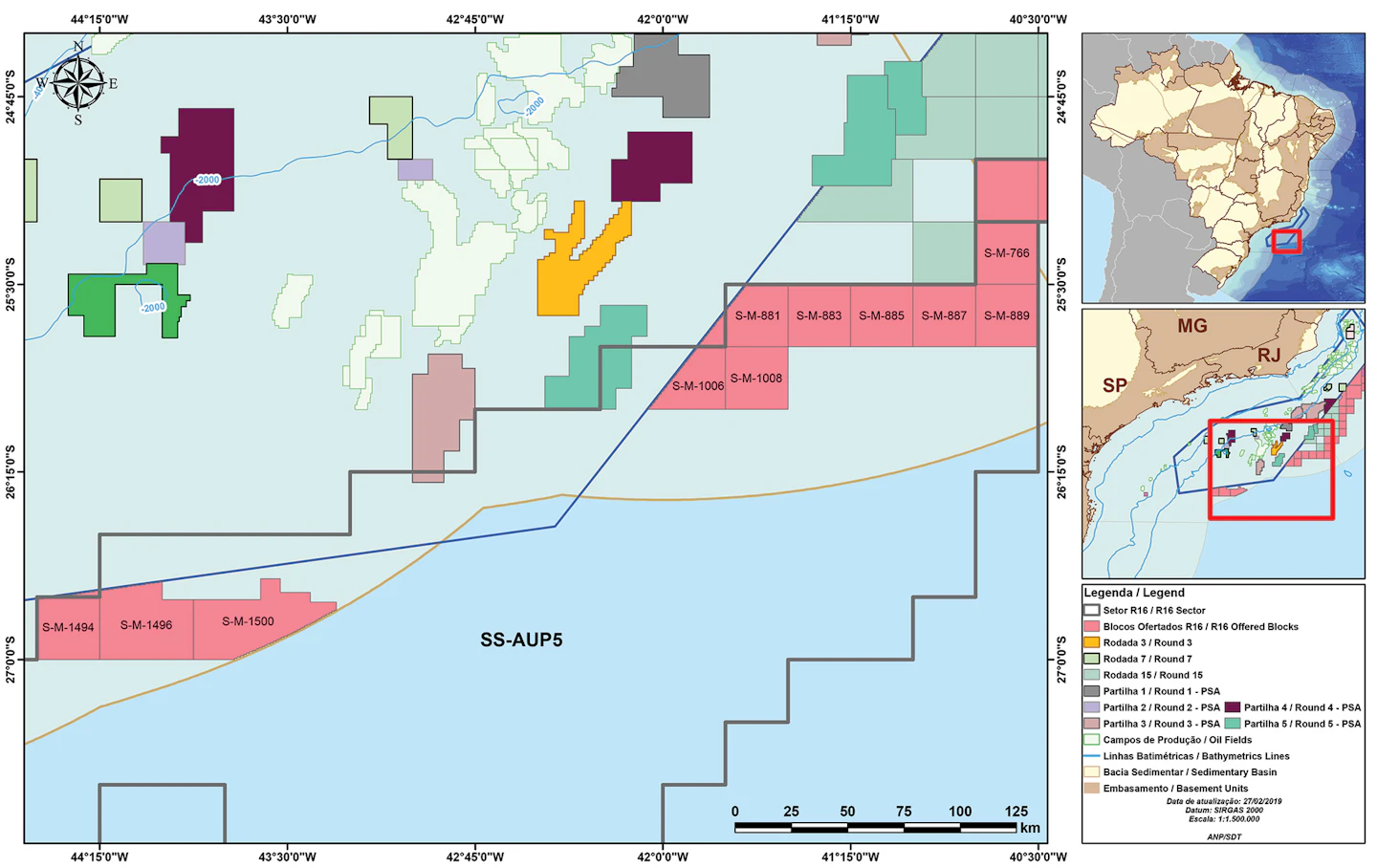 Blocks on offer in the Santos basin for the 16th Bidding Round.(Courtesy ANP)
Over time, the results of the 2016-19 auctions transformed the sector and Brazil’s oil, as Oddone suggested, more than doubling the country’s production, while the number of operating pre-salt platforms outside Brazil could nearly double, with significant implications for the country’s supply chain. However, the ANP is also looking to attract new small and medium-sized companies to some of the neglected onshore and shallow water prospects of Petrobras. Thus, a new regime was established in which all best available areas will be permanently offered. In 2018, the ANP invited Petrobras to define which of its concessions it wanted to keep, and the response was that over 77% could be sold. “So we can see a huge increase in new companies operating in certain areas,” Oddone said,
In collaboration with the Portuguese oil company GALP, the ANP is also investigating Petrobras’ dominance of the Brazilian natural gas market. The government announced changes to streamline business, he added, encouraging competition to attract new players – including pre-salt gas producers – to deliver more gas to consumers in the country instead of injecting most of it, as is still the case. “All these new measures, aimed at attracting all competitors, will put us in a position that Brazil has never been in before,” he concluded, “creating a more diversified and attractive oil and gas sector.”
Helping Investors
Felipe Rodrigues Caldas Feres, Partner at Mattos Filho, Veiga Filho, Marrey Jr and Quiroga Attorneys, provided a legal perspective on investment in the oil and gas industry in Brazil. Despite the recent bidding rounds, Petrobras maintains a monopoly on transportation infrastructure, Feres highlighted, which makes gas and fuel in Brazil extremely expensive. However, the new government elected last year is looking to curb investments in hydropower and do more to harness the country’s offshore natural gas for energy purposes.
“The new government’s policies are very business-friendly,” he said, adding that these policies played a key role in the success of the recent bidding rounds, especially for pre-salt areas. They include greater legal security for investors and tax incentives for importing more goods for E&P purposes.
Previous administrations heavily leaned towards nationalist policies, increasing local content requirements for oil and gas projects to up to 65% in the case of the initial Libra FPSO block. But now the terms have been relaxed, “for those who know Brazil, the country does not have the necessary shipyard capacity.” Other positive developments included the disclosure of historical geological data, previously accessible only by Brazilian companies, and a stronger arbitration policy, particularly regarding the unitization of overlapping fields in contiguous blocks. This followed pressure from new investors.
As for asset sales, a necessity for Petrobras to reduce its debt, the company now has two ways to do so, Feres said. One is through regular rounds of national bidding, and the other, according to laws passed in 2016, is through deals with other international oil companies. The transfer of rights round, slated for launch in October, will provide another means of liquidation and could raise over US$ 100 billion in signing bonuses, making this the largest auction of its kind ever held in the world.
Another priority of the new government is midstream, expanding the use of Brazilian gas. “Along with the sale of Petrobras assets, new regulations are coming to foster investments, and that is happening,” he said. “Additionally, gas is being imported to regasification terminals, although these are seen as a bridge to new offshore infrastructure expected in the coming years.”
Changes are also underway in the government’s approach to R&D for the new bidding rounds. “R&D, like local content, has been a failed policy,” Feres argued. “Simply giving money to Brazilian universities that do not have good governance is a waste.”
Pre-Salt Milestones
In 2019, Petrobras completed 10 years of production from the pre-salt. According to Isabela Mesquita, executive manager of Investor Relations, the company currently has 24 platforms operating in pre-salt areas, with 17 producing exclusively in the pre-salt and another six in both pre-salt and other layers. Pre-salt oil production reached a new high of 1.4 MMb/d and 1.7 MMboe/d overall, she added. “But it has been a learning curve. The first well took 300 days to drill and complete; now the process takes less than 100 days. At the same time, Petrobras cut its extraction costs from the pre-salt from $14/bbl to $7/bbl.
“The fields are giant resources with high productivity wells delivering light oil with low sulfur content. This used to be a frontier development activity, but it is no longer.” Last year, she added, Petrobras commissioned another seven platforms in the pre-salt, four in the Búzios transfer of rights area and two – P69 and P67 – in the Lula field, both in the Santos basin; and another in the Campos basin. The company is also heavily investing in the post-salt Campos basin – in Marlin and other producing fields, and also in exploration. In 2018, Petrobras acquired stakes in 11 exploratory blocks outside Brazil. Mesquita forecast expenditures of US$ 11 billion over the next five years, some of which will be allocated to concessions granted in future bidding rounds.
As production increases from the wells connected to the seven new platforms, the company’s output is expected to grow by 7% this year and then by another 5% per year until 2023, by which point another 11 new platforms should have come into service. Many will be in the pre-salt fields, with two replacing the old facilities in Marlin, where Petrobras is looking to recover another 1 Bbbl.
In the Campos basin, the Equinor, as a relatively new partner, is applying its North Sea expertise to help enhance recovery from the giant Roncador field in deep water. Petrobras sees potential to boost recovery in other mature fields to 50-60% and is open to new partnerships, she added.
Gas Initiatives
Ana-Paula Saraiva, executive manager of Acquisitions and Divestments at Petrobras, stated that the company raised US$ 50 billion in asset sales between 2016-2018 and aims for another US$ 26-27 billion in divestments over the next five years. Among the most recently completed deals is the sale of a 90% stake in the Transportadora Associada de Gas (TAG) pipeline network to ENGIE and the Canadian fund Caisse de Dépôt et Placement du Québec. But the main impetus for future divestments will be in E&P, Saraiva noted, with nearly 70% of Petrobras’ more mature fields included in the program, from northwest to southeast of the country. “This is a great opportunity for other companies with smaller cost bases to come to Brazil and invest in these assets that do not fit Petrobras’ [future plans] but still have oil.”
Saraiva also addressed the latest initiatives to harness larger volumes of associated offshore gas, mainly in pre-salt fields where in some cases it represents 30% of the existing resource. Currently, the country imports much of its gas needs through three LNG terminals and a land pipeline from Bolivia. BP, ExxonMobil, and Shell are all investing in gas projects for power generation to monetize their associated gas in Brazil, and ExxonMobil is importing LNG from Qatar. But additional measures are needed to increase competition and provide greater incentives to potential gas producers. Pre-salt gas, which has high CO2 and low sulfur content, will be expensive to develop and to place in the necessary transportation infrastructure, she added; floating LNG ships may be another option.
For Shell, gaining entry into the Libra field block in deep water in 2013 was “a major milestone,” said Fabio Gaspar, Tax Manager, Structuring and Advisory of the company and former Head of Upstream Tax for Brazil. “It was a play of about 10 Bbbl to be explored and developed, which was a game changer for Shell in Brazil. Then, about two years ago, after the merger with BG Group, we were able to access other joint ventures in the upstream space.”
In 2018, Shell invested US$ 66 million in R&D in Brazil, and the company expects to spend US$ 1-2 billion on its current assets. Additionally, it will consider upcoming bidding rounds and farm-in and farm-out opportunities.
“I also believe that field decommissioning will be huge,” Gaspar said, “with Brazil being number 3 in the global $100 billion market, according to Wood Mackenzie.” •
Brazil’s Transfer of Rights Round
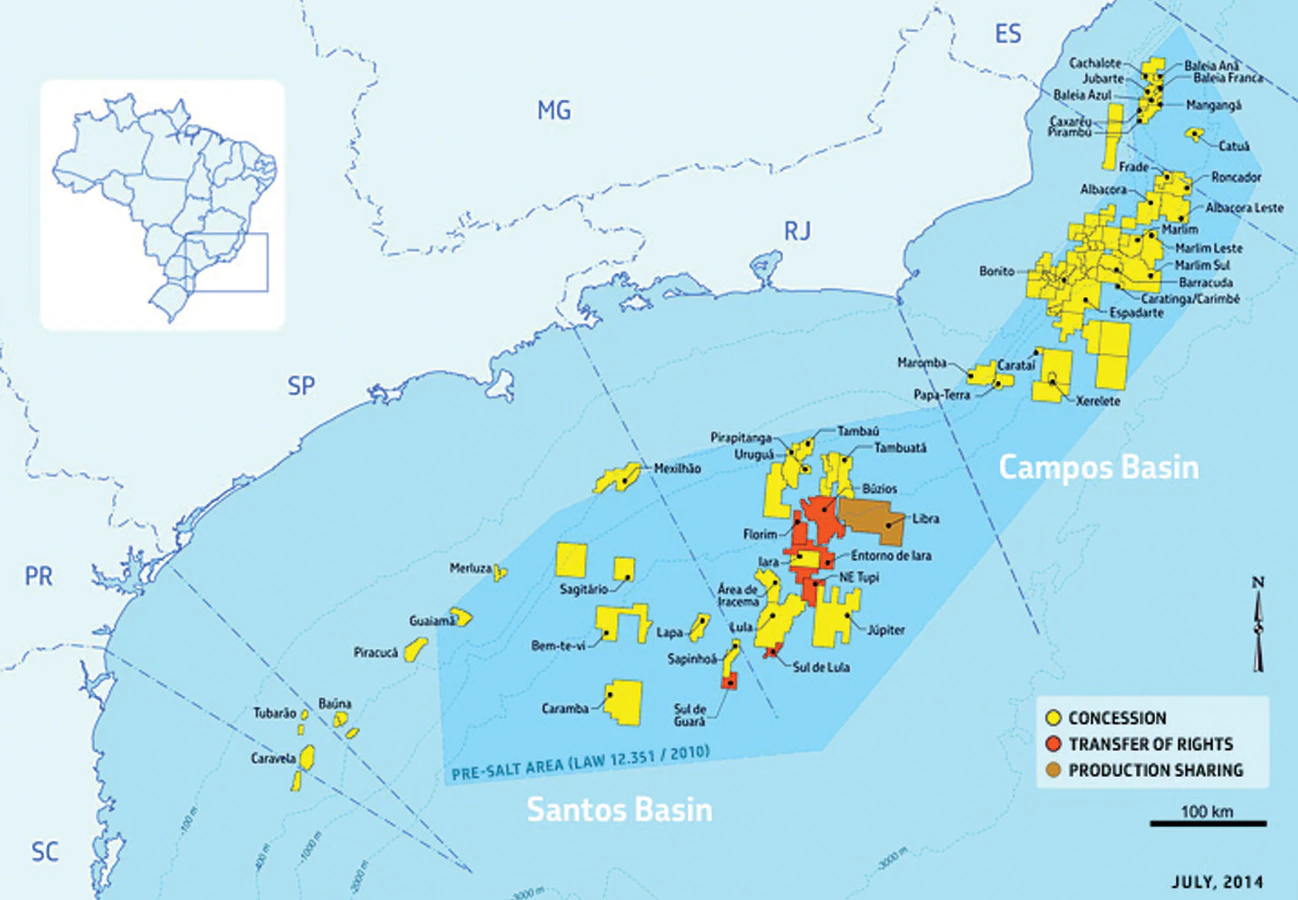 Petrobras’ (in red) share in the Transfer of Rights Area of the pre-salt in the Santos basin.(Courtesy Petrobras)
In early 2019, Petrobras reportedly resolved a contractual dispute with the Brazilian government regarding the transfer of rights area, a 2,800 km2 (1,081 km2) zone covering some of the most promising pre-salt prospects in southeastern Brazil. The zone was first outlined in 2010, with Petrobras having exclusive rights to develop and produce up to 5 Bboe from ‘unconceded’ areas. Búzios was the first field to be declared commercial and subsequently developed, but Petrobras then sought revisions to the original contract, as new studies indicated much larger oil volumes within the designated area (up to 15 Bbbl).
The dispute prevented the government from auctioning off additional oil until early 2019 when the new government appointed a new CEO for Petrobras. After an agreed payment, Petrobras agreed to the government’s plan for a transfer of rights round for the ‘surplus’ oil from the Atapu, Búzios, Itapu, and Sépia fields in the Santos basin, with Petrobras’ mandatory participation as operator (with a 30%) in the Búzios and Itapu areas. Wood Mackenzie suggested that the signing bonuses from the auction alone could exceed US$ 26 billion, and winners will also have to pay Petrobras compensation for its participation in projects that the company already operates.









Seja o primeiro a reagir!