





 Portuguese
  English
  Spanish
  5 min of reading
  0 comments


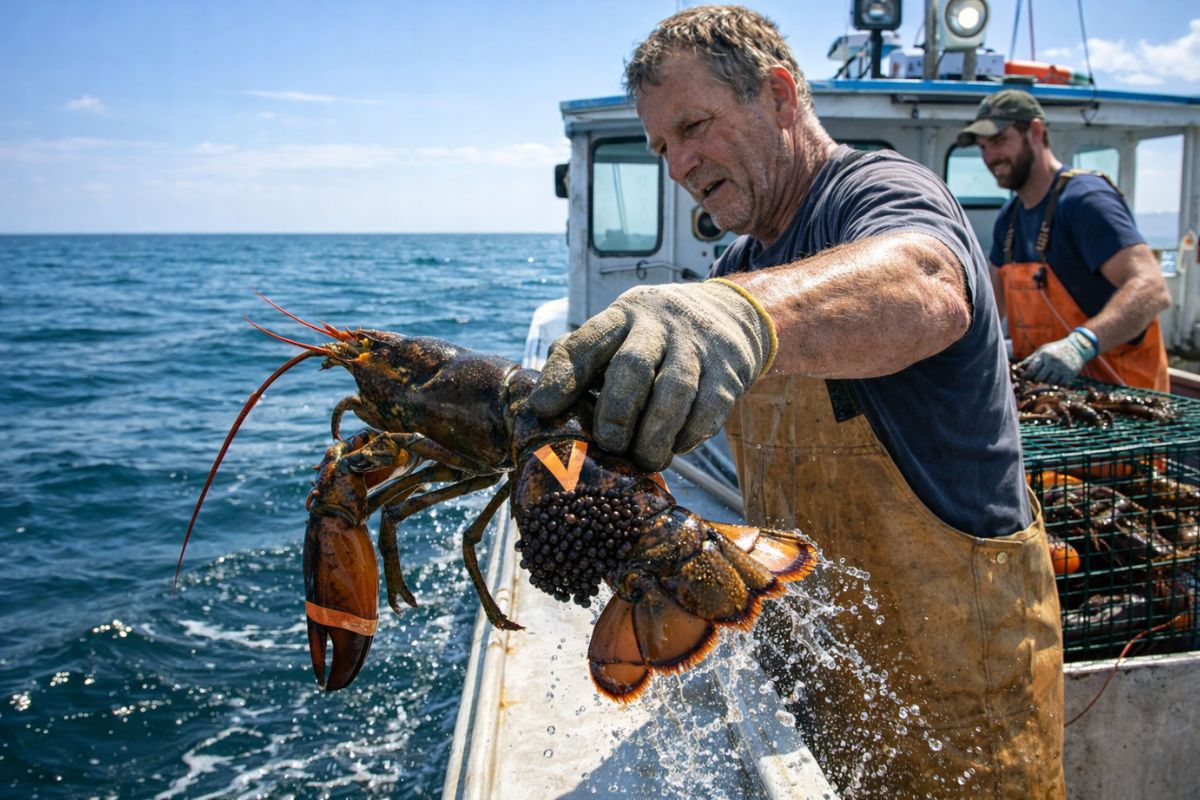
Understand How Lobster Management Protects Egg-Bearing Females, Uses V-Notching, and Balances Conservation, Economy, and Jokes About Gender at the Same Time
The video circulating on X shows fishermen holding lobsters for a few seconds, assessing size and sex, returning juveniles and egg-laden females to the sea, and mainly keeping males for commercialization. While the narrator jokes with the idea that, on that vessel, “the men get screwed,” the camera captures a real procedure of legal lobster fishing, including the V-notch marking on the tails of egg-bearing females.
Behind the humor lies a routine of sustainable lobster management, which attempts to reconcile income today with available lobsters tomorrow. By protecting breeders and limiting what can be taken to shore, the practice reduces the risk of stock collapse and shows, in a few seconds, how technical standards and environmental legislation come into the daily lives of those who depend on fishing.
What Are the Main Rules for Lobster Fishing?
Lobster fishing is organized by rules that dictate which lobsters can stay on board and which must be returned to the water immediately. Generally, the focus is on three basic pillars of management:
-
Motorola launched the Signature with a gold seal from DxOMark, tying with the iPhone 17 Pro in camera performance, Snapdragon 8 Gen 5 that surpassed 3 million in benchmarks, and a zoom that impresses even at night.

-
Satellites reveal beneath the Sahara a giant river buried for thousands of kilometers: study shows that the largest hot desert on the planet was once traversed by a river system comparable to the largest on Earth.

-
Scientists have captured something never seen in space: newly born stars are creating gigantic rings of light a thousand times larger than the distance between the Earth and the Sun, and this changes everything we knew about stellar birth.

-
Geologists find traces of a continent that disappeared 155 million years ago after separating from Australia and reveal that it did not sink, but broke into fragments scattered across Southeast Asia.

- Minimum Size for capture, ensuring that lobsters have time to reproduce at least once
- Protection of Egg-Laden Females visible under the abdomen, which are considered priority breeders
- In some regions, Maximum Size for very large individuals, which also act as significant breeders
The objective is simple: explore lobsters without destroying the population’s ability to renew. When these rules are respected and enforced, production tends to remain stable for longer, avoiding sharp declines in catch and losses for communities that rely on lobster as a source of income.
Therefore, what appears in the video is not just a random choice by the fisherman: it is the practical application of rules that define which types of lobsters can become products and which must remain in the sea to sustain the reproductive cycle.
Why Do Egg-Bearing Females Receive V-Notching?
The V-notch in the tails of egg-bearing females is one of the simplest and most effective tools for protecting breeding lobsters. When a female is caught with eggs attached to her abdomen, the fisherman cuts a fin in the tail in a V shape and immediately returns the animal to the sea.
This small cut transforms the lobster into a living signal of high reproductive importance. In subsequent years, even if she is without visible eggs, the mark remains, making it easy to recognize with the naked eye.
In management systems inspired by regions such as the East Coast of the United States, any female with a V-notch must be released again, without counting towards production.
In practice, this allows the same female lobster to contribute for several consecutive seasons to the abundance of the species, adding thousands of eggs over her lifetime. All this comes with a very low implementation cost, simple visual monitoring, and a clear message on board: lobster marked with a V is a protected breeder, not merchandise.
How the Viral Video Blends Lobster Management and Gender
In the viral video, the routine of separating lobsters that stay on board from those that return to the sea becomes the basis for a joke about gender relations.
Egg-bearing females and juveniles are spared, while males, in the majority, remain for sale. The narration appropriates this biological and legal logic to assert that, on that boat, “the men get screwed.”
This humorous reading creates a curious bridge between biology, environmental legislation, and culture. The same scene where the fisherman checks minimum size, identifies eggs, and notices the V-notch is interpreted as a metaphor for disputes between men and women in everyday life.
In the comments, people mix laughter with genuine questions about why so many lobsters return to the sea. Some highlight the social irony, while others are impressed to realize that this is, in fact, a conservation rule.
Thus, a quick joke helps bring visibility to practices that generally remain hidden in technical reports or in regulations that few people read.
Concepts of Sustainable Fishing That Appear in the Images
Although it was born as entertainment, the video functions almost like a “crash course” in lobster management, practically demonstrating some central concepts of sustainable fishing:
Catch Rule and Minimum Size
When the fisherman returns lobsters that are smaller, he is applying the principle of only catching individuals above a defined minimum size. The idea is simple: let the lobster grow, reproduce, and only then become a product, preserving the life cycle.
Protection of Egg-Laden Females
Females with eggs under the abdomen fall into another category: mandatory return to the sea. They carry a vital part of the next generation and are essential for the natural renewal of stocks.
By marking them with a V and releasing them, fishermen turn each female into a “reproductive asset” that should not be harvested.
V-Notching and Identification of Breeders
The V-notching appears as a simple technique to ensure continuous protection. Just looking at the tail is enough to know that the lobster has been identified as a good breeder and should be released. No sophisticated equipment, apps, or chips are required, just basic training and adherence to the rules.
Balance Between Economy and Conservation
Finally, the video shows that it is possible to work with lobsters without depleting the resource. The egg-bearing females and juveniles return to the sea, while the allowed individuals ensure immediate income.
This logic tries to reconcile the short-term financial needs of fishermen with the long-term availability of lobsters for the entire community.
What Social Media Teach About Lobsters and the Environment
The virality of a video showing fishermen selecting lobsters demonstrates that environmental themes gain traction when wrapped in storytelling, humor, and clear visuals.
Instead of a long technical text, the public sees a simple scene: some animals return to the sea, others stay in the box, someone makes a joke, and that’s it, the discussion is launched.
Even when the initial goal is just to elicit laughs, practices such as returning juveniles, protecting egg-laden females, and V-notching end up gaining visibility.
People who might never have encountered the subject begin to recognize the importance of environmental rules for food availability and the health of marine ecosystems.
In the end, the video helps translate into everyday life what is theoretically called management, fish stock, sustainability, and legislation.
By showing fishermen complying with the law in front of millions of viewers, it reminds us that the future of lobsters depends as much on the rules on paper as on the choices made with each throw of net or trap.
For you, should this type of video helping to explain why so many lobsters are returned to the sea appear more on social media, or is the topic of sustainable fishing still underexplored in viral content?







Seja o primeiro a reagir!