





 Portuguese
  English
  Spanish
  4 min of reading
  2 comments


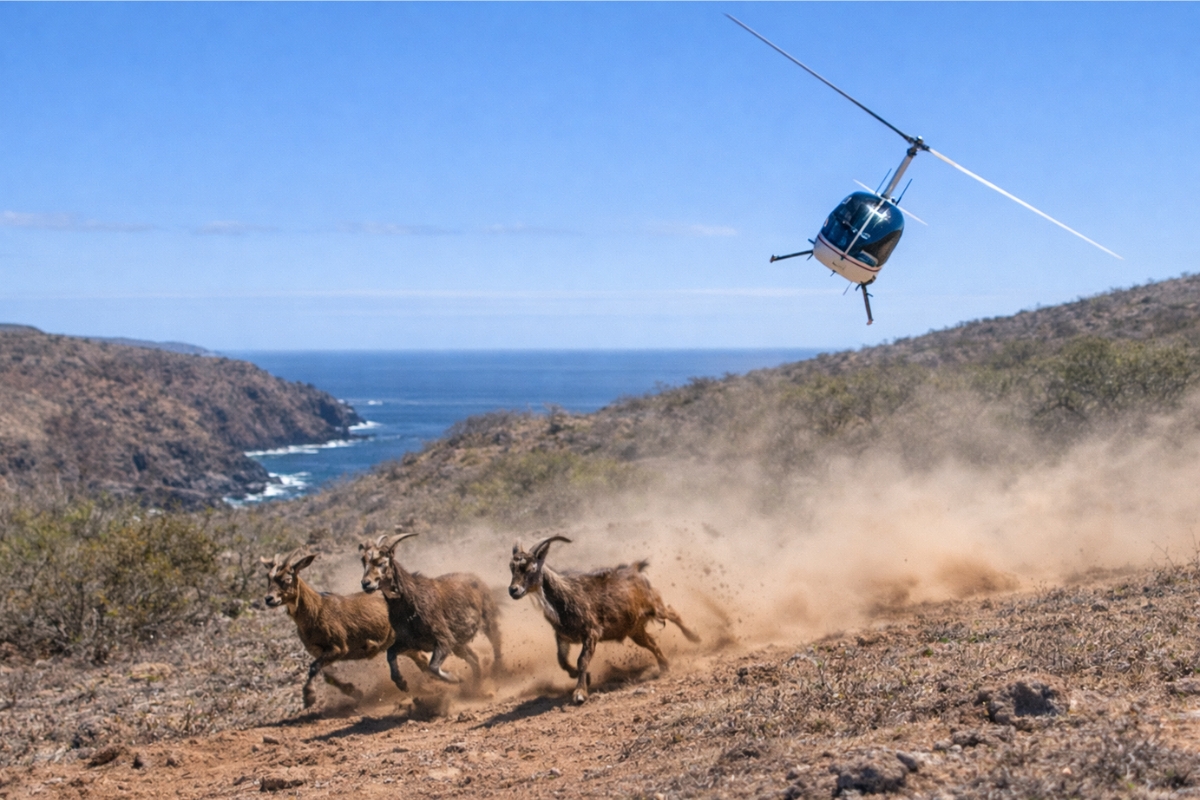


The Campaign in the North of Isabela Island Removed 62,818 Goats in 2 Years for US$4.1 Million, Using Aerial Hunting and Monitoring to Reduce Reintroduction Risk in the Archipelago
On islands, a large invader changes the game quickly. Feral goats consume seedlings, open clearings, and accelerate erosion, weakening the natural recovery of the habitat.
When the area is vast and the terrain is difficult, eradication becomes a precision operation. The focus shifts from just removing many animals to finding the last, the most elusive, before the cycle begins again.
Why Isabela Island Became the Center of the Board
Isabela Island has a scale that imposes strategy. In the north, the campaign targeted 458,812 ha, a section that required speed and broad coverage to avoid permanent refuges.
-
With a cost per shot close to zero, the DragonFire laser could change naval warfare in 2027 and provide British ships with nearly unlimited defense against drones.

-
A British startup creates tires that generate electricity in electric vehicles when passing over potholes, speed bumps, and cracks.

-
Scientists have created robots made with living cells that have their own nervous system, swim on their own, explore the environment, and self-organize without any genetic engineering, and now they want to do the same with human cells.

-
Students create a solar-powered ambulance that operates without a plug, without fuel, and still keeps medical equipment running in remote areas.

The presence of lava, remote areas, and irregular vegetation pulled the plan to the sky. The logic was simple: gain ground quickly, reduce densities, and then switch methods for the final phase.
Helicopters Enter the Scene and Set the Pace
Starting in March 2004, removal gained momentum with aerial hunting. Between April 2004 and May 2005, 55,657 goats were killed by helicopter, which defined the initial advance.
Land hunting played a supporting role, aimed at sections of denser vegetation. In the total campaign, this effort accounted for 2,637 goats, far below the volume obtained from the air.
When Density Drops, the Challenge Becomes Invisible
The end of an eradication is where costs usually rise. Fewer animals mean more hours to find signs, more flights, and a greater risk of leaving a hidden breeding group.
In the region itself, one example helps illustrate this pressure: on Santiago Island, 79,579 goats were removed in 4.5 years for US$6.1 million, and the last 1,000 required US$2 million in 1.5 years.
Judas Goats Function as Field Radar
With the density drop, the method shifted to Judas goats, equipped with radio telemetry collars, used to locate remnants by social behavior. This step was crucial to concluding the search in large areas.
According to the Galápagos National Park, the governing body of the archipelago’s protected areas, monitoring in Isabela totaled 465 days and 5,470 signal checks, supporting the final phase of the operation.
The last wild goat in the north of Isabela was eliminated in December 2005. Monitoring ended in March 2006, closing the campaign with 62,818 goats removed for US$4.1 million.

Return Risk and the Cost of Correcting Reintroductions
Even after an island is declared free, the risk does not disappear. Intentional reintroductions have already occurred in the archipelago and require a swift response, with financial and personal expenditure.
There is a record of removal after a return in Santiago in 2009, costing US$32,393 to monitor and eliminate the new presence. This is the type of setback that reopens the board and pressures regional strategy.
What Changes When Size Ceases to Be the Limit
Experience shows a significant turn: for some species, the size of the island is no longer the main obstacle. The bottleneck becomes bureaucracy, funding, political will, and stakeholder approval.
The practical consequence is direct. Without constant protection, the return can be costly and consume teams for years, keeping the region under pressure and changing the strategic reading in the Pacific.
The operation in the north of Isabela shows that technology and logistics can overcome the terrain. The next challenge is to hold the result in the long term, because reinvasion does not signal and repositions the entire chessboard.
When the source of animals disappears or becomes rare, the immediate risk drops. This does not end the dispute, but reduces the chance of the problem reappearing quickly and uncontrollably, affecting the Pacific.
Quietly, the campaign became a reference for scale and control. It reminds us that on islands, strategic impact lies both in removal and in preventing return.
Google Discover Meta Descriptions
458,812 ha under pressure: helicopters and tracking take down 62,818 goats in the north of Isabela Island and reduce the risk of return, affecting the Pacific.
A little-discussed movement: the offensive in the north of Isabela Island tightens the noose on invasive goats with US$4.1 million and changes the strategic reading in the Pacific.
62,818 goats off the map: the campaign in Isabela uses aerial hunting and monitoring for 465 days to locate remnants and pressure the Pacific board.
Quietly, the final phase becomes costly: Isabela trades volume for precision, uses tracking, and seeks the last animals to prevent return and affect the Pacific.
US$32,393 to correct return: reintroductions are costly and reinforce the strategy of cutting sources in the archipelago, pressuring the Pacific region.
Precision operation on the radar: 5,470 signal checks help finalize removal in Isabela and reinforce the struggle for control in the Pacific.
Rare scale on a giant island: helicopters take down 55,657 goats in the north of Isabela and pave the way for final monitoring, changing the board.
Cost rises at the end: in campaigns like Santiago, the last 1,000 goats require US$2 million, signaling logistical pressure that impacts the Pacific.
Insular board in tension: Isabela shows that the limit is not just area, but funding and political decision, which changes the strategic reading in the Pacific.
No easy promise: removing invaders in Isabela depends on persistence and vigilance, because return reopens the dispute and pressures the Pacific.







Ridiculous I know but since the Isabella project the local permanent residence are now allowed to have pet goats or goats for milk and cheese production on Isabella Island it only takes two to get away before you start another huge problem
Goats as pets and for milk and cheese production are allowed for the permanent residents of Isabela again after the eradication Project Isabela about 20 years ago. Any comments on thos decision by local municipal governments and Galapagos National Park plus CGREG the provincial government?