





 Portuguese
  English
  Spanish
  5 min of reading
  0 comments


Among Giant Mountains, Absolute Silence and Winters That Reach 40 °C Below Zero, Montana Attracts Millions of Tourists, but Only Those Who Accept to Live Under the Merciless Rules of Nature
Montana requires imagination before any judgment. Close your eyes for a moment and visualize a territory so vast it could swallow entire countries in Europe. In this context, silence dominates everything. The mountains tear through the sky like stone teeth, while crystal-clear rivers seem never to have been touched by human hands.
At first glance, Montana emerges as the ultimate paradise. The famous Big Sky Country attracts those dreaming of escaping traffic, noise, and urban chaos. However, it soon becomes clear that this beauty comes at a high price. Montana does not welcome with comfort. On the contrary, it tests everyone who decides to stay.
Here, nature does not serve as a backdrop. At the same time, it dictates the rules. Winters Freeze Even Thoughts. Predators share the territory with humans. Furthermore, prolonged isolation challenges the mind of those unprepared. In light of this, an inevitable question arises: would you have the courage to live here?
-
Spain surprises the world by erecting 62 artificial dunes, mixing sand with natural remains of posidonia, and causing the structure to lose only 1.4% of its volume in 1 year.

-
With 16 Bulava missiles, improvements in acoustic stealth, and a design focused on silent patrols, Russia’s nuclear submarine was born to ensure Moscow’s invisible retaliation and has become one of the pillars of its maritime strength.

-
‘Populous’ city in Rio among the worst in Brazil in national ranking and exposes silent development crisis.
-
Couple buys house in the South Zone of São Paulo, opens a hidden door in the garage, and finds a secret wine cellar with dozens of old wines forgotten since the 1970s.
A Geographical Colossus Almost Empty, Shaped by Extreme Cold
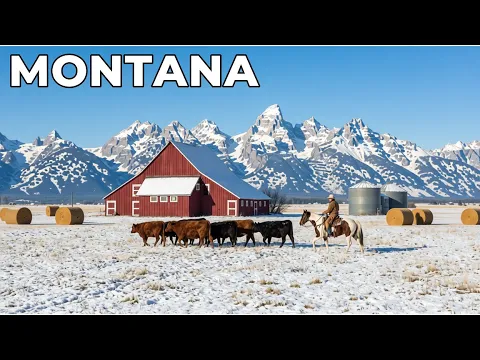

To understand Montana, one must first look at the numbers. The state occupies about 380,000 km², making it the fourth largest in the United States. In this sense, it surpasses entire countries like Germany and Japan. However, the comparison ends there.
While Germany has approximately 84 million people, Montana has slightly more than 1 million inhabitants. As a result, the population density drops to less than three people per square kilometer. According to local statistics, it is more likely to encounter a moose than a neighbor.
This emptiness has a clear culprit: the winter. In Montana, cold is not just a season. On the contrary, it acts as a survival test that can last from October to May. During this period, temperatures often plunge to 40 °C below zero, freezing engines, eyelashes, and decisions in seconds.
Curiously, the state receives about 12 million tourists per year, mainly attracted by Yellowstone. Still, most show up only in summer. When snow blocks roads and isolates towns, the crowd leaves. Consequently, only the most resilient remain.
The information has been disclosed by specialized tourism and geography outlets in the United States, with official government data and local residents’ reports.
Cattle, Yellowstone, and a Nature That Accepts No Mistakes
Despite the fame created by TV shows, real life in Montana has no glamour. Here, daily life is built with mud, calluses on hands and freezing nights. In this context, ranching dominates everything. There are almost three cows for every human inhabitant.
Being a rancher in Montana requires daily courage. Often, one must face blizzards to save a newborn calf. Additionally, fixing fences in cutting winds is part of the routine. While the modern world works in offices, here the clock is the sun.
On the other hand, while ranches sustain the state, Yellowstone represents its soul. Although much of the park lies in Wyoming, the most famous entrances are in Montana. Walking there means stepping on the mouth of a sleeping supervolcano.
The ground boils, releases steam, and erupts at predictable intervals with the Old Faithful geyser. At the same time, the Grand Prismatic Spring displays colors so intense they appear unreal. Still, beauty does not mean safety.
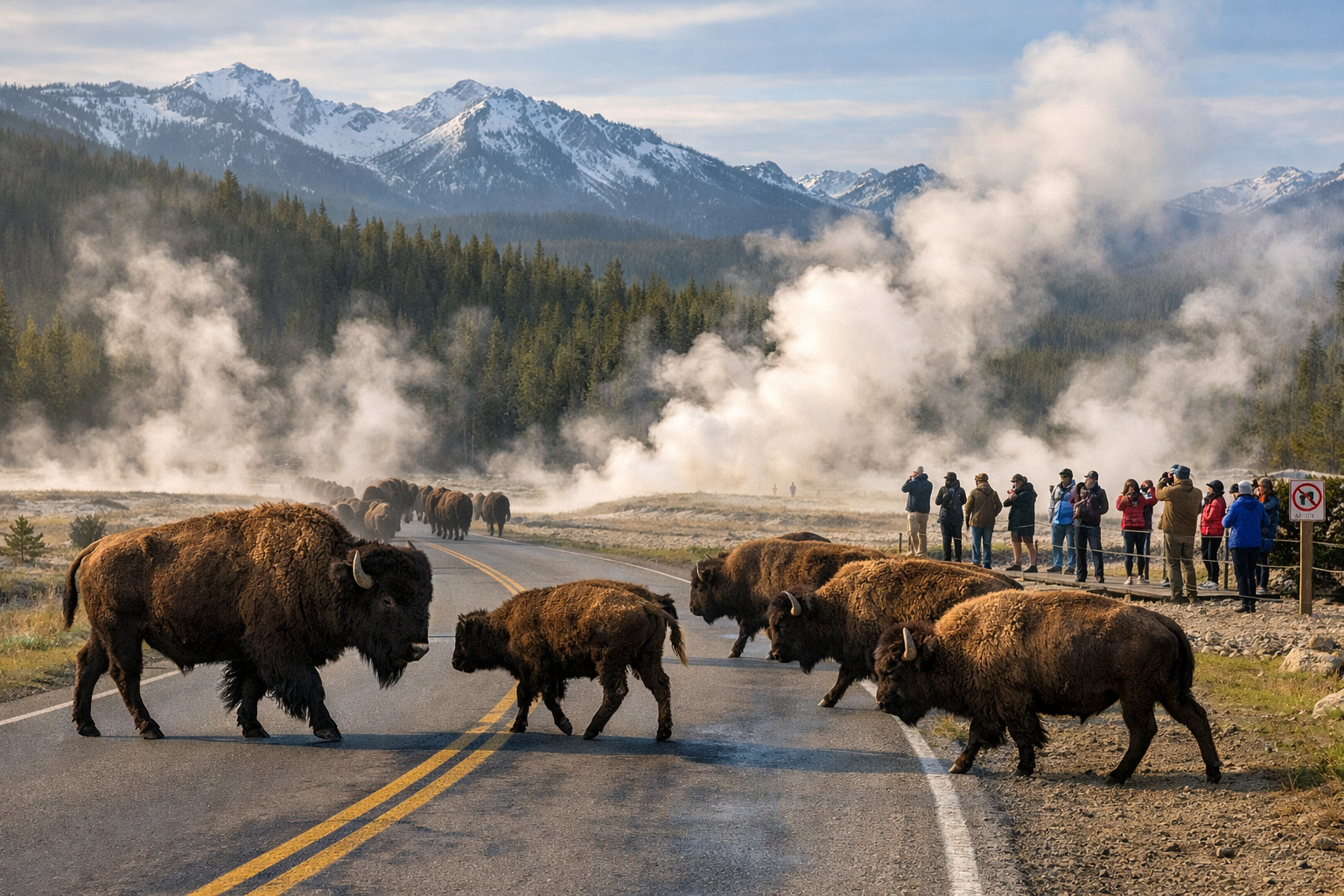
Yellowstone functions as the “American Serengeti.” Bison block roads for hours. Gray wolves restore ecological balance. Meanwhile, the grizzly bear reigns as the ultimate predator. For this reason, authorities emphasize that the park is not a zoo. An imprudent selfie can turn into tragedy in seconds.
Isolation, Daily Risk, and the Emotional Salary of Living Free

Before heading to the more hidden landscapes, it’s worth listening to those who live there. Many residents claim that they endure the cold and isolation for an invisible reward. It appears in the Glacier National Park, known as the “Crown of the Continent.”
In this setting, peaks sculpted by glaciers surround lakes so transparent they appear unreal. In the short summer, fields explode with wildflowers. Additionally, the famous McDonald Lake reveals colorful stones like submerged jewels.
However, the true test arises when someone turns the car key in winter. Roads transform into traps with Black Ice, an invisible ice that sends vehicles flying off the road without warning. When the ice melts, deep mud engulfs entire tires.
Here, the so-called “golden hour” of medical service does not exist. The nearest hospital may be up to three hours away, crossing snowstorms. Consequently, a mechanical breakdown at 30 °C below zero, without blankets or food, turns into a life-or-death emergency within minutes.
Nonetheless, there is a powerful bonus. When someone arrives home, lights the fireplace, and watches the sky explode with stars, the feeling of achievement is absolute. At that moment, silence becomes a luxury. No big city offers this.
Montana also hosts cities like Bozeman, Missoula, and Helena, each with its contrasts. Bozeman grows fast but has become expensive. Missoula pulses with culture yet struggles with thermal inversions. Helena offers stability, though it has fewer nightlife options. Still, when the blizzard arrives, all come to a halt.
Finally, many find meaning in fly fishing and responsible hunting. Tracking a moose to secure meat for winter connects generations. This direct relationship with the land creates the so-called emotional salary.
Montana does not adapt to anyone. On the contrary, it filters. It expels the impatient and rewards those who accept to live by its rules. In the end, the answer is not in the landscape, but within each person.
Would you trade comfort and convenience for the silent freedom of living in a place where nature always has the final word?
Source: Living Planet








-

-

-

-

-

-

10 pessoas reagiram a isso.