





 Portuguese
  English
  Spanish
 9 min of reading
  0 comments


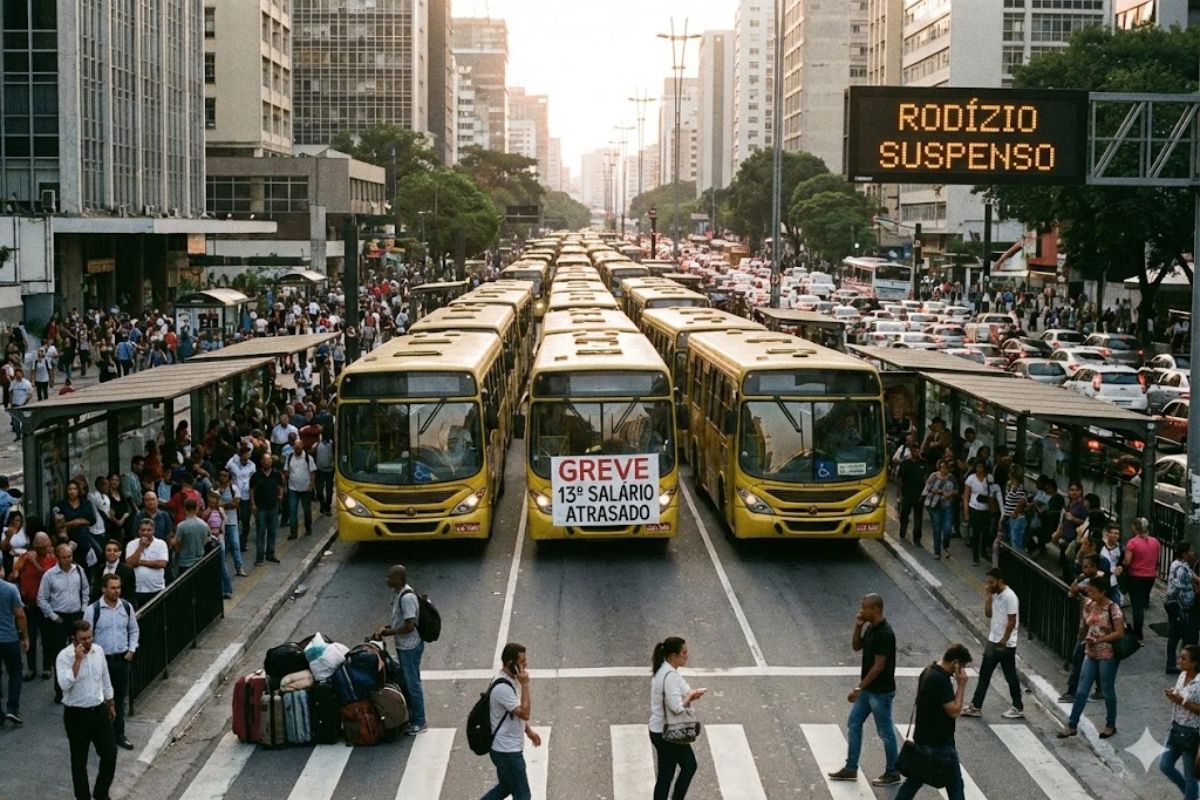
Bus Strike in São Paulo Exposes Dispute for 13th Salary, Affects 3.3 Million Passengers, Sets Traffic Jam at 1,486 Km, Suspends Citywide Driving Restrictions and Forces Metro and CPTM to Absorb Peak Demand on This Chaotic Tuesday Afternoon in 2025, Increasing Delays in Connections at Strategic Terminals in the Capital.
The bus strike in São Paulo on this Tuesday (9) halted part of the fleet in the afternoon, leaving 3.3 million passengers without regular service and putting pressure on the road system to a record 1,486 km of traffic jam in 2025, according to traffic monitoring. Buses began to drop off passengers at terminals and return empty to garages, creating an immediate void in surface public transportation.
At the same time, the labor impasse between companies, drivers, and conductors regarding the payment of the 13th salary and vacation meal vouchers by the 12th exposed a direct conflict with the City Hall, which claims to be up to date with all transfers. The crisis led to the suspension of vehicle driving restrictions on this Tuesday (9) and forced Metro and CPTM to reinforce trains and intervals to absorb part of the demand diverted from buses.
What Motivated the Bus Strike in São Paulo
According to Sindimotoristas, the bus strike in São Paulo was triggered after the companies reported on this Tuesday (9) that they would not make the payment of the 13th salary and vacation meal vouchers by the 12th, despite having made this commitment previously.
-
The government puts R$ 8.6 billion on the table to change the highway (BR) with 50 overpasses, 28 bridges, 4 tunnels, and 40 km of bike lanes in 180 km of historic duplication.
-
BRL 20.1 Million Bridge Project Kicks Off: 200-Meter Construction to Improve Access in Three Cities in Minas Gerais

-
‘Endless Road’ In Brazil Is One of The Largest In The World: 145 Km Stretch On An Important Highway (BR) Crosses The West Of Bahia And Had 135.9 Km Revitalized With R$ 35.3 Million
-
Engineer From ITA Who Worked at Embraer Leads Free Flow Expansion With National Artificial Intelligence and Technology for Toll Without Barriers in Brazil


The union states that the category was surprised by the change in position of the concessionaires, which led to a partial strike in 15 companies and an immediate impact on millions of passengers.
The protest occurs in the context of negotiating basic labor rights, in a sector that relies heavily on labor in fragmented shifts and prolonged hours.
The City Hall of São Paulo, in turn, reported that “the transfers to bus companies are up to date” and that the responsibility for the payment of the 13th salary and other benefits is exclusively that of the concessionaires, dismissing any possibility of financial delay on the part of the municipality.
What the City Hall Said and How the Conflict Was Framed
In an interview with TV Globo, Mayor Ricardo Nunes (MDB) stated that the companies “have no justification” for delaying the 13th salary of drivers and conductors and classified the strike as the result of an “irresponsible action” by the concessionaires.
According to the mayor, “there is not a single cent overdue from the City Hall of São Paulo to the companies”, and it is up to the operators to maintain 13th salaries and vacations on time for the workers.
Nunes also informed that he spoke with Governor Tarcísio de Freitas (Republicans) to reinforce the support of Metro and CPTM during the partial service interruption, trying to mitigate the effects on the 3.3 million passengers affected.
In practice, the message from the municipal executive seeks to politically isolate the companies, transferring to them the pressure of public opinion regarding the partial collapse of bus service in the middle of the afternoon on a weekday.
How the Strike Affected Passengers, Terminals, and Daily Life
The bus strike in São Paulo directly affected 3.3 million people, according to a survey released throughout the afternoon.
During the operation, buses began to drop off passengers at terminals and return immediately to garages, emptying the service in structural corridors and high-demand lines.
At neighborhood terminals and integrated stations, the consequence was immediate: crowded platforms, long waits, and competition for space in the few vehicles operating.
At the Jardim Ângela Terminal, graphic designer Fabio Miranda Vidal reported waiting for a bus since 4:30 PM, while a rideshare car to his home cost R$ 200, compared to less than R$ 70 under normal conditions, highlighting the price spike in individual rideshare transportation.
Images from strategic terminals, such as Pinheiros and Itaquera, showed crowded passengers, line panels with no clear departure times, and buses absent from the platforms.
In some places, terminals became almost empty of buses, with users scattered on the sidewalks waiting for alternatives, creating a scenario of partial collapse of mobility during extended peak hours.
Record Traffic, Suspended Driving Restrictions, and Pressure on Metro and CPTM
With the bus strike in São Paulo and the rush for alternatives, the capital recorded 1,486 km of traffic jam at 7 PM, the highest traffic rate of 2025.
The combination of reduced bus fleet, massive migration to cars, rideshares, and vans caused traffic axes to become jammed in almost all areas of the city.
In light of the situation, the City Hall suspended the vehicle driving restrictions on this Tuesday (9), in an attempt to ease the impact on drivers who rely on cars to replace the suspended bus lines.
At the same time, Metro and CPTM lines reinforced the operational fleet, increasing trains in circulation to absorb the additional demand, especially in connections with large bus terminals and transfer stations.
The tracks, however, also felt the effects: with full trains, congested platforms, and increased boarding times, the overload spread throughout the metropolitan transport system, making travel slower in practically all directions.
Companies and Corridors Most Affected by the Strike
The bus strike in São Paulo concentrated on 15 concession companies, affecting densely populated neighborhoods, structural terminals, and important links to the city center and office areas.
Among the main affected groups are Gatusa, Transunião, Movebuss, KPBX, and Mobibrasil, with dozens of strategic lines halted.
At Gatusa, several lines that connect the southern zone to the expanded center and business hubs were suspended:
- N702-11 Santo Amaro Terminal x Dom Pedro II Terminal
- 637P-10 Santo Amaro Terminal x Pinheiros Terminal
- 675N-10 Santo Amaro Terminal x Ana Rosa Metro
- 709G-10 Guarapiranga Terminal x Itaim Bibi
- 709M-10 Santo Amaro Terminal x Pinheiros Terminal
- 709P-10 Santo Amaro Station / Av. Guido Caloi x Pinheiros Terminal
- 5154-10 Santo Amaro Terminal x Princesa Isabel Terminal
- 5300-10 Santo Amaro Terminal x Dom Pedro II Terminal
- 6200-10 Santo Amaro Terminal x Bandeira Terminal
- 6291-10 Inocoop Campo Limpo x Bandeira Terminal
- 6414-10 Socorro x Bandeira Terminal
- 6422-10 Vila Cruzeiro x Bandeira Terminal
- 7245-10 Santo Amaro Terminal x Hospital das Clínicas
- 7550-10 Santo Amaro Terminal x Santa Cecília Metro
At Transunião, the list includes essential connections from the eastern zone to CPTM and Metro:
- 3006-10 Jardim Fanganielo x CPTM Guaianases
- 3008-10 Jardim Miriam x CPTM Itaim Paulista
- 3009-10 Itaim Paulista x CPTM Itaim Paulista
- 3010-10 Cemetery of Saudade x A. E. Carvalho Terminal
- 3026-10 Vila Iolanda II x CPTM Guaianases
- 3064-10 Cidade Tiradentes x CPTM Guaianases
- 3754-10 Inácio Monteiro x Metro Itaquera
- 3756-10 Barro Branco x Metro Itaquera
- 3768-10 Vila Yolanda x CPTM José Bonifácio
- 4051-10 Jardim São Paulo x CPTM Guaianases
- 4052-10 CPTM Guaianases x Metro Itaquera
- 4053-10 Guaianases x CPTM Guaianases
- 4055-10 CPTM Guaianases x Vila Solange
- 4506-10 Jardim Maria Estela x Metro Vila Mariana
And also:
- 2008-10 Jardim Nossa Senhora do Caminho x CPTM Itaim Paulista
- 2009-10 Jardim Robru x CPTM Guaianases
- 2021-10 Jardim Bandeirantes x CPTM Guaianases
- 2201-10 Boundary of Ferraz de Vasconcelos x CPTM Guaianases
- 2590-10 União de Vila Nova x Dom Pedro II Park
- 2702-10 Vila Americana x Metro Artur Alvim
- 2703-10 Jardim Etelvina x Metro Itaquera
- 2704-10 Jardim Robru x Metro Itaquera
- 2705-10 Jardim Fanganielo x Metro Itaquera
- 2707-10 Chabilândia x Metro Itaquera
- 2708-10 Jardim Lajeado x Metro Itaquera
- N333-11 São Miguel Terminal x Cidade Kemel
- 407T-10 Jardim Redil x Metro Itaquera
- 476G-10 Jardim Elba x Ibirapuera
- 476G-41 Vila Industrial x Metro Ana Rosa
- 573A-10 Metro Bresser x Vila Alpina (Circular)
- 574C-10 São Mateus x Boundary of São Caetano
- 574R-10 Sapopemba Terminal x Metro Belém
- 575A-10 Boundary of São Caetano x Tatuapé Metro Shopping
- 2004-10 Jardim Nossa Sra. do Caminho x CPTM Guaianases
- 2005-10 Jardim Romano x São Miguel
- 2006-10 Cidade Kemel x CPTM Itaim Paulista
- 2007-10 Cidade Kemel II x CPTM Itaim Paulista
At Movebuss, which operates in important axes in the east and southeast, lines such as:
- 4028-10 Hospital São Mateus x Boundary of Mauá
- 4029-10 São Mateus x Vila Prudente Terminal (Via Avenida Vila Ema)
- 4030-10 Fazenda da Juta x Aricanduva Shopping
- 4031-10 Parque Santa Madalena x Metro Tamanduateí
- 4032-10 Vila das Mercês x Objetivo Unip
- 4716-10 Metro Tamanduateí x Metro Santa Cruz
- 4729-10 Parque Bancário x Metro Belém
- 4734-10 Vila Moraes x Metro Saúde
- 4734-21 Vila Moraes x Metro Saúde (Via Avenida do Cursino)
- 4735-10 São Mateus x Jardim Vera Cruz
- 5020-10 Hospital Heliópolis x Sacomã Terminal
- 5025-10 Jardim Guairacá x Metro Tamanduateí
- 5031-10 Vila Arapuá x Sacomã Terminal
- 5032-10 Vila Arapuá x Sacomã Terminal (Via Metro Tamanduateí)
- 5035-10 Vila Arapuá x Sacomã Terminal (Via São João Clímaco)
And also:
- N534-11 Sacomã Terminal x Vila Arapuá
- N536-11 Sacomã Terminal x Jardim Itápolis
- N539-11 Sacomã Terminal x Hospital Heliópolis
- 364A-10 Hospital Ipiranga x Aricanduva Shopping
- 373T-10 Jardim Itápolis x Metro Bresser
- 414P-10 Vila Industrial x Metro Carrão
- 514T-10 Sacomã Terminal x Teotônio Vilela Housing Complex
- 524L-10 Parque São Lucas x Metro Tatuapé
- 573H-10 Hospital Sapopemba x Metro Bresser
- 574W-10 Jardim Walkiria x Metro Belém
- 3098-10 Jardim São Francisco x Aricanduva Shopping
- 3099-10 Hospital São Mateus x Jardim da Conquista
- 3112-10 Vila Industrial x Metro Belém
- 4025-10 Sítio das Figueiras x Metro Tatuapé
- 4726-10 Mooca x Metro Tatuapé
- 4027-10 Hospital São Mateus x Jardim Santo André
At KPBX, important lines in the south and southwest zones were affected:
- N742-11 João Dias Terminal x Pinheiros Terminal
- N745-11 Capelinha Terminal x Campo Limpo Terminal
- 647A-10 Valo Velho x Pinheiros
- 647P-10 COHAB Adventista x Pinheiros Terminal
- 669A-10 Santo Amaro Terminal x Princesa Isabel Terminal
- 675A-10 Parque Santo Antônio x Metro São Judas
- 695T-10 Capelinha Terminal x Metro Vila Mariana
- 695V-10 Capelinha Terminal x Metro Ana Rosa
- 707K-10 Guarapiranga Terminal x Metro Jabaquara
- 857A-10 Campo Limpo Terminal x Metro Santa Cruz
- 857C-10 Campo Limpo Terminal x Metro Conceição
- 5185-10 Guarapiranga Terminal x Dom Pedro II Terminal
- 6049-10 Valo Velho x Santo Amaro
- 6475-10 Jardim Vaz de Lima x Bandeira Terminal
- 7050-10 Jardim das Rosas x Campo Limpo Terminal
- 8605-10 Campo Limpo Terminal x Bandeira Terminal
At Mobibrasil, the impact affected key connections with Jabaquara, Santo Amaro, Ibirapuera, and airport lines:
- 6338-10 Jardim Miriam x Ibirapuera Park
- 6358-10 Jardim Luso x Bandeira Terminal
- 637J-10 Vila São José x Pinheiros
- 675M-10 Centro Sesc x Metro Jabaquara
- 675P-10 Shopping SP Market x Metro Conceição
- 875A-10 Airport x Perdizes
- 574A-10 Americanópolis x Largo do Cambuci
- 574A-21 Americanópolis x Metro Vila Mariana
- 576C-10 Metro Jabaquara x Santo Amaro Terminal
- 576M-10 Vila Clara x Pinheiros
- 577T-10 Jardim Miriam x Metro Ana Rosa
- 5791-10 Eldorado x Metro Vergueiro
- 5791-21 Eldorado x Metro Jabaquara
- 6000-10 Parelheiros Terminal x Santo Amaro Terminal
- 605A-10 Paralympic Center x Metro Jabaquara
- 607C-10 Jardim Miriam x Itaim Bibi
- 609J-10 Airport x Metro São Judas
This set of lines shows that the bus strike in São Paulo affected structural corridors, integrations with Metro and CPTM, and connections between peripheral neighborhoods and the center, amplifying the cascading effect on mobility, work, and services.
User Guidance and Immediate Scenario
With the gradual release of part of the fleet throughout the night, the recommendation from authorities is for passengers to follow real-time updates and check if their lines remain fully suspended or have resumed partial operations.
The bus strike in São Paulo exposed the fragility of a network that heavily relies on private concessions to ensure the daily transportation of millions of people.
As long as the impasse over the 13th salary remains unresolved, the risk of new strike actions, additional delays, and uncertainty for those who depend on the bus system to study, work, or access essential services persists.
Were you directly affected by the bus strike in São Paulo on this Tuesday, did you need to improvise another way to get home, or were you able to escape the chaos using an alternative route?









Seja o primeiro a reagir!