





 Portuguese
  English
  Spanish
  4 min of reading
  0 comments


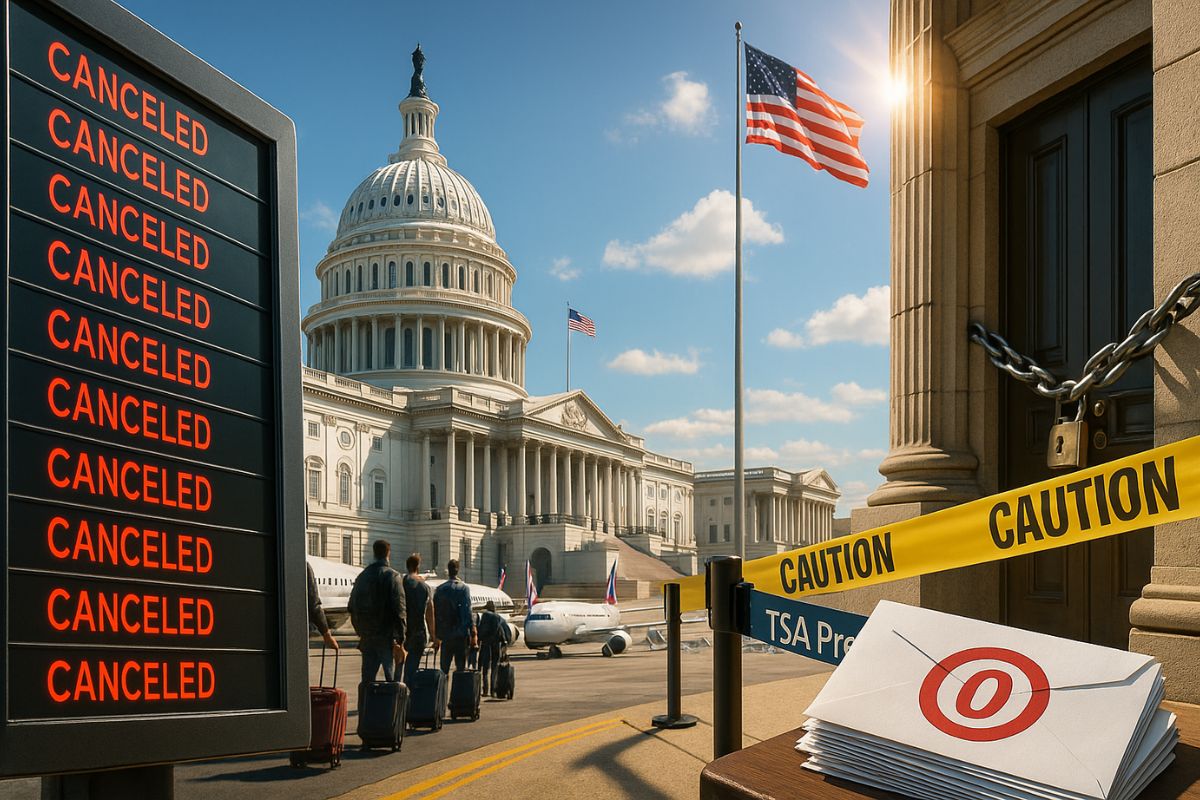
The Budget Crisis in the U.S. Government Reaches 38 Days, Suspends Federal Employee Salaries, Imposes Cancellations at 40 Airports, and Increases the Risk of Delays in Economic Data, Tourism, and Essential Civil Operations
The U.S. government is undergoing the longest shutdown in history, with 38 days without budget approval and a direct impact on federal employee salaries and the air transportation system. A directive from the Department of Transportation has mandated cancellations of at least 4 percent of flights and has allowed for gradual increases up to 10 percent, affecting the 40 largest airports in the country and causing hundreds of canceled flights in a single day.
At the center of the deadlock is the political dispute over healthcare programs and how to shape the budget package. While part of the workforce is on leave, essential services continue to operate without immediate payment, with retroactive payment expected once the budget is regularized.
What Is the Shutdown and Why Does It Happen
The shutdown occurs when Congress fails to approve the federal budget on time, leaving the U.S. government without authorization to maintain all services.
-
Elderly individuals aged 65 or older who have never contributed to the INSS can receive R$ 1,621 per month in 2026 without having paid any contributions in their lifetime: learn how the benefit works that already supports nearly 7 million Brazilians.

-
The gaucho city reduced the number of Bolsa Família beneficiaries by almost 40% in just a year and a half with active outreach that connects each registered person directly to job vacancies in Bento Gonçalves in Rio Grande do Sul.

-
The bluest city in Brazil has just gained a new floating bridge for the free crossing between the island and the mainland, connecting residents and visitors to the historic center of São Francisco do Sul every day of the week.

-
In a silent race, Shopee signs a mega contract in Guarulhos and accelerates the e-commerce war with faster deliveries, pressured shipping, and a new threat to rivals in Brazil.


Without this approval, agencies suspend non-essential activities and some employees go on leave.
In critical areas, teams continue to work without pay, with future compensation after fiscal normalization.
The current episode is the 15th since 1981 and exceeds the duration recorded in 2019. The disagreement over public health has become the central sticking point.
Democrats condition the agreement on extending expiring assistance programs, while Republicans aligned with Trump advocate separating the budget agenda from health issues.
Aviation Under Restriction and Impact on 40 Airports
Civil aviation faces immediate impacts.
Due to lack of paid personnel in critical areas such as air traffic control, the transportation authority has ordered cancellations of 4 percent of flights starting Friday morning, with projected increases up to 10 percent by mid-November.
More than 800 flights were canceled in a single day, with cascading delays.
The measure affects the 40 largest airports in the United States and is expected to strain connections and regional networks.
Aviation analysts estimate up to 1,800 daily cancellations, affecting hundreds of thousands of passengers.
The problem worsens just before the holiday season and Thanksgiving, a time of historically high demand.
Employees, Payments, and Public Services
The shutdown of the U.S. government puts thousands of employees on leave and keeps essential services without current payment, including security, borders, and critical operations.
The Postal Service continues to operate due to having its own revenue sources, and benefits such as pensions continue to be paid.
Courts and the IRS may reduce their operations if the crisis persists.
At the Pentagon, a significant portion of civilian employees has been furloughed, while around 2 million military personnel remain in their positions.
Contracts signed before the shutdown remain valid and can be executed, with ad hoc procurements for national security when necessary.
Tourism and National Heritage
In tourism, federal parks and museums may close partially or completely. The Statue of Liberty and National Mall are among the attractions with reduced or suspended visitation during this period.
The chain effect includes loss of local revenue, rescheduling, and additional operational costs for cities and concessions.
Beyond visitor flow, staff shortages affect internal services and maintenance.
The result is limited capacity to welcome the public and reduced experiences, with unstable schedules according to federal guidelines.
Economy and Disclosure of Indicators
The shutdown of the U.S. government tends to delay the publication of relevant economic data, which hinders public policy analysis and market decisions.
Small businesses may face temporary limitations in credit lines and federal services, while databases and statistical routines operate with lean teams.
The interruption of statistical series raises uncertainty regarding inflation, employment, and activity, increasing volatility and cost of capital.
For investors and managers, the lack of official signaling in the short term complicates risk pricing and strategic allocation.
The Political Deadlock in Congress
The budget dispute has polarized Congress.
Democrats advocate linking approval to health programs, while Republicans accuse the opposition of increasing costs and maintaining improper demands.
Party leaders are trading public accusations, keeping pressure on their bases and prolonging the deadlock.
The memory of 2019 remains a comparative landmark. At that time, the shutdown lasted 35 days and caused lines at security checks and reduction of air traffic in New York.
Now, with 38 days, the situation is already more extensive and has wider national effects.
What to Watch for in the Coming Days
In the short term, the evolution of flight cancellations and holiday demand behavior will be indicators of operational pressure.
In Congress, signs of convergence on scope and timing of health programs may unlock the agreement.
Without consensus, the trend is to maintain the compression of services and fiscal uncertainty.
For families and businesses, travel planning with cushion reservations and constant flight status checks are prudent measures.
For federal employees, cash management and recording hours worked will be essential for future regularization.
The U.S. government faces an unprecedented shutdown with direct effects on aviation, pressure on services, and delays in data that guide economic decisions.
In your opinion, what is the most sensitive impact of this shutdown on the daily lives of Americans: the reduced air network, suspended salaries, or economic uncertainty?










-

Uma pessoa reagiu a isso.