





 Portuguese
  English
  Spanish
  4 min of reading
  1 comment


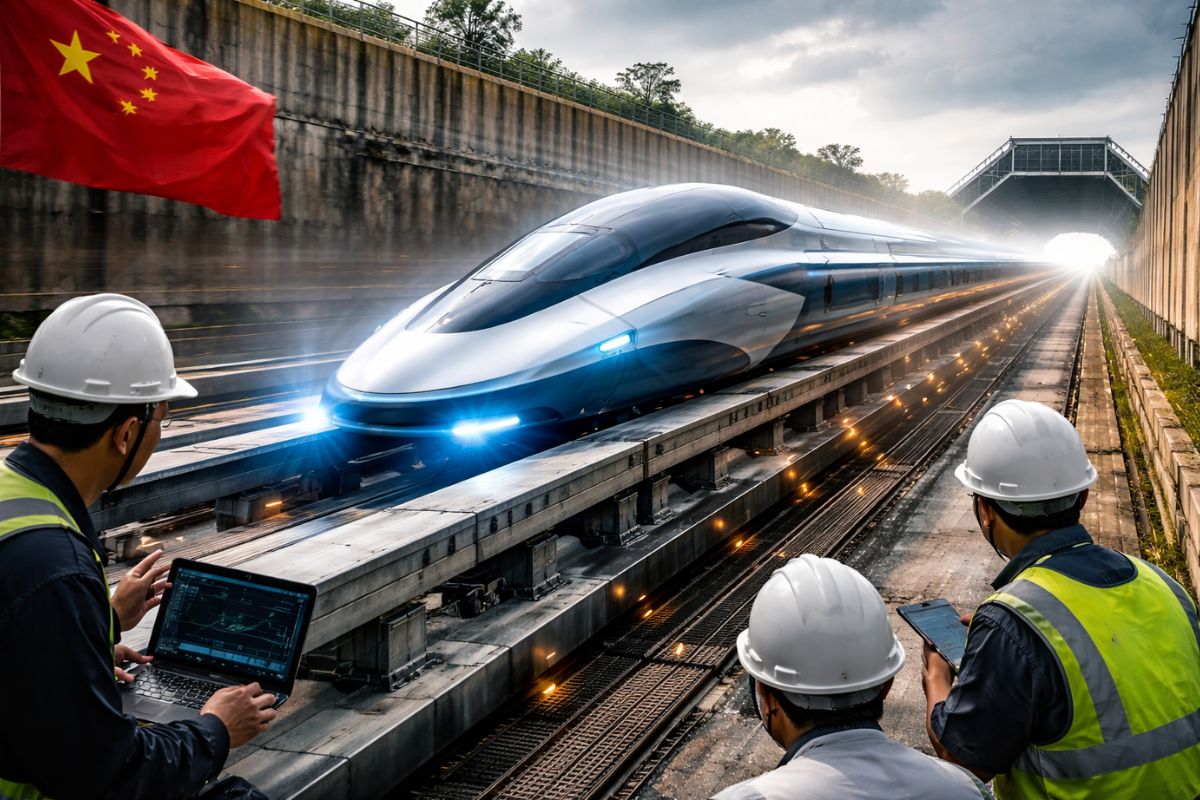


In a test by authorities attributed to CGTN, Chinese researchers accelerated a prototype of a magnetic levitation train with superconductor technology from 0 to 700 km/h in just 2 seconds, within a 400-meter track, while electric suspension and energy challenges remain at the core of the proposed system
At the heart of the announcement is magnetic levitation, presented as the basis of a Chinese experiment that tries to compress into two seconds a speed leap that, in everyday life, we associate more with aviation than with tracks. The contrast is simple: a train on the ground, but with aircraft numbers.
China describes the test as part of a race for ultra-high-speed urban and interurban platforms, with more tests planned for the coming months. The short track and extreme acceleration become a showcase, but they also raise technical questions about how to sustain this outside the laboratory.
The Leap from 0 to 700 km/h in 2 Seconds and What That Suggests

The most eye-catching data is the sequence that goes from zero to 700 km/h in 2 seconds.
-
Motorola launched the Signature with a gold seal from DxOMark, tying with the iPhone 17 Pro in camera performance, Snapdragon 8 Gen 5 that surpassed 3 million in benchmarks, and a zoom that impresses even at night.

-
Satellites reveal beneath the Sahara a giant river buried for thousands of kilometers: study shows that the largest hot desert on the planet was once traversed by a river system comparable to the largest on Earth.

-
Scientists have captured something never seen in space: newly born stars are creating gigantic rings of light a thousand times larger than the distance between the Earth and the Sun, and this changes everything we knew about stellar birth.

-
Geologists find traces of a continent that disappeared 155 million years ago after separating from Australia and reveal that it did not sink, but broke into fragments scattered across Southeast Asia.

On a 400-meter track, this acceleration changes the reading of the project: it is not just about “going fast,” but about controlling stability, position reading, and system response in a minimal time frame.
When the window is so short, every correction becomes part of the result.
The practical effect is that the train doesn’t have much time to spare for mistakes.
The very choice of track reinforces this, because a shorter track compresses the moments of acceleration, stabilization, and braking.
In an experiment of this kind, the track almost becomes a measuring instrument, not just the path.
Inside Superconducting Magnetic Levitation
Magnetic levitation, in the strict sense, seeks to make the vehicle “float” over the track through magnetic fields, reducing mechanical contact.
With superconductor technology, the idea is to work with more intense and stable fields, which helps keep the set suspended and guided.
Without direct wheel-rail friction, the train can pursue higher speeds with less wear.
This promise connects to another point mentioned: operation in low vacuum.
With less air resistance and no physical contact with the tracks, the train begins to be described as a low-friction system.
This is where the discourse becomes ambitious: to bring the train’s performance closer to that of aircraft, without relying on the same type of airport infrastructure.
The Bottleneck That the Announcement Admits: Electric Suspension, Propulsion, and Energy
The account of the project itself acknowledges that the last decade has been marked by challenges in developing electric suspension.
This matters because magnetic levitation is not just “going up” and “floating”: it involves fine control of the gap, alignment, and response to oscillations, especially at high speeds.
When the suspension fails, the entire system fails.
There is also the tripod mentioned as a challenge: ultra-high-speed electromagnetic propulsion, large-scale energy storage, and temporary inversion of high-power energy.
These three items appear as the least visible part of the spectacle.
The train can even reach peaks on the track, but it needs to repeat this with reliability, efficiency, and safety in real operation.
Low Vacuum, Maintenance, and the Boundary Between Demonstration and Network
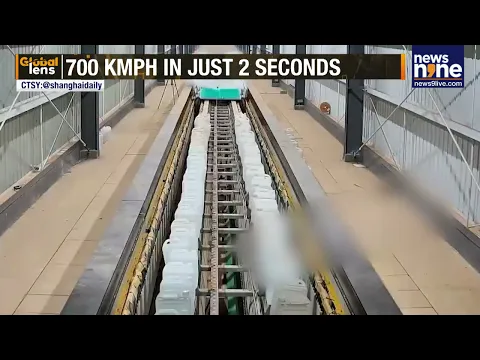

The project is described as T Flight maglev, with magnetic levitation and operation in low vacuum, and a direct bet on reducing friction.
On paper, this has obvious consequences: less mechanical wear, lower intervention in components, and potentially a longer lifespan for the system.
Maintenance, which is usually the silent cost of any network, becomes a central argument.
At the same time, scale is the part that does not fit on a 400-meter track.
Projections for international trips in about 60 minutes depend on networks, stations, energy, safety, and integration with cities.
Between the track and the map, there is an engineering, licensing, and cost chasm that does not appear in the test.
China turned a 400-meter track into a stage for a superconducting magnetic levitation train that reaches 700 km/h in 2 seconds, but the announcement also exposes the list of what still needs to work together: electric suspension, energy, and propulsion.
The experiment impresses, but the real story begins when it becomes routine.
If you had a train like this in your area, what would weigh more in your opinion: time, ticket cost, safety, or urban impact? And when you read “low vacuum” and “700 km/h,” what seems more plausible to you: nearby revolution or distant demonstration?








Seria interessante entregar o trem bala SP RJ SP aos chineses, quem sabe sai do papel e da promessa política **** dos nossos eleitos que só legislam em causa própria… 2026EleiçõesNelesJá…