





 Portuguese
  English
  Spanish
  4 min of reading
  1 comment


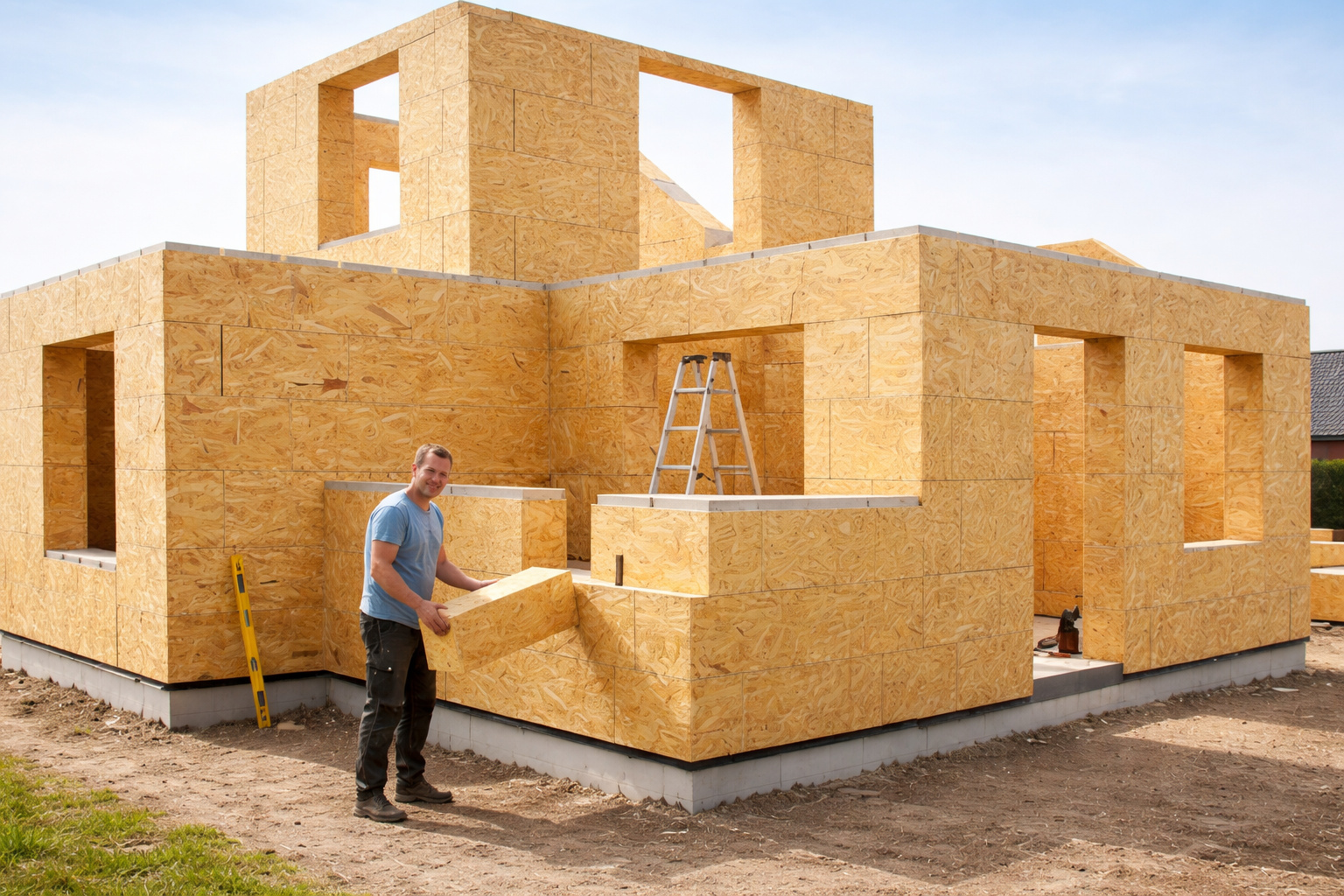


A Pressed Wood System Assembled Without Cement And With An Interlocking Block Style Shows That The Construction Industry Can Face Its Biggest Structural Break In Years
An entire house assembled without cement would already be intriguing. Now imagine this structural building emerging with pressed wood and a style of blocks fitting together like industrial pieces. This is exactly the point that is attracting attention in civil engineering.

While the traditional construction model relies on concrete, trucks, and heavy machinery, this proposal bets on manual assembly, precise fittings, and millimetric organization. The result pressures a sector that has operated almost the same way for decades.
What is at stake is not just a compact house. It’s a method that confronts the dominant logic of residential construction.
-
With 74% of companies facing difficulties in hiring, technicians and engineers in renewable energy are becoming scarce in Brazil and are essential to support the expansion of solar, wind, and green hydrogen projects.

-
The lack of welders, electricians, and operators becomes a structural threat in 2025, with the construction industry and manufacturing already suffering from delays, cost pressures, and labor shortages in Brazil.

-
Brazil and Paraguay are just 46 meters away from a historic union on the bioceanic bridge that promises to revolutionize trade between the Atlantic and the Pacific.

-
With 55 km over the sea, a cost of US$ 20 billion, and enough steel to build 60 Eiffel Towers, China’s largest project has connected Hong Kong, Zhuhai, and Macau in a colossal bridge that defies the logic of engineering.


The Traditional Concrete-Based Model Faces Pressure Against A Modular System Using Pressed Wood
For years, the construction standard followed the same guideline. Rigid base, layered elevation, and reliance on heavy equipment. This process takes time, logistics, and a heavy structure.
Now a format emerges that executes the same structural steps but with pressed wood organized in a block style. The base is prepared and leveled manually, forming a firm platform that supports the rest of the building.
The difference lies in the execution of the construction. Instead of large mechanical interventions, assembly occurs piece by piece, with manual adjustments and controlled fittings. This alters the pace of work and reduces external dependencies.
It is within this contrast that tension arises. A compact method begins to compete for space with the conventional model.
The Secret Of Structural Construction Is In The Precise Fitting Of Pressed Wood Blocks
The turning point occurs when the walls begin to rise. The pressed wood modules are positioned in sequence, forming regular and well-aligned horizontal lines.

Each piece receives bonding material at the joints and undergoes fine adjustment before final fixation. Excess is removed during construction. The result is a uniform wall, with openings already planned for doors and windows.
Vertical reinforcements are inserted at strategic points. These internal bars work together with the blocks and increase the rigidity of the assembly.
This technical detail of construction is the framework that supports the system. There is no improvisation. There is calculated fitting and precise repetition.
Non-Cement Roof Assembly Reinforces The Break With Traditional Methods
Once the walls reach sufficient height, the construction of the wooden beams that support the top of the structure begins. Everything is done without cement, only with organization and manual strength.
Rafters and battens are distributed parallelly, forming a firm mesh. On this base, metal sheets are fixed one by one, ensuring complete coverage.
Working at height requires control and balance. Each tightened screw represents structural stability.
The image that forms is symbolic. An entire roof installed without cranes or heavy equipment. This disrupts the logic of traditional construction sites.
Internal Finishing Reveals The Efficiency Of The Modular System And Enhances Impact On The Sector
With the structure closed, doors and windows fit into the already defined openings. The frames undergo manual adjustment until reaching exact alignment.
The internal surfaces go through a finishing layer application, covering the visible joints of the block style. Later, the light paint transforms the environment.
The floor receives aligned covering over the already leveled base. The space stops looking like a construction site and assumes a residential function.
It is at this moment that the market observes closely. A lean process delivers a complete result without the conventional apparatus.

What This Advancement In Pressed Wood Could Trigger In Civil Engineering In The Coming Years
Estimates indicate that modular systems gain ground when they reduce, thus, steps and simplify execution. There is no official number released regarding economic impact, but experts indicate that lean methods tend to pressure traditional production chains.
When a house becomes a reality with manual assembly, pressed wood, and well-fitting block style, the question ceases to be technical. It becomes strategic.
If the model expands, construction companies will have to revise processes. Suppliers of heavy materials may face indirect competition.
The sector does not ignore signs of change. And this modular system acts as a silent alert within civil engineering.
What do you think of this technology? Is traditional construction threatened or does it still dominate the market? Leave your opinion in the comments and share it with those following innovation in engineering.









Muy buena, me gustaría conocer sobre donde podría consultar precios y detalles