





 Portuguese
  English
  Spanish
  4 min of reading
  1 comment


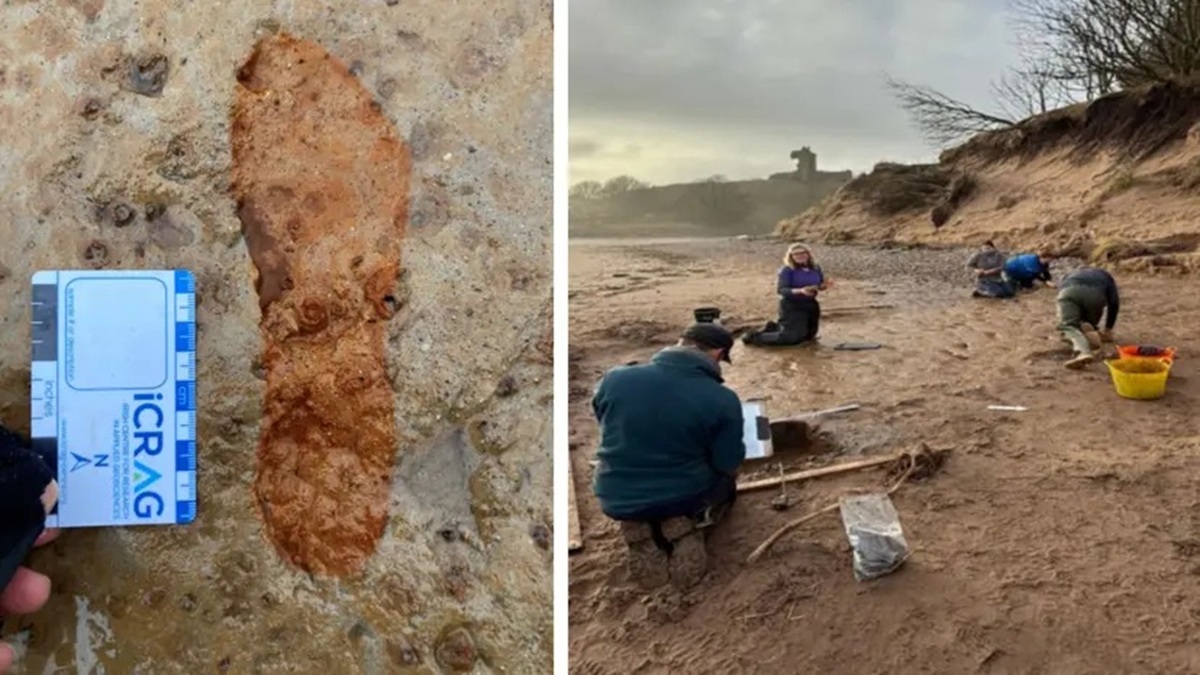


Discovery in Lunan Bay Mobilized Local Residents and Archaeologists from the University of Aberdeen, Who Faced Winds of 88 km/h and Registered 3D Models and Physical Molds Before the Waves Erased the Site Just 48 Hours After the Identification of the Rare Footprints
Archaeologists rushed to Lunan Bay, in eastern Scotland, after local residents found rare 2,000-year-old footprints exposed by storms; under winds of 88 km/h, the team recorded molds and 3D models before the waves erased the site 48 hours later.
Rare Footprints Revealed After Storms in Lunan Bay
After a sort of emergency call, archaeologists were summoned to preserve rare footprints dating from the Roman expansion in Britain. The discovery occurred after storms removed the vegetation from the dunes, exposing preserved marks in a layer of clay that was previously hidden.
Ivor Campbell and Jenny Snedden were walking their dogs, Ziggy and Juno, when they noticed the mark left on the beach. They alerted the council’s archaeologist, Bruce Mann, who notified experts from the University of Aberdeen.
-
Motorola launched the Signature with a gold seal from DxOMark, tying with the iPhone 17 Pro in camera performance, Snapdragon 8 Gen 5 that surpassed 3 million in benchmarks, and a zoom that impresses even at night.

-
Satellites reveal beneath the Sahara a giant river buried for thousands of kilometers: study shows that the largest hot desert on the planet was once traversed by a river system comparable to the largest on Earth.

-
Scientists have captured something never seen in space: newly born stars are creating gigantic rings of light a thousand times larger than the distance between the Earth and the Sun, and this changes everything we knew about stellar birth.

-
Geologists find traces of a continent that disappeared 155 million years ago after separating from Australia and reveal that it did not sink, but broke into fragments scattered across Southeast Asia.

With time running out, the team stopped at a craft store to buy plaster before heading to the site. Winds of 88 km/h battered the area as the tide threatened to erase what was described as a discovery of unparalleled importance.
The urgency was justified because only a few footprints of this kind had been found in England and none previously in Scotland. The team worked to capture the rare footprints digitally and physically before the elements eliminated a real and tangible connection to the region’s past.
Race Against Time in an Archaeological Emergency
Kate Britton, an archaeologist present at the site, told Live Science that it is very rare to be involved in a true archaeological emergency. The definition was confirmed 48 hours later, when the waves forcefully erased the site.
Dr. William Mills stated in a statement that it is incredibly rare to see such delicate evidence being preserved, taking only minutes to be created and hours to be destroyed. According to him, it is a snapshot of what people were doing thousands of years ago.
The team managed to capture 3D models and produce physical molds of the rare footprints. While transporting the material to the lab, the archaeologists watched the site being destroyed by the waves that were flooding in.
Bruce Mann reported that watching the archaeological site being destroyed was, in some respects, heartbreaking. Still, he highlighted that at least they were able to document most of the site before the definitive loss.
Laboratory Analyses Confirm 2,000-Year Dating
Back at the lab, researchers conducted in-depth analysis of the plant remains found beneath the rare footprints. When the weather improved, drones were sent to capture aerial images of the site.
The analyses confirmed that the footprints belonged to the period of Roman expansion in the British Isles, 2,000 years ago. Professor Noble told the University of Aberdeen that it is incredible to think that these engravings were made during the time of the Roman invasions of Scotland and in the centuries prior to the emergence of the Picts.
The excavations also revealed traces of red deer, roe deer, and humans who frequented the area. According to the University of Aberdeen, some of the individuals walked barefoot.
Ecological Portrait of the Coast of Angus in the Iron Age
In addition to the rare footprints, archaeologists reconstructed aspects of the landscape from 2,000 years ago. The site demonstrated that the current sandy beach was once a muddy estuary used by humans.
According to Dr. Mills, the inhabitants likely used the environment to hunt deer or gather edible wild plants, such as sea fennel. The discovery provided direct evidence of human presence along the coast of Angus at the end of the Iron Age.
The set of analyses preserved not only a physical mark but also an ecological portrait of the region two millennia ago. As highlighted in a statement, the most significant discoveries begin when someone notices something and decides to report it.
Mann thanked the team from the University of Aberdeen for responding to the call for help. The episode was described as a race against time to save a record that could disappear in a matter of hours, leaving only the memory of the discovery.








Podiam ter comprado uma pa, colocava por baixo da argila e removido a pegada. Povo nao pensa.