





 Portuguese
  English
  Spanish
  6 min of reading
  0 comments


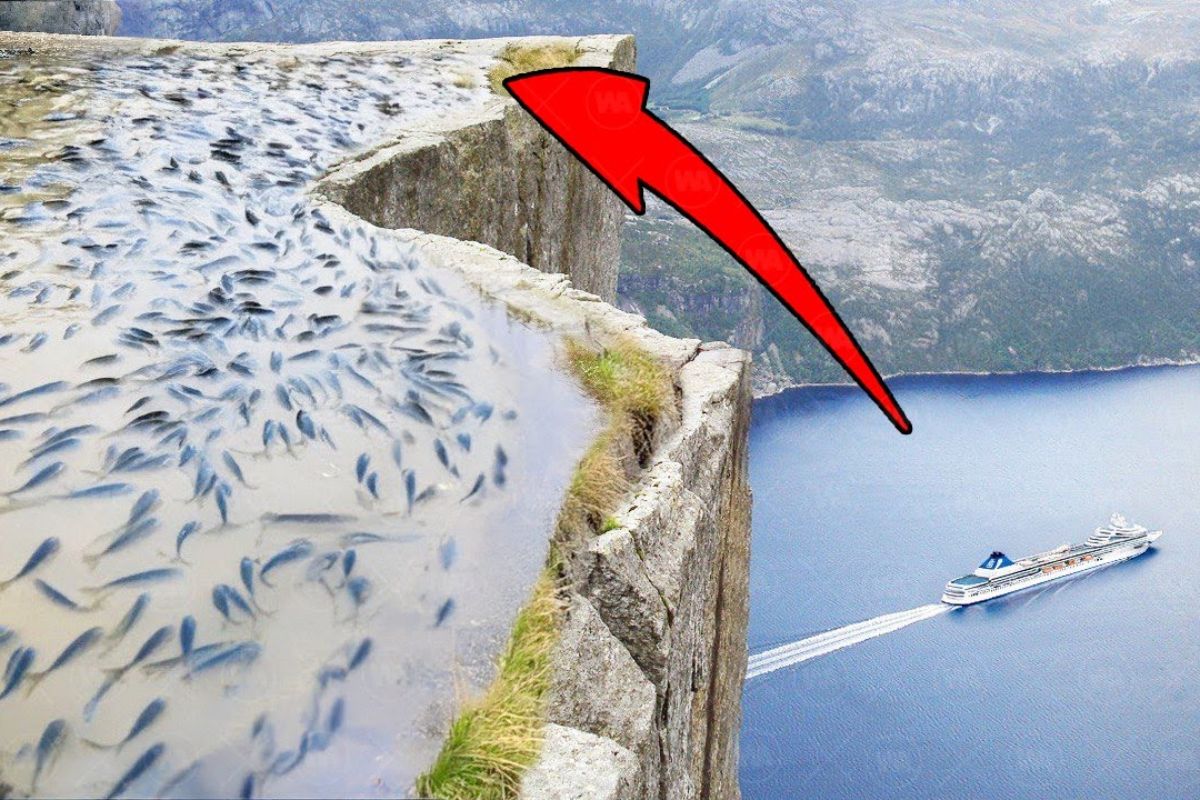
Fish in Remote Mountain Lakes Seem to Be an Enigma, But the Combination of Rare Hydrological Events, Aerial Stockings, Bird Transport, Legacies of Wet Paleoclimates, and Even Terrestrial Movement in Specific Species Shows That the Unlikely Can Occur Without Breaking the Rules of Ecology at Different Temporal and Geographical Scales.
Fish found at the tops of mountains, in lakes with no visible connection to rivers and far from the ocean, seem to pose an ecological paradox. The question arises immediately: who brought these organisms there, when, by what route, and with what real chance of survival in high-altitude environments?
The scientific answer does not point to a single cause. Instead, it describes a mosaic of processes that may act together or separately: exceptional floods, aerial human management, dispersion by waterfowl, legacies of ancient climate changes, and, in some cases, terrestrial movement of species with unusual adaptations. The mystery diminishes when geological time is taken into account.
When Water Connects What Seemed Disconnected
Fish can reach new bodies of water during extreme hydrological events. In small lakes, especially those under 1,000 square feet, intense rains can cause temporary overflows, create temporary channels, and transport eggs, larvae, or juvenile individuals. These episodes are short but sufficient to alter local biological composition. Connectivity, even brief, can redefine the map of aquatic life.
-
The specifications of the Xiaomi 18 Pro Max have been leaked, and the highlight is a dual 200 MP camera with a new 22-nanometer technology that promises to consume less energy and capture details in shadows and bright areas using LOFIC HDR.

-
If the trip to the Moon were a hoax, it would be necessary to keep the secret among 400,000 people for more than 50 years and to deceive even the Soviet Union, which was tracking the radio signals coming from the exact direction of the satellite during each Apollo mission.

-
Artemis 2 launches at 7:35 PM with four astronauts and ends a 50-year fast in lunar orbit: the SLS rocket departs from Florida, the mission lasts 10 days, circles the far side, and tests Orion in a free-return trajectory.

-
China is testing a train that will operate at 400 km/h in daily service, which is 80 km/h faster than the French TGV, and uses carbon fiber, magnesium alloys, and more than 4,000 sensors to become the fastest commercial train on the planet.

There are clear limits to this explanation. In lakes at the tops of mountains, above other bodies of water and without regular inflows, the flood hypothesis loses strength because water tends to flow downwards, not upwards. Still, the ability of currents to transport large and small organisms in extreme situations shows that rare events matter. The technical point is simple: the absence of permanent connection does not mean the absence of historical or episodic connection.
Aerial Stockings and Human Introductions: Presence Explained by Choice, Not by Chance

Fish also reach lakes through direct actions of environmental and fishery management. In Utah, in 2021, wildlife agents released thousands of fish into about 200 high-altitude lakes by airplane, a practice used since 1956.

The method prioritizes lightweight individuals, and records indicate a survival rate of about 95% after the drop. One flight can release up to 35,000 specimens. When there is infrastructure and a goal for restocking, geographic isolation ceases to be an absolute barrier.
Before aerial logistics, transport was done via trails, including support from horses, which increased the stress on the animals. Today, part of the management includes breeding in incubators and, in many programs, sterilization to reduce population explosions and minimize ecological risk. In addition to official management, there are unauthorized introductions, such as the release of aquarium fish and the disposal of live bait. This shifts the central question about origin: in various lakes, it is not just about “how they arrived,” but about who decided that they would arrive.
Fish That Move on Land and the Biological Limit of This Route
Fish from some lineages can achieve terrestrial movement for short periods, using undulating body movements outside of water. In armored catfish from Central and South America, for example, this behavior appears when searching for food or needing to reach a new aquatic environment. Movement can last for hours under favorable conditions, and measurements indicate a speed of around 90 cm per second. For a fish, this represents functional mobility outside its usual medium.
These cases, however, do not explain all occurrences at altitude. Common trout from mountain lakes do not have this capability and cannot tolerate extended time out of water. Therefore, the terrestrial route is plausible for specific species, but insufficient to generalize the phenomenon across all lakes. The correct inference is technical: the mechanism must be compatible with the physiology of the observed species. If the fish cannot survive on land, this hypothesis should lose priority in local investigation.
Migratory Birds, Resistant Eggs, and Low-Rate Dispersal with High Effect

Fish can be dispersed by waterfowl in two main ways: externally, with eggs adhered to feathers and feet, and internally, after ingestion and subsequent elimination with some of the embryos still viable. The idea is ancient and has been discussed since the 19th century. Modern reviews have shown that not all historical hypotheses have robust proof for all cases, but recent studies have demonstrated real viability in specific species and contexts. It is not frequent transport by individuals, but it can be efficient at a population scale.

In 2019, studies with killifish reinforced this pathway by highlighting adaptations such as diapause and embryonic protection. In 2020, experiments indicated that even embryos without extreme protection can survive the intestinal transit of waterfowl, with a low success rate of about 2%. This may seem low, but birds consume a large volume of eggs, and this compensates for the low proportion. In arid environments, such as Lake Zakher in the United Arab Emirates, the presence of water and high circulation of birds creates a concrete scenario for this dispersion. The record of about 130 species of waterfowl in the area reinforces the ecological plausibility of the process.
Ancient Climate, Remaining Lakes, and the Isolation That Followed
Fish in lakes today may be remnants from times when the landscape was wetter and more connected. Between the end of the Pliocene and the beginning of the Pleistocene, around 2 to 1.5 million years ago, portions of the western United States had extensive lacustrine systems. With progressive aridification, these large bodies of water shrank and fragmented. Populations that were once continuous became separated, initiating their own evolutionary trajectories. In this scenario, fish did not “arrive now”; they “stayed” after the environmental rupture.
In a more recent timescale, post-glacial changes also explain current isolations. In Lake Thingvallavatn, Iceland, brown trout, arctic char, and threespine sticklebacks are interpreted as results of the reorganization of relief and hydrology after the last glacial period. This type of evidence shifts the focus from immediate curiosity to deep environmental history: in many cases, understanding “where” and “why” requires looking back thousands or millions of years, not just at recent events.
The Ecological Cost of Introducing Fish Where There Were None Before
Fish introduced into lakes originally without fish fauna tend to restructure food chains rapidly. In high mountain lakes, natural barriers typically prevented spontaneous colonization from downstream. When new species enter, especially predators or efficient competitors, invertebrates, amphibians, and other local organisms can experience abrupt declines. The change is not just numerical; it is functional: the ecosystem starts to operate differently.
Historical records show that introductions in mountains are not recent: reports from the Alps date back to the late 16th century; in the Pyrenees, occurrences have been noted since the Middle Ages, intensifying in the 19th century and the second half of the 20th century. In light of the impacts, restoration projects in the U.S., Canada, and Europe have used mechanical removal with gill nets and electric fishing, followed by periodic monitoring. In various areas, the goal has been to restore the original state without fish, showing that conservation, in this context, can mean reducing presence, not increasing it.
Fish in mountain lakes do not represent a unique enigma but rather a set of possible trajectories that include nature, climatic history, and human action. The most solid technical analysis always intersects species, relief, local history, signs of management, and bird dynamics to identify the most likely mechanism in each case. The correct question is not whether it can happen, but which path occurred there.
In your region, have you ever seen a pond or reservoir that seemed isolated suddenly gain fish after heavy rain, infrastructure work, or human release? What changes have you noticed in the water, fauna, and local fishing afterward, and which hypothesis makes the most sense to explain what happened?







-

3 pessoas reagiram a isso.