





 Portuguese
  English
  Spanish
  4 min of reading
  0 comments


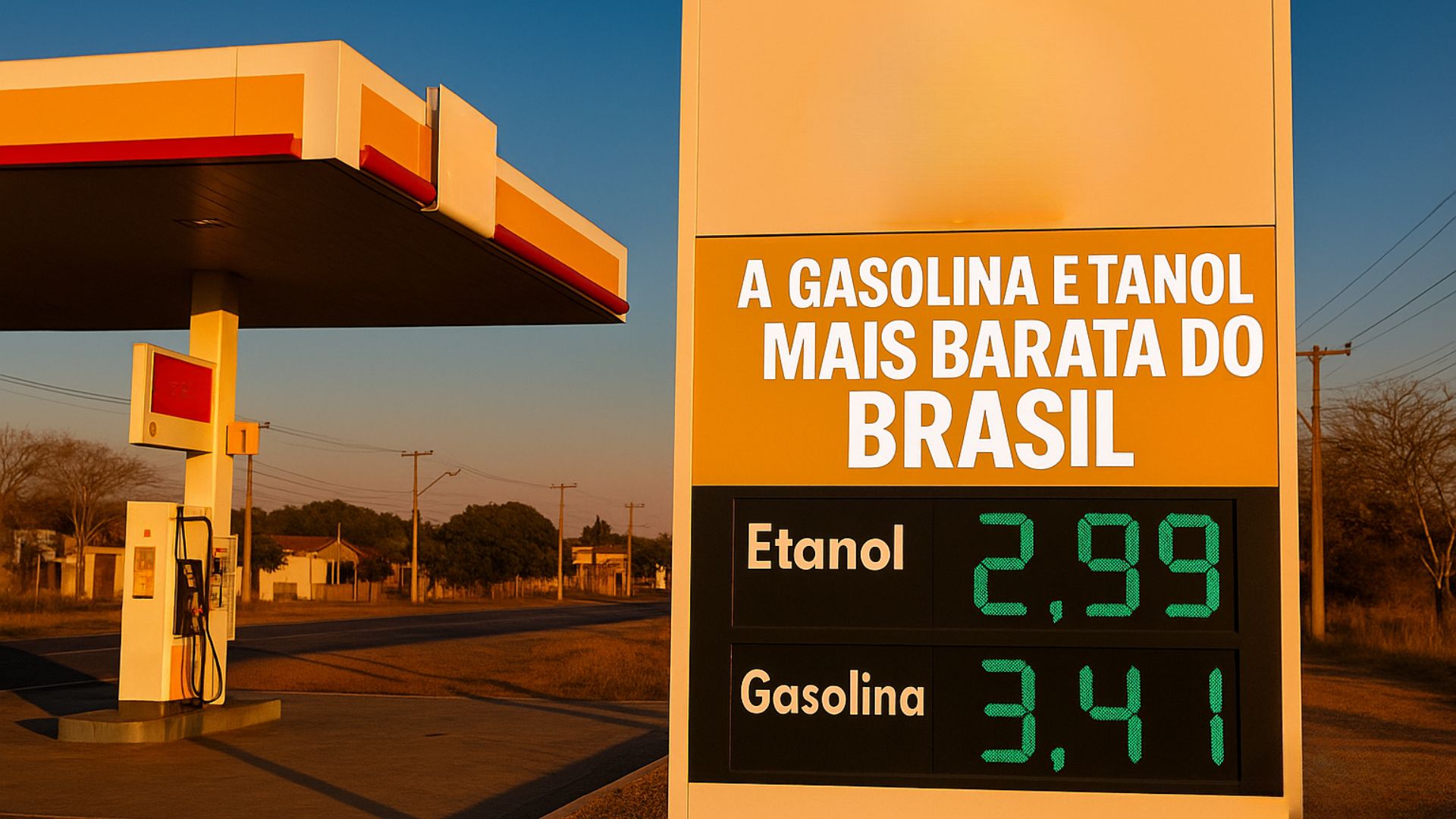
The City of Itaguari, in Goiás, Stands Out Among the Lowest Fuel Prices in the Country, Attracting National Attention with Values Well Below the Average. Understand How Local and Economic Factors Sustain This Phenomenon of Prices.
Itaguari, 130 kilometers from Goiânia, has once again topped the ranking of cheap fuels.
In September, consumers paid on average R$ 5.49 per liter of gasoline and R$ 3.59 for ethanol, a result that places the municipality among the lowest prices in the country, according to a survey by Ticket Log based on 21,000 gas stations.
Although small, with around 5,000 inhabitants, the city has been consistently performing well in different measurements throughout the year.
-
Russia reveals that it is already conducting 95% of all its business with China without using a single dollar; dedollarization has ceased to be a promise and has become a reality in record time, and the West watches helplessly.

-
While Brazilians work more than 44 hours a week, Norwegians leave the office at 3 PM and are now testing a four-day workweek with full pay and no loss of productivity.

-
A legend of Brazilian TV is 75 years old, returned to narrate the World Cup for SBT, and still finds time to manage a farm of over 100 hectares in Rio Grande do Sul where she produces award-winning wines, olive oil, and raises cattle.

-
Family buys mansion destroyed by fire for $1.5 million, faces over 500 days of construction, transforms loss into high-end property, and leaves neighbors in awe.


Why Are Prices So Low in Itaguari
The central point is the proximity to ethanol production.
Goiás has established itself as one of the largest biofuel hubs in Brazil, with consistent growth in corn ethanol and the presence of mills in nearby cities.
With supply at the doorstep, logistical costs decrease, and the product reaches the pumps with less freight impact, a component that weighs on the final price in regions far from production centers.
In addition to favorable geography, the distribution network helps.
Itaguari is close to road axes used by transporters and distributors.
This combination reduces travel distances, speeds up stock replenishment, and decreases operational losses — factors that reflect in the price per liter.
Effect of the Ethanol Mix in Gasoline
The recent dynamics of gasoline also play in its favor.
Since August, the gasoline sold at gas stations has contained 30% anhydrous ethanol, a higher proportion than before, which was 27%.
The rule was defined by the National Energy Policy Council and regulated by ANP.
In practice, with more ethanol in the composition, gasoline becomes even more sensitive to the price of the biofuel produced in the region.
When ethanol is cheap near Itaguari, gasoline follows suit.
According to Renato Mascarenhas, director of the fuel supply network at Edenred Mobilidade (the owner of Ticket Log), location is crucial because it “reduces transportation costs and shortens the route of fuel to the pumps.”
He emphasizes that, with the supply chain nearby, prices “already arrive lower at the source,” an expression that summarizes the local competitive gain.
Tax Incentives Strengthen the Ethanol Chain
The state tax framework also contributes.
Goiás maintains policies to stimulate mills, such as ICMS granted credit regimes and specific adjustments for the biofuel sector.
These instruments, created and expanded in recent years, aim to provide predictability to the industry, encourage investments, and sustain the competitiveness of Goiás ethanol compared to other fuels.
When the local industry operates with benefits and scale, the input tends to be cheaper out of the mill, and this effect spreads throughout the chain until it reaches retail.
Although tax incentives vary according to state decrees and laws, the guideline of support for biofuels remains.
For consumers, the message is simple: the more efficient and closer the production is, the greater the chance of prices at the pump being below average.
Local Competition Pressures Margins
There is another market component: the competition among gas stations.
In Itaguari, service to the population is concentrated in a few establishments.
Direct competition, in a relatively stable demand with competitors from other municipalities nearby, tends to tighten margins.
In such scenarios, promotions, loyalty programs, and frequent price adjustments are used to attract local drivers and travelers passing through the region, especially on routes connecting cities in the Central Goiás.
This price battle often leads to alignment between gasoline and ethanol.
Although each fuel follows different logics — ethanol depends on vehicle consumption parity and regional supply; gasoline responds to oil, exchange rates, taxes, and blending — the market seeks balance so that one does not become much more advantageous than the other for long periods.
In September, the observed difference in Itaguari reflects precisely this competitive calibration.
The Role of Freight and Scale in Price Formation
Freight remains a critical variable in Brazil, a country of continental dimensions with a strong dependence on road transport.
In municipalities far from ports, refineries, or mills, each additional kilometer matters.
In Itaguari, the short distance to ethanol mills and distribution bases shortens the route.
Trucks travel less, operations are completed with faster turnover, and the costs passed on to consumers decrease.
Scale also matters.
The regional production of sugarcane and corn ethanol has gained momentum with new plants and expansions in the Midwest.
When there are more liters competing in the market, the increased supply pressures prices and benefits nearby regions.
In gasoline, the effect appears through mandatory blending; in hydrated ethanol, the impact is direct, as it is sold pure at the pumps.
What September Numbers Say
In the most recent snapshot from Ticket Log, R$ 5.49 for gasoline and R$ 3.59 for ethanol were the average prices reported in Itaguari during September.
These values remained below the state average and competitive compared to the national average reported by different market indicators during the same period.
The repeated leadership in reports throughout the year suggests that this is not a one-off event, but a price pattern associated with the structural conditions of the municipality and its region.
According to specialists, Itaguari’s performance arises from a set of factors: nearby and abundant production, efficient logistics, tax incentives, and intense retail competition.
Together, these elements can sustain the price differential as long as the supply scenario remains favorable and the ethanol blend in gasoline maintains the current proportion.







-

-

-

-

-

-

49 pessoas reagiram a isso.