





 Portuguese
  English
  Spanish
  5 min of reading
  5 comments




In Manual Drilling of Artesian Wells, Residents of Valle Hermoso in Tamaulipas Access Groundwater with 3m Pipes, Adapted Drill, and a Pump That Recirculates Water and Mud; in Half an Hour, Without Machines, the Hole Receives a Filter and Begins to Supply for Domestic Use and Irrigation.
On the rural outskirts of Valle Hermoso in Tamaulipas, manual drilling of artesian wells has gained attention for condensing a process that usually relies on drilling rigs, trucks, and crews into just 30 minutes. The contrast lies in doing the essentials with minimal infrastructure. What is observed is coordinated work, circulating water, and a practical bet on groundwater.
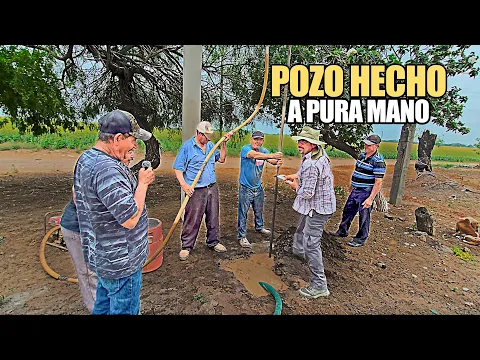
The demonstration is led by a family and community network. Romualdo and Beto visit relatives in La Zacatecana, while brother-in-law Osvaldo executes the manual drilling of the artesian well and explains depth limits, risk of slips, and the logic of operating without machines on soil that alternates between mud and sand.
Where Manual Drilling of Artesian Wells Occurs and Why the Location Matters

La Zacatecana appears as a rural corner of Valle Hermoso in Tamaulipas, with everyday use of water for homes, plants, and, when salinity allows, even for drinking.
-
Friends have been building a small “town” for 30 years to grow old together, with compact houses, a common area, nature surrounding it, and a collective life project designed for friendship, coexistence, and simplicity.

-
This small town in Germany created its own currency 24 years ago, today it circulates millions per year, is accepted in over 300 stores, and the German government allowed all of this to happen under one condition.

-
Curitiba is shrinking and is expected to lose 97,000 residents by 2050, while inland cities in Paraná such as Sarandi, Araucária, and Toledo are experiencing accelerated growth that is changing the entire state’s map.

-
Tourists were poisoned on Everest in a million-dollar fraud scheme involving helicopters that diverted over $19 million and shocked international authorities.


The choice of the point is described as pragmatic: there, according to the residents, “almost everywhere” groundwater appears within a few meters.
The agricultural context reinforces the motivation. There is mention of cultivation and irrigation in a region marked by water scarcity, with irrigation canals coming from afar, making any local source relevant.
In this scenario, manual drilling of artesian wells becomes a low-cost operational alternative and a quick response, especially when the priority is to have groundwater on one’s own land.
Tools, Pipes, and the Heart of the Method Without Machines

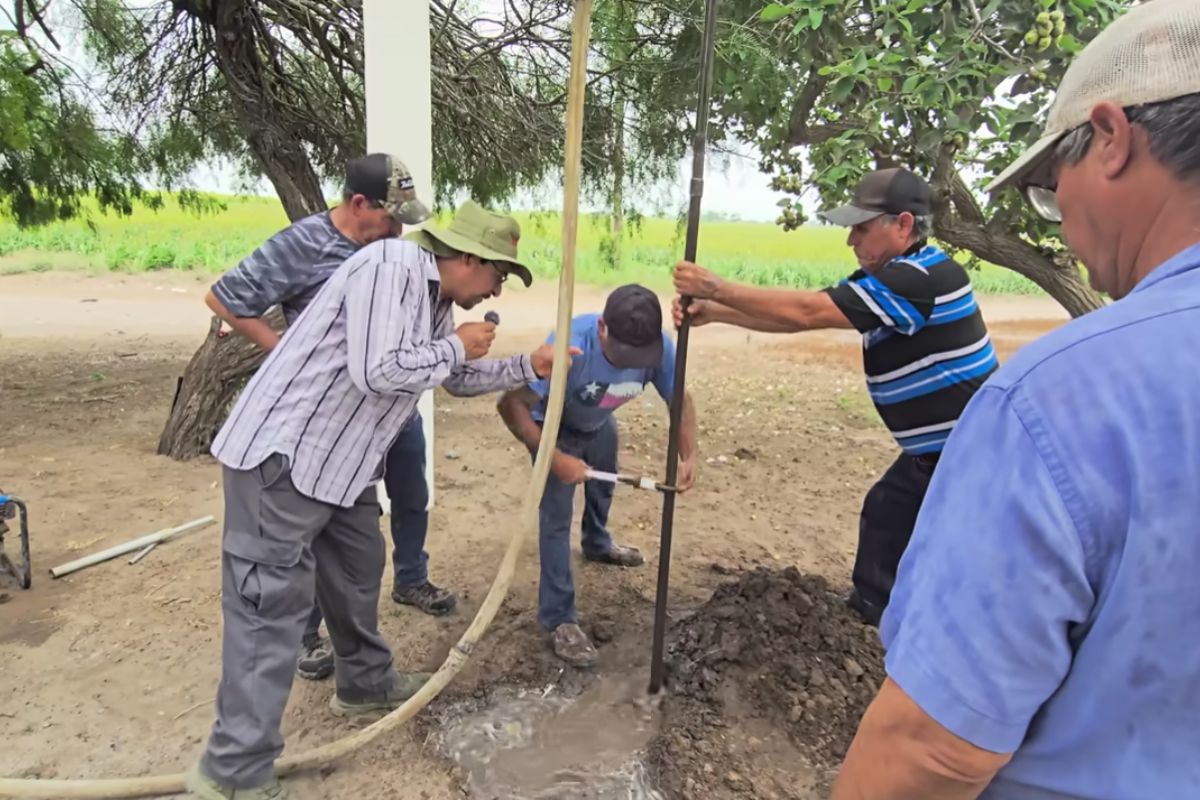
The process begins with standardized pipes. The first mentioned pipe is 3m long, and the initial advancement reaches “one and a half” while the team keeps the water circulating to soften the soil and push the mud out.
The image left is one of a simple system: water enters, the set spins, the material rises, and the hole progresses without machines.
The component that provides efficiency is an adapted drill with a bearing, made and welded by Osvaldo himself. He describes that the piece needs to rotate continuously to clear a path and that the extra rods help when the mud weighs down.
The improvisation here is not random: it is practical engineering applied to manual drilling of artesian wells, focused on controlling rotation, flow rate, and stability of the set.
Groundwater, Mud, and What Changes When the Soil Becomes Sand

The team distinguishes between two behaviors of the terrain. When the section is heavy mud, the manual drilling of the artesian well becomes slower and requires more strength and care to avoid deviation.
When it reaches the sand, the work speeds up because the sand “flies” and the groundwater tends to flow more easily.
This detail explains why depth is treated as a range, not a fixed number.
Osvaldo indicates that, there, 7 or 8 meters is usually sufficient to reach groundwater, but he admits that the level can vary, and in some areas, it requires going deeper.
He states that if the sand layer isn’t reached, the well delivers only a small and unstable jet, even with the effort made without machines.
Safety, Failures, and the Risk That Appears in Half an Hour
The promise of 30 minutes comes with warnings. The team mentions the risk of “blowouts,” slips, and mud showers when the pressure changes or when the pipe comes loose.
At one stage, there is a mechanical failure with the hose and coupling, requiring a quick replacement to prevent the line from drying out and to keep the manual drilling of the artesian well on schedule.
The correction is handled as part of the protocol. The piece is replaced, the set is cleaned, and the water circulation resumes, keeping the mud flowing out of the work area.
The technical point is simple: without machines, the system depends on continuous flow and rotation, and any long pause can harden the material and reduce the efficiency of progress.
Filter, Purging, and Finalization of the Well Without Machines
After opening the hole, the stage that transforms the cavity into a catchment begins. A perforated pipe with holes is installed to allow the entrance of groundwater and reduce clogging by particles.
The filter is described as a resistant material that does not rot, and the assembly proceeds with paired pipes, adjusting depth and position.
At the outlet, the water initially appears murky because the earth has been pushed into the flow. The team describes the need to purge the pump and maintain circulation until the water clears.
The closure includes leveling the surface and leaving the set ready to receive an electric pump later, maintaining the logic of operation without heavy machines during the opening stage.
What Manual Drilling of Artesian Wells Reveals About Cost and Rural Autonomy
Although the charged amount is not mentioned, the conversation makes it clear that the decision is economic. The method avoids drilling rigs, reduces displacement, and uses transportable items in a pickup truck, focusing on speed.
In a region like Tamaulipas, where Valle Hermoso lives with scarcity and irrigation dependent on canals, the gain is controlling time and access, not showcasing equipment.
It also becomes evident that the technique is not universal. Osvaldo states that there are nearby areas, just a few kilometers away, where “you won’t get water, only mud,” and that the best results require sand because that is where the groundwater circulates.
Manual drilling of artesian wells, in this portrayal, works when the terrain and depth cooperate, and when the community masters the fine adjustment, always without machines.
In your context, have you seen anyone access groundwater with a method without machines, or only with a drilling rig? The answer changes depending on the soil, the risk, and the cost of error. In Valle Hermoso, what seems more decisive for this outcome: knowledge of the soil, water circulation, or the design of the filter at the end?










Aqui no Brasil, num passado não muito distante, fazíamos poços com três metros de circunferência e, em alguns casos, até mais de 25 metros de profundidade, *poço artesiano não precisa de bomba de sucção, Esse método aí, nem sempre funciona.
Bem isto mesmo, sou uma Srª 64 anos e todos tinham seu próprio poço aqui no sul do Brasil, cada casa tinha seu poço d’água e todos ajudavam a cavar puxar a terra etc, até nós que éramos crianças na época ajudava-mós , no inverno água saía quentinha e no verão geladinha e não havia contas de água exorbitante para pagar no final do mês e podia gastar água a vontade, puxava na corda e no cambito . Hoje aqui no sul ou tu come ou paga a água e a luz !? 😭😭😭
Esses poços não são artesianos! O artesianismo é um fenômeno onde ocorre pressurização do lençol freático! A perfuração de poço nessas condições faz com que a diferença de pressão expulse a água do leito freático e provoque o jorro em superfície. Os poços abertos fora dessa condição sao denominados poços tubulares!
No Brasil já há décadas já se usa esse sistema de furar poço manualmente!
Isso não é novidade para nós!