





 Portuguese
  English
  Spanish
  5 min of reading
  1 comment


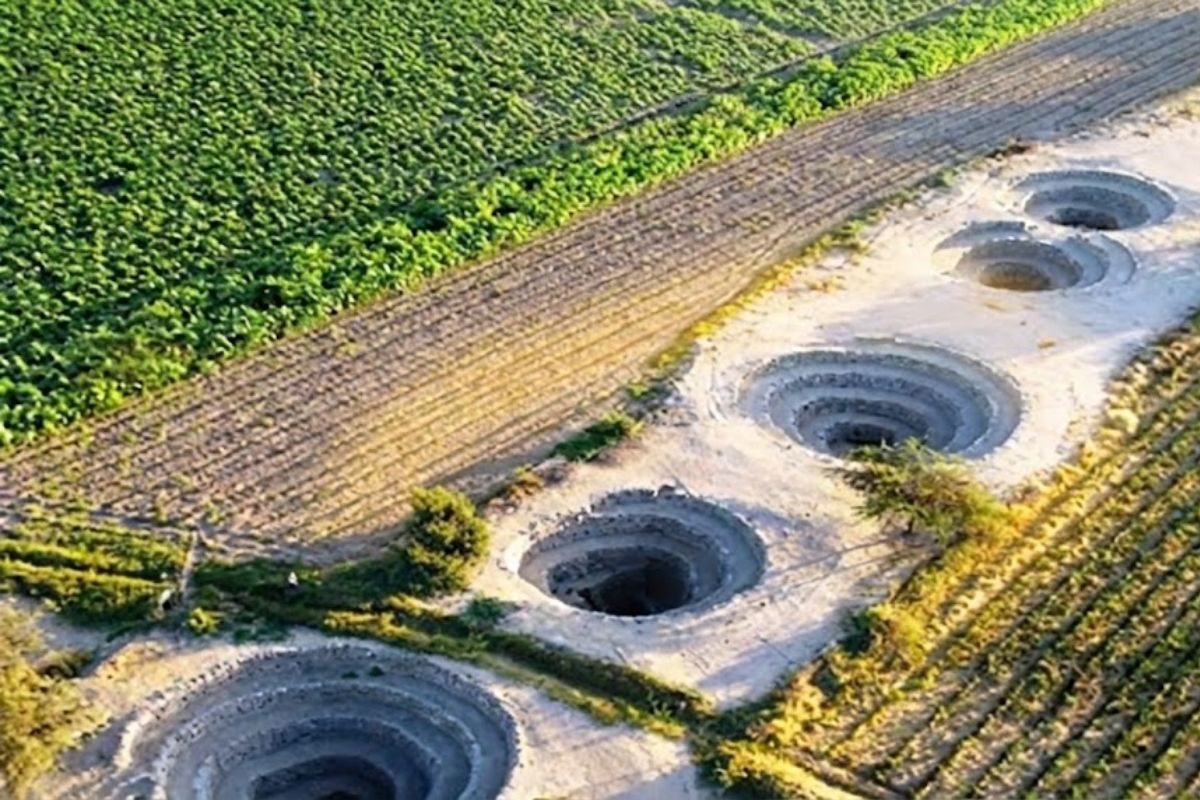


In The Nazca Desert, In Southern Peru, Spirals Dug By The Nazca Between 500 BC And 500 AD Form Wells Up To 5 Meters That Use Wind To Move Water From The Aquifer, Feed Channels, And Still Sustain Local Agriculture Where It Rains Less Than 12 Mm A Year, Almost Nothing
In the Nazca Desert, in Peru, there is a structure that seems impossible for one of the most hostile and dry places on the planet: spiral holes that function as part of an ancient hydraulic system linked to the underground aquifer and capable of keeping water circulating where the average annual precipitation is less than 12 millimeters.
In the Nazca Desert, researchers have been puzzled for decades since these shapes were noticed in the 1920s. For a long time, the most repeated explanation pointed to astronomical or religious uses, until recent evidence began to support a more practical and radical hypothesis: the spirals were designed to capture and conduct water, irrigating farms to this day.
An Extreme Desert Where Not Even Cacti Can Survive In Some Areas

Peru, located on the western side of South America, has a coastline marked by deserts that occupy about 18% of the country. In this arid mosaic, the Nazca Desert stands out for its hostility, with stretches where not even cacti survive.
-
Spain surprises the world by erecting 62 artificial dunes, mixing sand with natural remains of posidonia, and causing the structure to lose only 1.4% of its volume in 1 year.

-
With 16 Bulava missiles, improvements in acoustic stealth, and a design focused on silent patrols, Russia’s nuclear submarine was born to ensure Moscow’s invisible retaliation and has become one of the pillars of its maritime strength.

-
‘Populous’ city in Rio among the worst in Brazil in national ranking and exposes silent development crisis.

-
Couple buys house in the South Zone of São Paulo, opens a hidden door in the garage, and finds a secret wine cellar with dozens of old wines forgotten since the 1970s.

The aridity is so intense that the region is described as one of the driest places on Earth, with an average annual precipitation below 12 mm. In such an environment, any agriculture depends on engineering, storage, and a stable water source, something that seems incompatible with the landscape of stone, sand, and wind.
Spiral Holes Up To 5 Meters That Can Be Seen From Above

The mystery begins on the ground. The shapes, classified as geoglyphs, consist of spiral holes with up to five meters in diameter, noticeable from the air or from elevated terrain.
These structures are attributed to the Nazca civilization and date from between 500 BC and 500 AD. The geometry is not random: the spiral shape creates a continuous design that leads to a central point, suggesting a function beyond ornamentation.
From Ritual Symbol To Survival Tool In The Nazca Desert

For many years, the dominant reading was symbolic. The hypothesis of astronomical or religious function gained strength precisely because the region is famous for enigmatic shapes on the ground and because the immediate purpose of the spirals seemed indecipherable.
The interpretative turn arises when scientists start to argue that the spirals were, in fact, a survival system. The central idea is simple yet sophisticated: enabling food self-sufficiency in a desert where survival should be impossible, creating an infrastructure that guarantees water for people and crops.
The Hydraulic “Machine”: Central Well, Channels, And Underground Aquifer
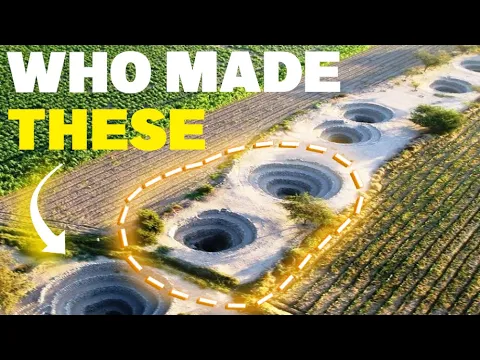

The technical description attributes a chain operation to the set. The spiral holes would have been made by digging the soil in a spiral pattern, connecting to a central well that would be supplied with water from the underground aquifer.
Once accessed, the water would be channeled through a network of channels. These channels would have two practical functions: to irrigate farms and also to serve as a supply management pathway, connecting productive areas and the local city.
It is at this point that the name by which the system is also recognized arises: Cantalloc Aqueducts. The term does not appear as a metaphor but as an identification of the set of hydraulic structures associated with the spiral holes.
Wind As Engine: When The Air Pushes Water Underground
The most unusual aspect is the integration with natural forces. The presented hypothesis describes a system designed to harness the wind: the shape of the holes would allow the air to blow through underground channels, creating pressure and helping to force the water from the aquifer to move and supply Nazca and irrigate agricultural areas.
This detail transforms the interpretation of the site. It would not merely be passive capture, but a design that combines geography, wind, and underground infrastructure to maintain supply in a rain-scarce environment.
Rounded Stones And Seismic Resistance In A Tremor-Prone Region
The construction is also described with structural concern. The concentric arrangement and the use of rounded stones are cited as elements that help the spirals withstand seismic activity, including recorded earthquakes and tremors in the region.
In practical terms, this suggests engineering intended to last. In a territory where the ground can move, crack, and give way, the stability of the system becomes a condition of survival, not an aesthetic detail.
Cotton, Beans, And Potatoes: The Nazca Desert That Became A Productive Area
The proposed reading directly links water infrastructure to agriculture. With accessible and distributed water, the Nazca were able to cultivate in an unlikely place, with a focus on cotton, beans, potatoes, and other crops.
The strongest assertion is the transformation of the desert itself: a space described as “green” in terms of productive capacity, despite the extreme climatic context, sustained by a system that links wells, channels, and the aquifer.
Current Use: Farmers Still Irrigate Farms With The Spirals
The most striking point in the present is continuity. The spiral holes are still used by local farmers to irrigate farms in the desert, functioning as a crucial water source and sustaining livelihoods.
In addition to capturing and storing water, farmers also use the spirals to capture runoff from nearby rivers, helping to replenish water within the system. In a region with little rain, any seasonal water reinforcement becomes part of the strategy to keep the aquifer and reservoirs active.
In the Nazca Desert, the combination of spirals up to 5 meters, construction attributed to the Nazca between 500 BC and 500 AD, and a design capable of harnessing wind and underground aquifer forms a portrait of engineering that does not rely on expensive technology but on a deep understanding of the territory. In a place where it rains less than 12 mm per year, agricultural survival becomes a matter of design, channeling, infiltration, and collective maintenance, with structures that are still in use today.
In your opinion, what impresses you the most about the Nazca Desert: the idea of using wind to pull water from the aquifer or the fact that this system still sustains farms many centuries later?








É conhecimento ancestral sofisticadíssimo. Nota mil.