





 English
  Francês
  Alemão
  Italiano
  Japonês
  Norueguês
  Portuguese
  Spanish
  6 min of reading
  0 comments


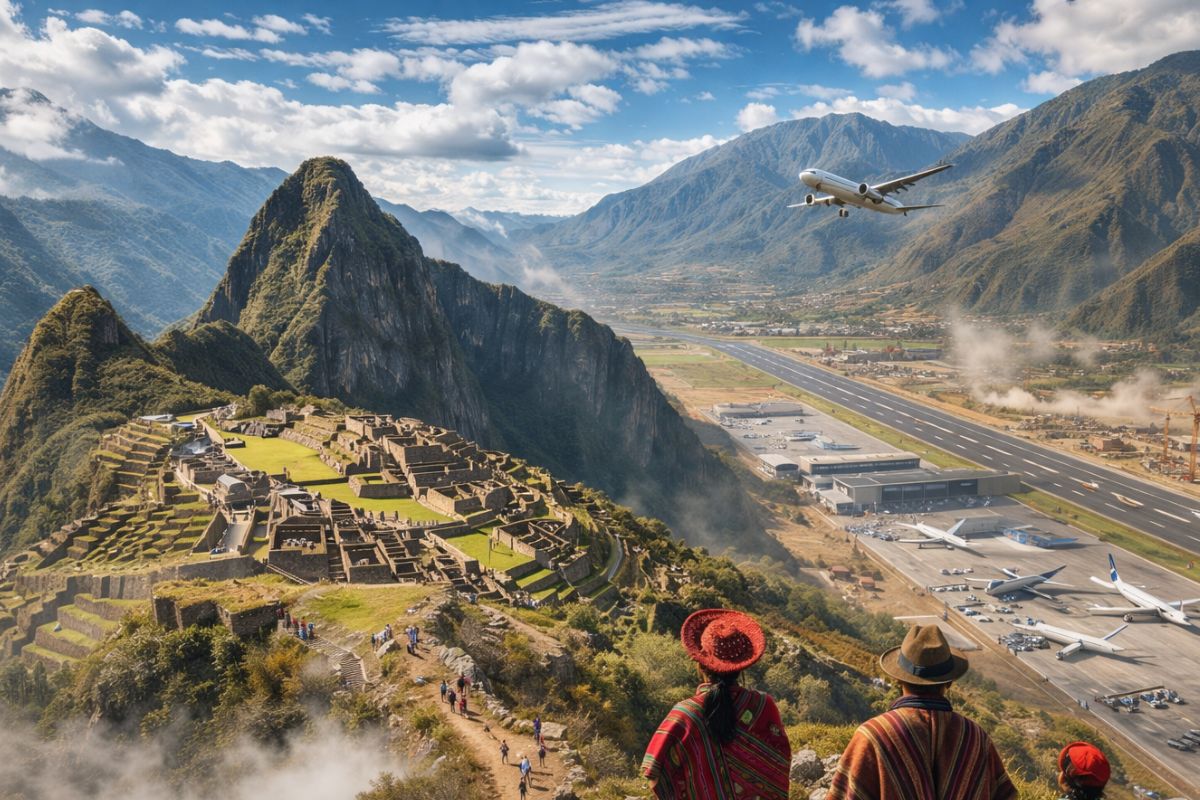
New Mega-Airport in the Sacred Valley Shortens the Path to Machu Picchu, Boosts Tourism in Machu Picchu, and Raises the Alarm for Tourist Saturation
Peru is building a mega-airport in the Cusco region, around the Sacred Valley of the Incas, aiming to increase tourist flow to Machu Picchu by up to 200%, shorten travel time, and transform the area into a new South American air hub.
At the same time, residents, guides, and indigenous communities warn that the mega-airport could trigger an environmental, cultural, and infrastructure collapse in a valley already pressured by touristification. Between the dream of boosting the economy and the fear of compromising a unique heritage, the debate is becoming increasingly intense.
It Is Not Easy to Reach Machu Picchu Today
It is no coincidence that, historically, reaching Machu Picchu is not simple. The Incas designed the ancient citadel as a protected place, surrounded by the Eastern Cordillera, distant and difficult to access. The idea was precisely to ensure security and isolation.
-
Chaos On Airplane Could Be Expensive: Proposal Aims To Prevent Disruptive Passengers From Flying For Up To 1 Year In Brazil And Face Fines Of Up To R$17,500

-
Man Arrested After Halting Takeoff of Fire Department Helicopter During Child Rescue in Guaratuba

-
With 37 Tons of Cargo, Over 8,000 km Range, and Ability to Land on Unpaved Runways, the Airbus A400M Demonstrates How Europe Created a Military Giant That Transports Armored Vehicles, Aerially Refuels Fighters, and Operates in Conflict Zones and Humanitarian Missions Worldwide

-
Emergency Landing in Campos Amarais After Bird Strike on Small Plane

Today, the scenario is different. Machu Picchu has ceased to be a remote settlement and has become one of the greatest tourist attractions on the planet.
Since 2007, it has been recognized as one of the “New Seven Wonders of the World” and receives, year after year, hundreds of thousands of visitors from various countries, attracted by the combination of landscape, history, and symbolism.
The Chinchero Mega-Airport and the Peruvian Government’s Ambition
With the declared objective of increasing visitor flow in the region by up to 200%, the Peruvian government is betting on the Chinchero mega-airport as the centerpiece of a new phase of tourism around Machu Picchu.
According to the portal Xataka, the Chinchero-Cusco International Airport (AICC) is being built in the province of Cusco, near Chinchero, in an area close to the Sacred Valley of the Incas and a few dozen kilometers in a straight line from Machu Picchu.
The project began to take shape around 2018, and if the latest official forecasts hold, the terminal should start operating between late 2027 and 2028.
Today, the air connection to the region is made through the Alejandro Velasco Astete aerodrome in Cusco, which is already operating at its limit, with over five million passengers and nearly 30% growth compared to the pre-pandemic period.
With the new mega-airport, the goal is to serve 8 to 12 million users per year, consolidating the southern part of the country as a new hub for connections.
The Directorate General of Civil Aviation summarizes the official vision: after Jorge Chávez Airport in Lima, the intention is for Cusco to become the second major center of connections in South America, anchored in this mega-airport.
Sacred Valley Under Pressure

The problem is that the Sacred Valley of the Incas and its surroundings are already experiencing intense tourism pressure.
The BBC itself detailed that the plan to attract 200% more visitors would not only come with economic benefits but also a considerable increase in the burden on the territory.
On one side, there is a mega-airport designed to multiply tourist arrivals. On the other, a valley with villages, agricultural areas, and traditional communities that need to deal with more traffic, more enterprises, more demand for water, energy, and services.
The equation between tourist growth and the actual capacity of the territory is the most sensitive point of this debate.
Machu Picchu Is Already Facing Tourist Saturation
A few dozen kilometers away, Machu Picchu is already showing clear signs of saturation. The Inca citadel, which once represented isolation, is now a global icon visited by hundreds of thousands of visitors every year.
According to projections reported by local media, in a recent month alone, the site received nearly 150,000 people, and the expectation was to close 2025 with over 1.5 million tourists in the year, surpassing pre-pandemic levels.
The growing volume of visitors has placed the site under constant observation by heritage bodies and international entities.
In recent years, Machu Picchu has been compared to destinations facing similar problems, such as Mount Fuji in Japan, the Giza region in Egypt, and European cities like Florence and Amsterdam, which deal with the impacts of large-scale touristification.
There were moments when the citadel almost made it onto UNESCO’s list of endangered heritage sites.
More recently, the Peruvian Comptroller General warned of the “tourist overload” at Machu Picchu, and the New7Wonders organization even cautioned the country that the ancient Inca city could lose the title of “New Wonder of the World” if the situation was not corrected.
In response, the government strengthened security, access control, and ticket sales in an attempt to balance preservation and visitation.
How the Mega-Airport Changes the Route to Machu Picchu
Reaching Machu Picchu today requires a combination of transportation modes. The typical sequence includes an international flight to Lima, a domestic flight to Cusco, and then a final journey by taxi, train, and bus to the entrance of the citadel.
This fragmented route, although tiresome, acts as a natural filter, limiting the daily flow of visitors.
With the Chinchero mega-airport, this logic changes radically. The trend is for more flights to arrive directly in the region, with greater capacity and frequency, shortening the total travel time.
In practice, this reduces logistical barriers that currently act as a brake, making room for a much higher daily volume of tourists arriving around Machu Picchu.
For the tourism sector, this means more packages, more flight options, and a more intense schedule. For those observing the territory’s support capacity, the scenario raises questions about how far this growth can go without compromising what is intended to be valued.
Environmental, Cultural, and Infrastructure Concerns
It is not just passenger numbers that are at stake. Local operators, guides, and indigenous communities have raised criticism of the mega-airport, pointing out three types of impact:
- Environmental: alteration of agricultural areas, changes in land use, greater pressure on natural resources in the Sacred Valley.
- Cultural: loss of identity in traditional localities, replacement of crops and lifestyles by new urban enterprises.
- Infrastructure: risk of overload on water, sanitation, energy, and basic service systems that already operate close to their limits.
An example cited is Urquillos, where corn fields are being sold and urbanized as the project progresses, changing the profile of the region.
For the communities, the fear is that the mega-airport will act as a catalyst for an irreversible transformation, where fields and villages are replaced by subdivisions, hotels, and structures focused solely on tourism.
A Project Already Facing Resistance
The concerns surrounding the mega-airport in the Sacred Valley did not arise now. Long before construction progressed, there were mobilizations calling for greater care with the project.
Before the pandemic, signatures were collected to try to halt or rethink the construction, precisely due to the perceived risks.
With the advancement of works, these concerns intensified. Residents fear that the increased pressure on the region will not be matched by sufficient investments in infrastructure and environmental protection, creating an imbalance that is difficult to reverse.
The risk is not only to the landscape but to the routine of communities that see the territory as a central part of their identity.
At the same time, the government maintains the narrative that the mega-airport is a historic opportunity to reinforce the role of tourism in the national economy, attract more international visitors, and position Cusco as a strategic air hub.
Between these two poles, economic development and heritage protection, lies the Sacred Valley, which will have to absorb the change.
Mega-Airport: Gateway to the Future or Threat to the Past?
At the heart of the debate is an uncomfortable question: to what extent can a mega-airport coexist with the preservation of a historic site like Machu Picchu and a valley with a strong cultural identity?
On one hand, there is the promise of more jobs, more income, and more international connections. On the other, there are warnings about tourist saturation, infrastructure overload, loss of agricultural areas, and the risk to a heritage that cannot be rebuilt if damaged.
In the end, the decision regarding the mega-airport in the Sacred Valley is not merely technical or economic. It involves choices about what kind of tourism Peru wants to encourage and what balance it wishes to establish between growth and preservation.
And you, in your opinion, should the mega-airport proceed as it is, or should Peru prioritize stricter limits to protect Machu Picchu and the Sacred Valley of the Incas?








-

-

2 pessoas reagiram a isso.