





 Português
  Inglês
  Espanhol
  5 min de leitura
  0 comentários


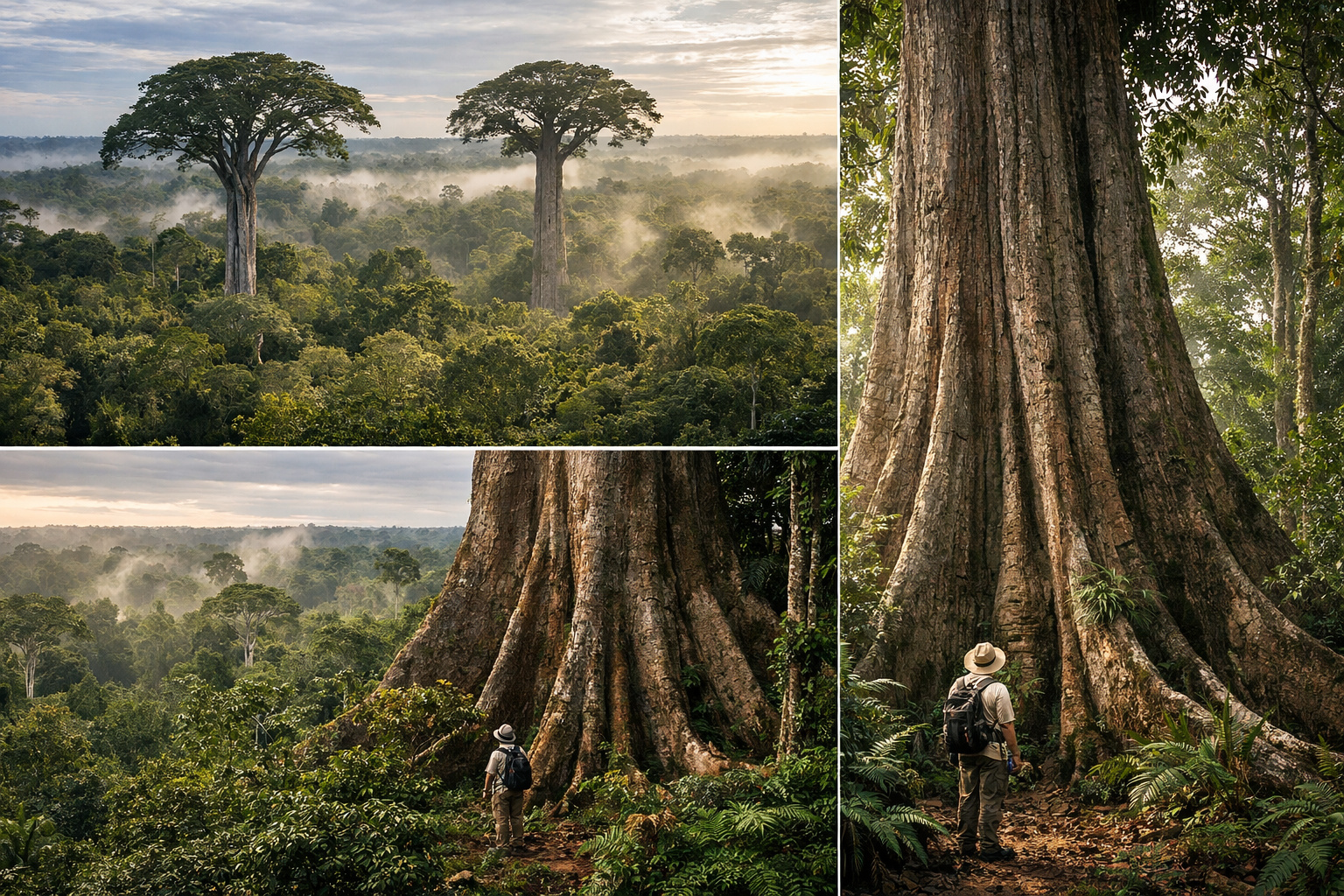
A Study Reveals That Few Trees Concentrate the Majority of Carbon in the Amazon Rainforest, Sparking Alerts About Silent Impacts on Climate, Biodiversity, and Peru’s Forest Policy
The Amazon rainforest is often described as one of the planet’s greatest allies in combating climate change. However, new scientific evidence indicates that this vital function may be more threatened than previously thought. A recent study shows that the largest trees in the Peruvian Amazon store a disproportionately greater amount of carbon, playing a central role in the forest’s ability to act as a carbon sink.
The information was released by Live Science, based on a scientific article published in the journal Frontiers in Forests and Global Change. According to the researchers, it is precisely these giant trees, fundamental for climate balance, that face the greatest risk of logging in Peru.
Currently, about 60% of Peru’s territory is covered by forests, most of which are located in the Amazon region. This area represents approximately 11% of the entire Amazon rainforest, making the country a strategic player in global environmental conservation. Still, the current forest legislation permits selective logging of trees when they reach a minimum diameter that varies between 41 and 61 centimeters (16 to 24 inches), depending on the species.
-
Omoda & Jaecoo and AiMOGA Robotics advance in industrial artificial intelligence with a strategic debut in Thailand and a focus on advanced automation.

-
In a scenario of rising fuel prices, Omoda & Jaecoo enhance value for consumers with a range of up to 1,200 km, energy efficiency, and a new concept of worry-free mobility.

-
Cement battery inspired by chemistry used since Ancient Rome resurfaces as a rechargeable thermal solution and enters the competition for the future of industrial heat.

-
Scientists have found in the dark depths of the North Sea giant marks from 18,000 years ago left by colossal icebergs, and the discovery could help predict the future of Antarctica.


Giant Trees Concentrate the Majority of Carbon in the Forest

According to the study, this policy ends up directing logging precisely towards the most valuable individuals from a climatic perspective. This occurs because, in the Peruvian Amazon, the difficult terrain and complex logistics make the extraction of smaller trees inefficient. As a result, forestry companies prioritize larger trees, which offer a greater volume of wood, thus reducing transportation costs, time, and labor.
These trees, besides being larger, tend to be older and more mature, with denser, harder, and more stable wood. However, it is exactly this combination of characteristics that causes them to store significantly higher volumes of carbon, both above and below the ground.
The study’s co-author, Geomar Vallejos-Torres, an agricultural scientist at the National University of San Martín in Peru, explained that the removal of these trees returns a large part of the accumulated carbon to the atmosphere, weakening the forest’s role as a climate regulator.
To quantify this impact, Vallejos-Torres and his team analyzed hundreds of trees in five different forests in Peru. They measured variables such as trunk diameter, height, crown area, and wood density, allowing them to estimate aboveground and belowground biomass and the stored carbon.
The results revealed that carbon storage increases disproportionately as trunk diameter grows, with the 41 centimeter threshold being a critical point. In the studied areas, the forests were found to store up to 331 metric tons of carbon per hectare above ground and 47 metric tons per hectare below ground.
Even more impressive, between 88% and 93% of all carbon was concentrated in trees with a diameter greater than 41 centimeters. In the case of the breadnut tree (Brosimum alicastrum), only 11.4% of the above ground carbon was in smaller trees, while 88.7% was in the larger trees.
Scientific Debate on Forest Management and Carbon Retention Time
The study was published on January 25 and quickly generated discussions within the scientific community. For the authors, the data indicate that Peru’s forest policy, by allowing the logging of these trees, ends up directly impacting the largest carbon reservoirs in the forest.
Vallejos-Torres advocates for a clear change in approach. According to him, protecting trees with a diameter above 41 centimeters is essential not only to keep carbon out of the atmosphere but also to preserve biodiversity, microfauna, and the forest microclimate, making the forest more resilient to future climate change.
However, not all experts agree that tree size should be the primary criterion. Ulf Büntgen, a professor of environmental systems analysis at the University of Cambridge, argues that the study does not adequately address the carbon residence time, which tends to be shorter in tropical forests.
In response, Vallejos-Torres emphasizes that large trees continue to accumulate carbon for centuries, while smaller trees grow slowly and face limitations caused by degradation, environmental disturbances, and microclimatic changes. Thus, the lost carbon is not recovered within a timeframe relevant to climate mitigation.


Political and Economic Barriers Hinder Changes in Legislation
Another point raised by experts is that the size of trees alone does not guarantee sustainable forest management. Martin Perez Lara, director of climate forest solutions at the World Wildlife Fund (WWF), acknowledges that the relationship between diameter and carbon stock is intuitive and empirically valid, but warns that well-designed management systems, including controlled selective logging, can contribute positively to climate balance.
Despite this, the study’s author himself is skeptical about the possibility of changes in Peru’s forest policy. According to Vallejos-Torres, a legal reform that protects the largest trees would directly affect the economic interests of the timber sector, which depends on the extraction of these high-value individuals and exerts a strong influence on the country’s political decisions.
Thus, while science points to the urgency of protecting the largest natural carbon reservoirs in the Amazon, economic and structural interests continue to represent a significant obstacle, leaving the future of the forest and its role in combating global climate change in question.
In light of these findings, how long will the Amazon be able to fulfill its role as a global climate shield when the very trees that store the most carbon continue to be the most vulnerable to exploitation?




-

-

-

-

-

-

106 pessoas reagiram a isso.