





 Portuguese
  English
  Spanish
  3 min of reading
  1 comment


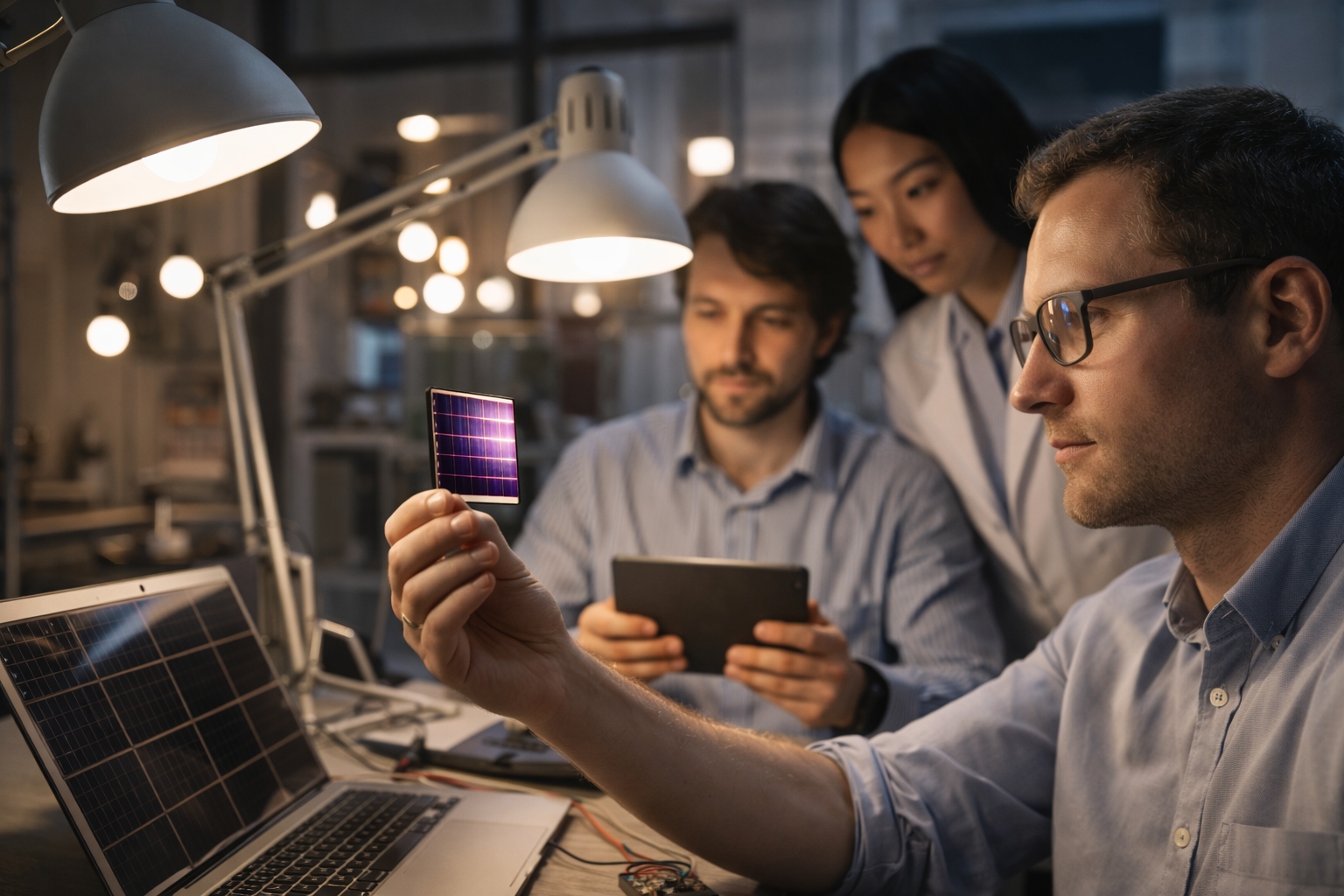


Perovskite Solar Cells Advance in Generating Electricity with Artificial Light in Homes, Offices, and Industries, Turning Ordinary Lightbulbs into Stable Energy Sources for Internal Electronics without Batteries or Batteries, and Paving the Way for a New Era of Clean Continuous Energy.
Perovskite solar cells are devices capable of generating electricity from artificial light, something recently demonstrated by Brazilian researchers in partnership with Italian scientists, through a new surface treatment applied to the material, developed among laboratories at Unicamp, USP, UFSCar, and European centers, with the objective of powering electronic devices used indoors where sunlight barely reaches.
This technology arises as a response to a real problem. Indoor environments have low light levels, usually between 200 and 1000 lux, which drastically reduces the efficiency of traditional solar panels. Therefore, sensors, smart devices, and low-consumption equipment still rely on disposable batteries, which generate costs and waste.
Why Indoor Environments Have Always Been a Challenge for Solar Energy
The global market for photovoltaics for indoor environments was valued at around US$ 1.2 trillion in 2023, according to industry estimates. Nevertheless, most available technologies have been designed for outdoor use, under intense sunlight.
-
Motorola launched the Signature with a gold seal from DxOMark, tying with the iPhone 17 Pro in camera performance, Snapdragon 8 Gen 5 that surpassed 3 million in benchmarks, and a zoom that impresses even at night.

-
Satellites reveal beneath the Sahara a giant river buried for thousands of kilometers: study shows that the largest hot desert on the planet was once traversed by a river system comparable to the largest on Earth.

-
Scientists have captured something never seen in space: newly born stars are creating gigantic rings of light a thousand times larger than the distance between the Earth and the Sun, and this changes everything we knew about stellar birth.

-
Geologists find traces of a continent that disappeared 155 million years ago after separating from Australia and reveal that it did not sink, but broke into fragments scattered across Southeast Asia.

In homes, offices, and factories, light mainly comes from LED and fluorescent lamps. They have a spectrum and intensity very different from sunlight. This causes conventional solar cells to lose efficiency sharply, making their application unfeasible.
Perovskite solar cells change this scenario because they can better absorb diffuse and low-intensity light, a characteristic of indoor environments. This behavior opens new possibilities for continuous energy generation in previously considered unproductive locations.
How the New Surface Treatment Increased the Efficiency of Solar Cells
The breakthrough was made possible thanks to an innovative treatment applied to the active layer of perovskite solar cells. The researchers developed a technique that deposits a mixture of the organic salt PEAI with the additive DIO onto the surface of the material.
This process spontaneously generates a two-dimensional layer of perovskite over the original three-dimensional structure. In practice, this reduces microscopic defects that tend to trap electrical charges and decrease the device’s performance.
According to tests conducted under indoor lighting of 1000 lux, 500 lux, and even 200 lux, the modules achieved an efficiency close to 34%, a record level for this type of application, as reported in an article published in the journal Nano Energy.
Another important point is that the method does not require heating. The entire process occurs at room temperature, simplifying manufacturing and reducing industrial costs.
Artificial Light with Perovskite Solar Cells: From the Laboratory Bench to Ready-to-Use Modules
The research was not limited to small cells. The scientists manufactured devices ranging from small areas to modules of 121 cm², composed of up to 15 subcells connected in series.
This step is essential to show that the technology can move from the laboratory to the market. Very complex or expensive strategies often hinder commercial adoption. In this case, the simplicity of the process has become a competitive advantage over other techniques.
The advanced infrastructure of the Italian Chose center, a global reference in perovskite photovoltaic devices, was crucial for validating the results on a larger scale and under controlled conditions.
Where This Technology Can Be Used in Day-to-Day Life
Perovskite solar cells designed for artificial light can power Internet of Things sensors, smartwatches, remote controls, electronic tags, and building automation systems.
In industries and businesses, they can reduce battery use in monitoring devices, improving sustainability and lowering operational costs. At home, they create space for electronics that self-power only with the ambient lighting.
These advances reinforce the potential of perovskite as the foundation for a new generation of clean, silent energy integrated into daily life. For those following innovation and sustainability, this is a topic that will continue to unfold.
To learn more about research into new energy sources, keep following our content and discover how science is transforming the way we produce and use electricity.








Por gentileza, indique o artigo original da matéria!