





 Portuguese
  English
  Spanish
  3 min of reading
  0 comments


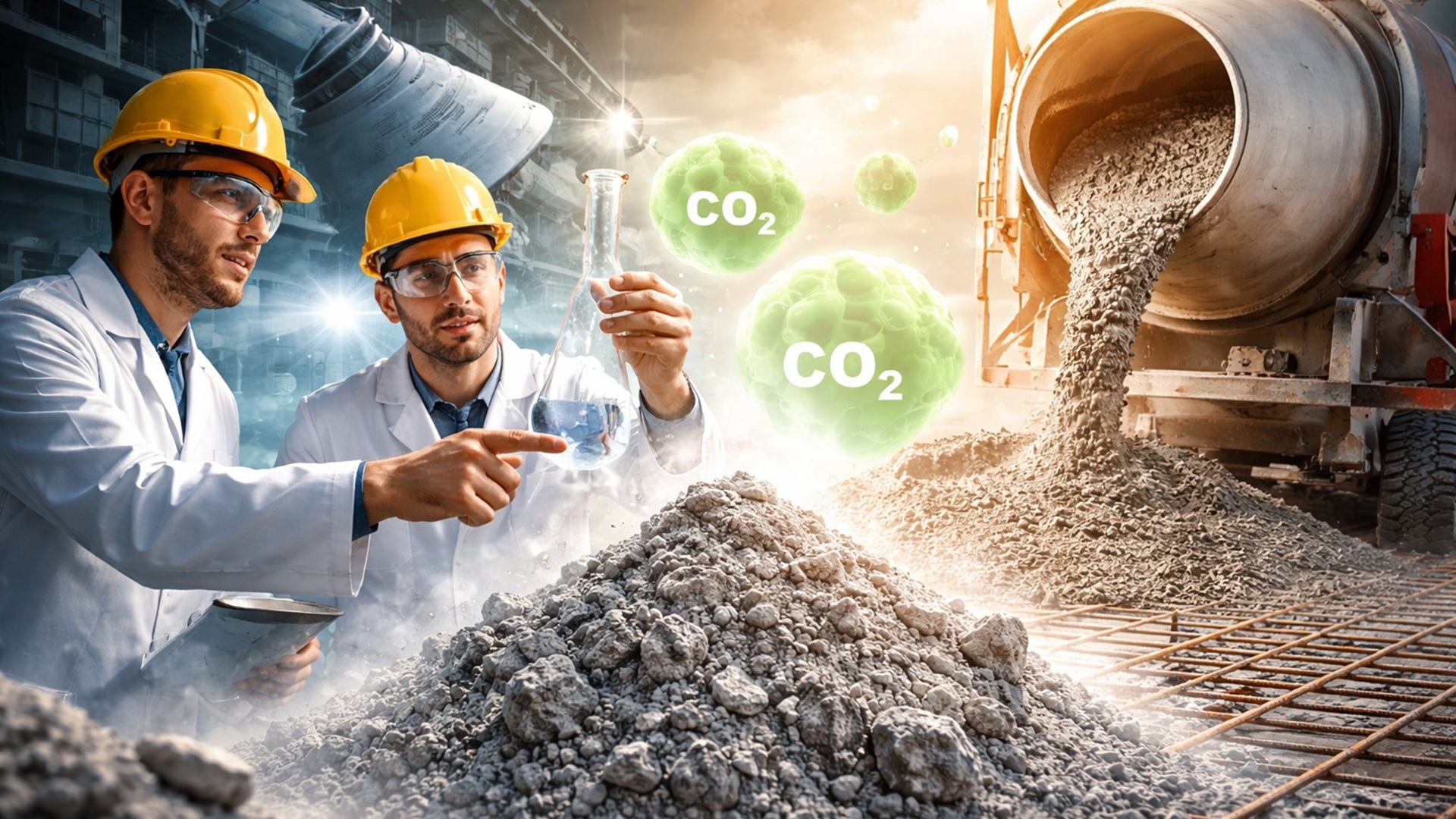
Project Led by Researchers Tests Permanent CO2 Fixation in Waste Ash Through Carbonation, with Pilot Plant in Operation to Evaluate the Use of the Resulting Material as a Substitute for Sand, Gravel, and Components for Concrete in Civil Construction
German researchers are developing a technique to fix CO2 in waste ash and transform the waste into material for concrete and construction. The project involves universities, a pilot plant in Germany, and aims to recycle up to 6 million tons annually.
The initiative is led by scientists from TH Köln and RWTH Aachen University, under the leadership of the Bergischer Waste Management Association, focusing on the carbonation of waste ash resulting from the incineration of municipal solid waste.
Project Transforms Waste Ash into Raw Material for Concrete
The waste ash from the incineration of municipal solid waste consists of up to 95 percent bottom ash and fly ash. This material is classified as hazardous waste due to the presence of heavy metals, dioxins, furans, and soluble salts.
-
Motorola launched the Signature with a gold seal from DxOMark, tying with the iPhone 17 Pro in camera performance, Snapdragon 8 Gen 5 that surpassed 3 million in benchmarks, and a zoom that impresses even at night.

-
Satellites reveal beneath the Sahara a giant river buried for thousands of kilometers: study shows that the largest hot desert on the planet was once traversed by a river system comparable to the largest on Earth.

-
Scientists have captured something never seen in space: newly born stars are creating gigantic rings of light a thousand times larger than the distance between the Earth and the Sun, and this changes everything we knew about stellar birth.

-
Geologists find traces of a continent that disappeared 155 million years ago after separating from Australia and reveal that it did not sink, but broke into fragments scattered across Southeast Asia.

In light of this scenario, researchers began to investigate whether waste ash could be reused as a raw material with a lower environmental impact. The central proposal is to use the natural carbonation reaction to permanently bind carbon dioxide to the minerals present in the waste ash.
According to Björn Siebert, a civil engineering professor at TH Köln, the mineral components of the waste ash are capable of absorbing and fixing CO2 through carbonation. The goal is to develop a practical process that allows for the evaluation of the material’s use in concrete and road construction.
Pilot Plant Tests Carbonation of Waste Ash for Concrete
To test the application outside the laboratory, the responsible association began constructing a technical pilot plant at the Leppe Waste Management Center, near Lindlar, Germany. The unit will test different carbonation methods using waste ash provided by the partner company refer GmbH.
Axel Wellendorf, a mechanical engineering professor at TH Köln, explained that at least two approaches will be evaluated. Wet carbonation, conducted under water, allows for greater CO2 absorption but requires additional energy for subsequent drying.
On the other hand, carbonation with limited moisture forms a denser carbonated layer on the surface of the waste ash. However, this layer stores less CO2, as it prevents the gas from penetrating the interior of the material.
Germany Produces 6 Million Tons of Waste Ash Annually
Germany generates about 6 million tons of bottom ash per year from the incineration of municipal waste. This byproduct is already processed in specialized facilities, recovering materials and removing contaminants.
After targeted sorting and separation stages, the material is converted into finished clean ash. From this point, the team intends to apply carbonation methods and evaluate the incorporation of waste ash in different uses.
Use of Waste Ash in Concrete and Construction Depends on Rigorous Testing
The project initially plans to test the carbonation processes and then operate a flexible pilot plant capable of adjusting methods under real conditions. After that, the focus will be on defining how to utilize the resulting material.
In unbound form, carbonated waste ash can replace gravel or sand in road construction or earthworks. At the same time, researchers are examining whether the material can act as a binder in concrete.
This application requires strict quality control. Therefore, the project includes selective crushing tests and additional processing to ensure consistent particle size and composition.
If the carbonated waste ash meets the relevant environmental standards and requirements, the project could represent a breakthrough for the circular economy and climate protection, as stated in an official announcement.








-

Uma pessoa reagiu a isso.