





 Portuguese
  English
  Spanish
  4 min of reading
  0 comments


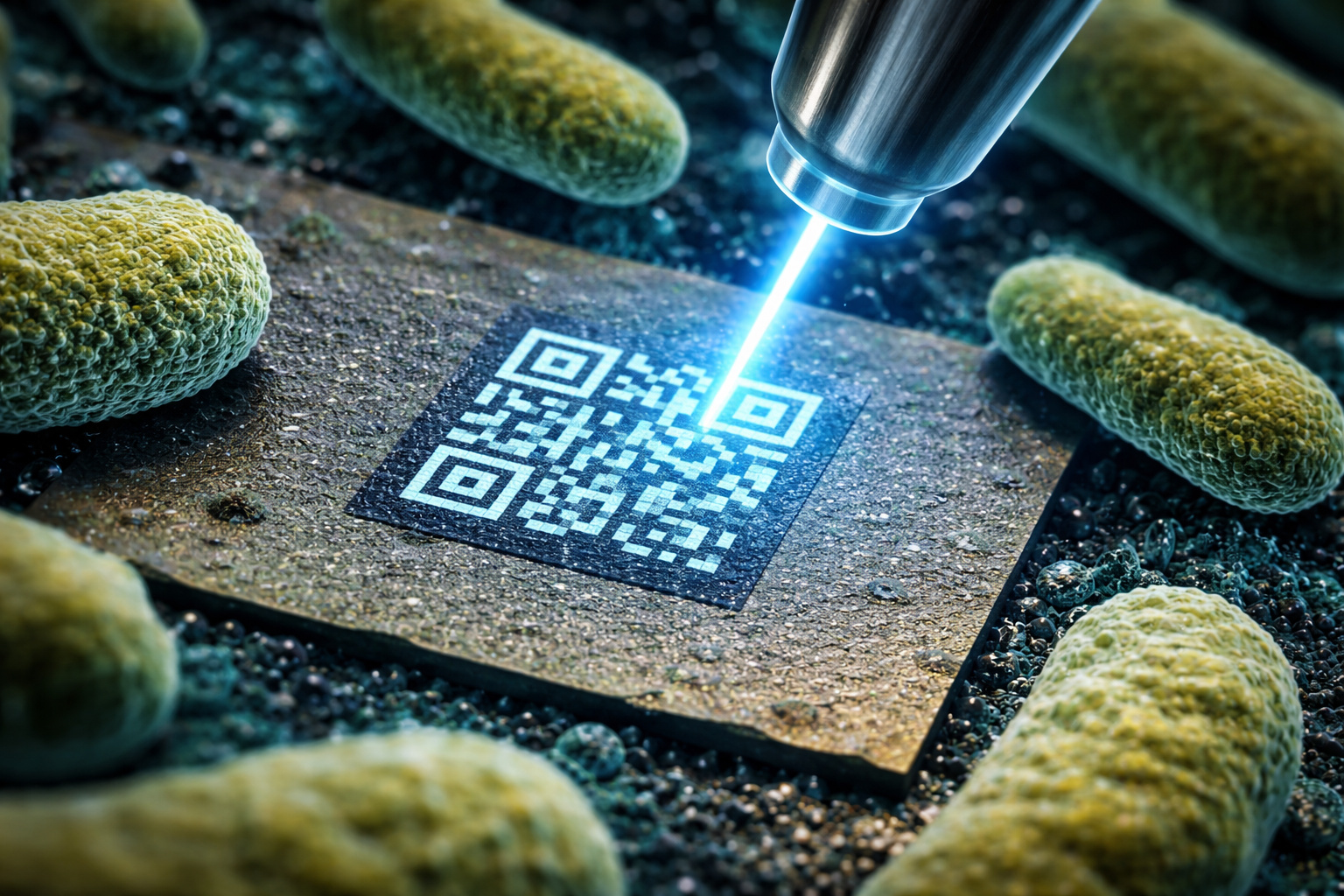
Researchers from TU Wien in Austria Etched a QR Code of Only 1.98 Square Micrometers in Ceramic Film, Smaller Than Many Bacteria, Capable of Revolutionizing Data Storage in the World
A QR code smaller than a bacterium has just entered the Guinness World Records. And we are not talking about millimeters. We are talking about something that requires an electron microscope to be seen.
Researchers from TU Wien in Austria managed to reduce a QR code to 1.98 square micrometers. For comparison, this is smaller than many common bacteria.
The race for the smallest QR code on the planet was already heating up behind the scenes of materials engineering. But now the bar has been raised.
-
Motorola launched the Signature with a gold seal from DxOMark, tying with the iPhone 17 Pro in camera performance, Snapdragon 8 Gen 5 that surpassed 3 million in benchmarks, and a zoom that impresses even at night.

-
Satellites reveal beneath the Sahara a giant river buried for thousands of kilometers: study shows that the largest hot desert on the planet was once traversed by a river system comparable to the largest on Earth.

-
Scientists have captured something never seen in space: newly born stars are creating gigantic rings of light a thousand times larger than the distance between the Earth and the Sun, and this changes everything we knew about stellar birth.

-
Geologists find traces of a continent that disappeared 155 million years ago after separating from Australia and reveal that it did not sink, but broke into fragments scattered across Southeast Asia.

A Silent Race Among European Labs to Create the Smallest QR Code on the Planet
Before the Austrian record, the title was held by the University of Münster in Germany. The German team had managed to fit a QR code into 5.38 square micrometers.
The number already seemed extreme. But the new mark is nearly three times smaller.
It was not just about reducing size. The real challenge was to keep the code readable and stable over time. Reducing for the sake of reducing was not enough.
According to the researchers, microscopic structures have been possible for years. The problem has always been ensuring that the pattern remained functional and resilient.
The Technical Secret Behind the World Record: Ceramic Film, Ion Beam, and Pixels Smaller Than the Wavelength of Visible Light
To achieve the feat, the team worked with the German startup Cerabyte, specializing in long-lasting data storage.
The chosen material was an ultrathin ceramic film. The choice was not random. Ceramic provides stability under varying conditions and can preserve information for long periods.
The QR code was etched using focused ion beams, a technique of extremely high precision.
Each pixel measures 49 nanometers. This means they are about ten times smaller than the wavelength of visible light. As a result, no common optical microscope can see the code.
Only an electron microscope reveals the complete pattern.
This technical detail is the real game changer. It is not just a tiny QR code. It is a demonstration of extreme control over materials at the nanoscale.
Why a Microscopic QR Code Matters to the Industry, From Energy to Data Centers, and the Potential of Over 2 TB in A4 Paper Area
At first glance, it seems like a scientific curiosity. But what lies behind it is much greater.
The researchers claim that an area of ceramic film the size of an A4 sheet could store more than 2 TB of data.
Translating it into something tangible: we are talking about capacity comparable to commercial hard drives concentrated in a thin sheet of ceramic material.
In a scenario of explosive industrial data, offshore operations, sensors in energy fields, and processing centers, high-density and long-lasting solutions gain strategic weight.
Estimates indicate that global demand for storage is growing rapidly, putting pressure on data centers and energy infrastructures.
A technology that promises high density with long-term stability directly enters this equation.
The New Technological Race That Puts Ceramics Against DNA, Advanced Magnetism, and Glass Recording in the Future Storage Market
The advancement of TU Wien does not happen in isolation.
Other approaches are vying for space in the next-generation storage market. Researchers are studying DNA encapsulated in solid materials, new magnetic molecules capable of increasing the capacity of small devices, and even data recording in glass using lasers.
There are also studies involving new forms of magnetism for next-generation hard drives.
The microscopic QR code in ceramics fits into this competitive landscape. It is a technological race that resembles historical battles in the energy industry, where those who dominate innovation set the pace of the market.
The difference is that now the battlefield is invisible to the naked eye.
What Could Happen If the Technology Leaves the Laboratory and Reaches Commercial Applications on a Large Scale
The researchers still acknowledge that there are steps ahead. The current goal is to test other data structures beyond QR codes and explore new materials that enhance efficiency and reliability.
There is also the challenge of taking the technology out of the academic environment.
If this happens, the impact could reach entire chains that depend on secure data archiving, from the energy industry to critical infrastructure management.
There is no official number released on commercial timelines. But the fact that it has already entered the Guinness shows that the technology has surpassed the stage of mere theory.
In the end, what drew attention was not just the microscopic size. It was the demonstration that materials engineering is already operating on a scale that redefines the limits of digital storage.
And you, do you believe that nanometric-scale technologies will replace traditional storage methods in the coming years? Leave your opinion in the comments.








-

-

2 pessoas reagiram a isso.